Job
enquiry:+91-9121642626
Job
enquiry:+91-9121642626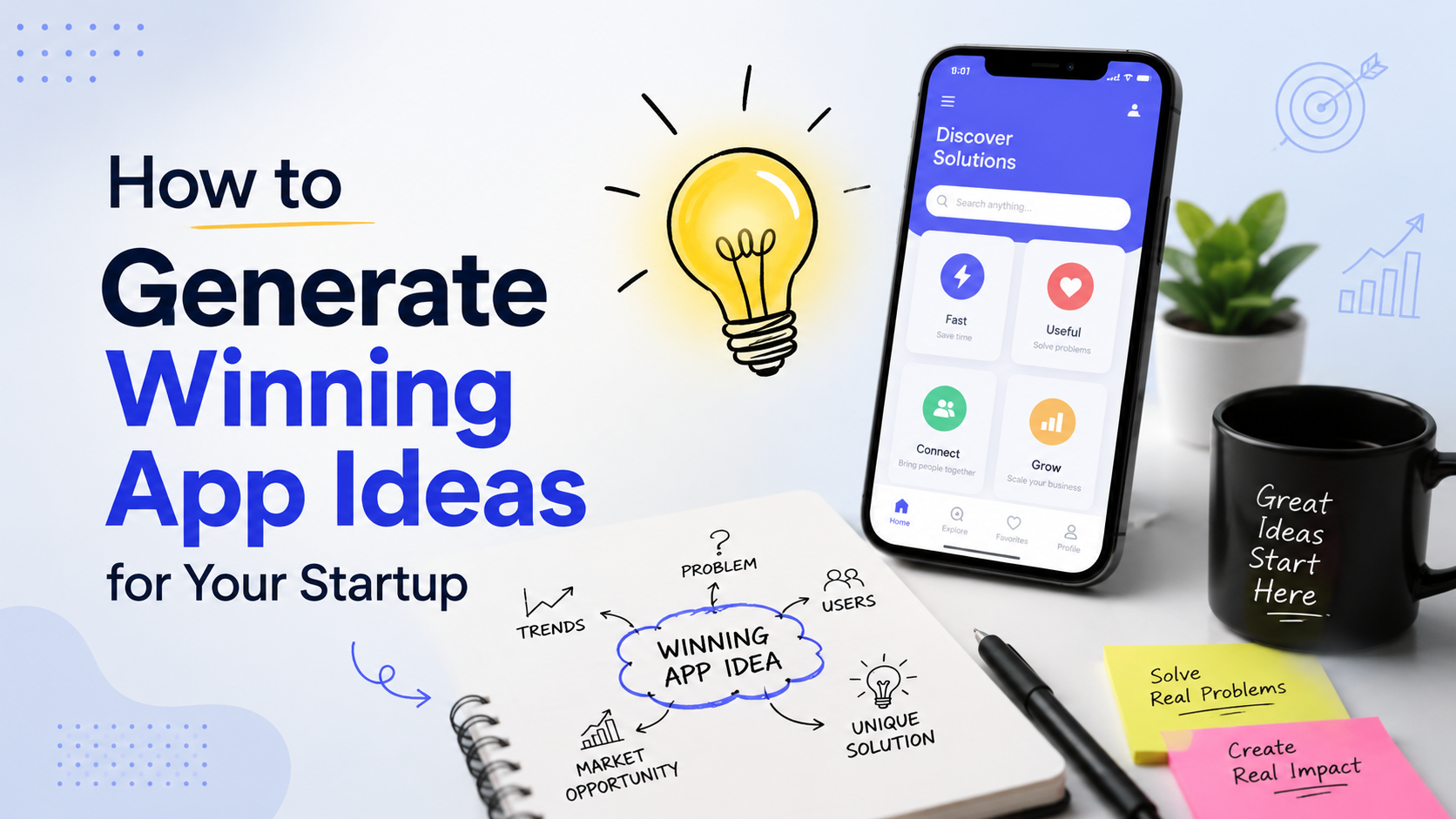
App Ideas That Solve Real Problems: A Startup Founder’s Guide
Startups are everywhere. The ecosystem's noisier than it's ever been, and honestly, most of what's getting built probably shouldn't be. But something that hasn't shifted — not really — is how the ones that matter tend to start. Not with funding decks or pitch competitions. With an app idea someone actually believed in. One that solved something real.
In 2026, mobile apps keep reshaping how industries operate, how customers interact with businesses, how people manage their own lives. And yet the best startup app ideas aren't the flashiest ones. They're rarely the most technically ambitious either. They're the ones that fix something broken, hit a market that's been waiting, and give users a reason to keep showing up. That's the whole game.
This guide is about finding those ideas, stress-testing them before they cost you anything, and understanding where the real gaps in today's market actually are.
What Are App Ideas?
App ideas are concepts for software applications designed to solve specific user problems, improve business processes, or create better digital experiences.
The apps that make it , that actually find their footing and stick around , tend to share three things. They fix a real problem. They serve a market that actually exists. And they bring something distinct that nobody else is offering in quite the same way.
Food delivery. AI productivity tools. Healthcare platforms. Every single one of them started small. Someone had a frustration, or watched other people have the same frustration repeatedly, and thought: there's something here. Then they tested it. Usually more than once.
What Are the Best App Ideas in 2026?
The best app ideas in 2026 combine emerging technologies such as artificial intelligence, automation, predictive analytics, and personalization with real-world customer problems.
The categories that keep attracting serious attention right now:
- AI-powered assistants
- Healthcare applications
- Financial management tools
- Educational platforms
- Local service marketplaces
- Productivity solutions
- Sustainability applications
- Recruitment and HR technology
These aren't trending because someone decided they should be. They keep pulling in users and investment because the underlying demand is real. Growing, actually. And in most of these categories, the dominant player hasn't fully emerged yet.
Why Most App Ideas Fail Before Launch
Here's the thing most people get wrong: they think having a sharp idea is most of the work. It isn't. From what I can tell, the majority of app failures happen way before launch — because someone spent months building a product without ever confirming that people wanted it. That's a brutal and expensive lesson to learn after the fact.
The patterns that show up again and again:
Lack of Market Demand
If users don't actually need the fix, no amount of good design will save the product. A well-built app solving the wrong problem just fails slower.
Poor Problem-Solution Fit
Some apps technically do solve a problem. Just not one users care enough about to change how they currently do things. That gap is wider than founders usually expect.
Weak Monetization Strategy
No real revenue model means the ceiling shows up fast. Most teams know this going in. A lot of them still skip it.
Ignoring User Feedback
Feedback is free product research and most teams leave it on the table. They collect it, nod at it, and then build what they already planned to build anyway.
Overcomplicated Features
The apps that get traction are almost never the ones with the most features. Usually the opposite. One problem, solved well, is a product. Twelve problems solved okay is a mess.
Knowing these failure modes won't make you immune to them. But it at least puts a name on what to watch for.
Real-World Examples of Apps Solving Business Problems
The apps I keep coming back to as good examples of focused execution aren't the giant platforms. They're the ones that picked a specific operational headache and just got really good at fixing it.
- Troop Messenger helps organizations tighten up secure team communication, file sharing, and collaboration — making workplace interactions faster without creating new friction.
- Taskity handles project management and task tracking in a way that genuinely moves the needle on productivity, accountability, and how visible workflows actually are to the people doing them.
- Clap Messenger builds out business communication through instant messaging and collaboration tools that fit how modern teams actually work, not how someone hoped they'd work.
- Attendance.ai runs on AI to automate attendance tracking, workforce monitoring, and employee management, cutting the administrative drag and improving operational efficiency in ways people can measure.
What these products share is worth sitting with. Each one identified a specific business problem and went deep on it instead of broad. Apps that deliver real improvements in productivity, communication, automation, or customer experience get adopted. And they stay adopted. That's the pattern worth building toward not the one with the most impressive feature list.
How to Generate Winning App Ideas
Good ideas rarely arrive fully formed. They tend to come out of sustained attention — watching what breaks, listening to what frustrates people, noticing where processes feel older than they should.
1. Identify Everyday Problems
A surprising number of successful products came from someone who just got tired of something being harder than it needed to be. That's honestly where I'd start.
Questions worth sitting with:
- What tasks eat time they shouldn't?
- What processes feel like they were designed in a different decade?
- What do people complain about repeatedly without anyone fixing it?
Scheduling appointments, tracking expenses, managing distributed teams, finding service providers you can actually trust — these frustrations come up over and over. Every one of them is a potential opening. Most of them still don't have great solutions.
2. Study Existing Apps
The market tells you things if you look at the right signals. Existing apps are a research gift most founders underuse.
Worth digging into:
- Customer reviews
- Feature requests
- Ratings
- User complaints
Negative reviews especially. That's where the real unmet needs sit, spelled out by frustrated people who wanted something better. It's essentially a free brief for what to build.
3. Follow Industry Trends
New technology doesn't create demand on its own, but it changes what's now possible to build. And that creates windows.
Major trends shaping app development in 2026:
- Artificial Intelligence
- Machine Learning
- Generative AI
- Voice Search
- Augmented Reality
- Internet of Things (IoT)
- Automation Platforms
The products that find scale usually come from pairing one of these with a problem that's been waiting for a better solution. The technology is just a tool. What matters is what it unlocks.
4. Explore Industry-Specific Challenges
Different sectors carry entirely different unsolved problems. And some of the best opportunities are in industries that haven't gotten much startup attention yet.
Healthcare
- Telemedicine
- Patient monitoring
- Mental health support
- Medication reminders
Education
- Online learning
- AI tutoring
- Skill development
- Exam preparation
Finance
- Budget tracking
- Expense management
- Investment tools
- Savings platforms
Logistics
- Route optimization
- Fleet management
- Delivery tracking
Real Estate
- Property search
- Virtual tours
- Rental management
Industry-specific apps run into less competition while still sitting inside large markets. That combination is rarer than it sounds.
5. Use AI for Idea Discovery
AI tools are genuinely useful here, not just as a buzzword.
- Emerging market trends
- Consumer behavior patterns
- Competitor weaknesses
- Content gaps
AI-driven research speeds up the ideation process considerably. It won't tell you what to build. But it'll surface patterns you'd otherwise miss — and it'll do it faster than manual research by a long stretch.
The 7-Step Framework for Evaluating App Ideas
Having an idea is easy. The hard part — the part most founders rush past — is figuring out whether the idea actually holds up before you've poured months of work into it.
Step 1: Define the Problem
Get specific:
- Who actually experiences this problem?
- How often does it come up in their life or work?
- How much does it genuinely bother them?
Vague problems produce vague products. The sharper you can make this, the clearer everything downstream becomes.
Step 2: Assess Market Demand
Before anything else, check whether the demand is real:
- Search volume
- Industry growth
- Customer demand
- Market size
Demand is probably the single strongest predictor of whether a startup idea goes anywhere meaningful. Everything else is downstream of this.
Step 3: Analyze Competitors
Competition in a space usually signals real demand, not a reason to walk away. Study what exists:
- Features
- Pricing
- Reviews
- Weaknesses
You're looking for differentiation, not an empty field. Empty fields usually mean there's no demand.
Step 4: Create a Unique Value Proposition
Figure out why someone would actually pick your product over what's already there:
- What does your app do better?
- What does the user get that they can't get elsewhere?
- How does it save them time or money in a way they'll feel?
Step 5: Validate Monetization
Revenue models worth looking at:
- Subscription plans
- Freemium models
- In-app purchases
- Marketplace commissions
- Advertising
Step 6: Build an MVP
A Minimum Viable Product lets you put something real in front of real users before you've burned your runway.
- Faster launch
- Lower costs
- Early customer feedback
Step 7: Gather User Feedback
Real users surface things no market report will ever show you. And they tend to do it fast, and sometimes brutally.
Continuous feedback shapes:
- Product-market fit
- Retention
- Customer satisfaction
Top Startup App Ideas for 2026
1. AI Personal Assistant App
AI assistants have been reshaping productivity for a few years now. But the gap between what's possible and what's been built is still wide.
Features:
- Smart scheduling
- Task automation
- Email summaries
- Workflow management
Revenue Potential: Very High
2. AI Meeting Notes App
Remote and hybrid work created demand for smarter collaboration tools that nobody fully anticipated. This gap is still wide open.
Features:
- Meeting transcription
- Summary generation
- Action-item tracking
Revenue Potential: High
3. Personal Finance Management App
People want real control over their finances. Not dashboards, not graphs. Actual clarity about where their money goes. That demand isn't going anywhere.
Features:
- Expense tracking
- Savings goals
- Budget planning
- Financial analytics
Revenue Potential: Very High
4. Health Monitoring Application
Healthcare tech is one of the fastest-growing app categories right now, and from what I can tell, still genuinely underbuilt relative to what people actually need.
Features:
- Fitness tracking
- Sleep monitoring
- Nutrition planning
- Wellness insights
Revenue Potential: High
5. Local Services Marketplace
Connecting people with local service providers they can actually trust. Simple idea. Harder than it looks to execute well.
Examples:
- Tutors
- Electricians
- Plumbers
- Freelancers
Revenue Potential: High
AI App Ideas with High Growth Potential
AI keeps opening windows that weren't there even two years ago. The categories below are worth serious attention.
AI Resume Builder
Generate optimized, targeted resumes using AI-driven recommendations. Most people are still doing this manually and doing it badly.
AI Interview Coach
Provide:
- Mock interviews
- Feedback analysis
- Communication improvement
AI Customer Support Platform
Benefits include:
- Faster response times
- Lower support costs
- 24/7 availability
AI Research Assistant
Help professionals actually find and use the information they need instead of drowning in it. Most research workflows are still a mess.
AI Learning Platform
Personalized education has been a promised category for years. AI is finally making it genuinely workable.
Features:
- Adaptive learning
- Progress tracking
- AI tutoring
App Ideas for Students
Students are a massive, digitally-native audience. And honestly, most existing tools built for them feel like they were designed by people who haven't been in school for a while.
Study Planner App
Manage:
- Assignments
- Exams
- Deadlines
- Academic goals
Campus Marketplace
Let students buy and sell what they actually need:
- Books
- Electronics
- Study materials
Peer Tutoring Platform
Connect learners with tutors who understand the same material, studied from the same curriculum. Closer match than most tutoring platforms offer.
Internship Finder App
Help students find actual career opportunities not just repackage job board results with a nicer interface.
AI Homework Assistant
Real educational support with explanations, not just answers. The distinction matters and most existing tools get it wrong.
Innovative App Ideas for Entrepreneurs
Sustainable Lifestyle App
Track:
- Carbon footprint
- Energy consumption
- Eco-friendly habits
- Smart Travel Companion
Provide:
- Personalized itineraries
- Budget forecasting
- Destination recommendations
Elderly Care Assistance App
Features:
- Medication reminders
- Emergency alerts
- Health monitoring
Skill Exchange Platform
Users trade skills rather than money. The concept is simple. Getting the trust mechanics right is where most attempts at this stumble.
Digital Memory Vault
Secure storage for family stories, recordings, memories. The kind of thing most people intend to do something about eventually.
Most Profitable App Categories in 2026
| App Category | Demand | Competition | Revenue Potential |
| AI Apps | Very High | High | Very High |
| Fintech Apps | High | Medium | Very High |
| Healthcare Apps | High | Medium | High |
| SaaS Apps | High | Medium | High |
| Education Apps | High | Medium | High |
| Marketplace Apps | High | Medium | High |
| Logistics Apps | Medium | Low | High |
| Student Apps | Medium | Low | Medium |
How to Validate an App Idea Before Development
Validation is not optional. To check whether an app idea is worth building: pin down who you're building for, talk to those people directly, build a landing page, get an MVP in front of real users, and collect feedback before you commit serious resources. That sequence matters.
• Customer Interviews
Sit down with the people who'd actually use this thing. Or get on a call. The medium doesn't matter, the conversation does.
Questions that tend to surface real insight:
- What specific challenges keep coming up for you?
- How are you dealing with them right now?
- Would you pay for something that actually solved this properly?
• Landing Page Validation
Measure actual behavior, not stated intent:
- Sign-ups
- Conversion rates
- Customer interest
• MVP Testing
Ship something minimal and real. Not a prototype. Something that works, even if it only does one thing.
- Faster validation
- Lower development costs
- Better product decisions
• Paid Marketing Campaigns
Running ads is one of the more honest demand tests available. People click on things they want. They don't click on things they don't.
• App Monetization Models
Revenue planning should happen early, not once the product is already built. Most teams treat it as a later problem. It isn't.
• Subscription Model
Works well for:
- SaaS platforms
- Productivity tools
- Educational applications
• Freemium Model
Free access with the option to upgrade for more capability. The trick is designing a free tier that's genuinely useful without cannibalizing paid conversion.
• Advertising Model
Only really works at scale. Before you have the audience, this revenue model doesn't do much.
• Marketplace Commission
Take a cut of transactions. Requires a functioning marketplace first, which is the hard part.
• Enterprise Licensing
Larger deals, longer cycles. But the contract sizes tend to justify the wait for the right product.
Future Trends Shaping App Ideas in 2026
A few technologies are driving most of the interesting new product possibilities right now.
• Generative AI
Apps are being built that create content not just organize it or surface it, but actually generate it. Text, images, video, code. The surface area here is still expanding fast.
• Hyper-Personalization
Generic experiences don't hold users anymore. People expect the product to learn what they actually want and adjust. That expectation is now baseline, not premium.
• Voice Technology
Voice-enabled interactions have been growing for years. The quality has finally caught up to the promise. People are actually using them now, not just talking about using them.
• Augmented Reality
AR keeps improving in education, retail, and entertainment. Slowly, and then all at once — the practical applications are getting less niche.
• IoT Integration
Connected devices are opening up real opportunities in:
- Healthcare
- Logistics
- Smart homes
- Manufacturing
Startups that move into these areas early tend to build advantages that are hard to close later. Not a guarantee. But the gap between early movers and late ones in IoT is genuinely wide.
Common Mistakes Startup Founders Make
These keep showing up. They're worth naming.
• Building Before Validation
Validate the idea before you build it. Always. Building first and validating later is how teams end up with polished products nobody asked for.
• Ignoring User Feedback
Users will show you things you'd never find on your own. Most teams collect feedback and don't act on it nearly fast enough.
• Weak Monetization Planning
Revenue strategy isn't a later conversation. It belongs at the beginning. Teams that skip it usually regret it around month nine.
• Overcomplicating Features
One thing, done really well, is a product. Twelve things done okay is something users close and forget about.
• Poor Marketing Execution
A great product that nobody knows about is still a product nobody uses. Distribution matters as much as the thing itself. Most founders spend too little time on this.
Conclusion
The best app ideas fix real problems, land in a market where real demand exists, and give users something they can feel. It doesn't matter whether you're looking at mobile app ideas broadly, startup app ideas, AI app ideas specifically, or student-focused app ideas — the underlying logic is always the same: understand your users before you build, and test your assumptions before they become expensive ones.
In 2026, the founders who put in the work on market research, actually listen to customers, use AI where it helps, and execute with some discipline those are the ones building things that scale. The trend-chasers tend to build things that look impressive in a deck and go nowhere. The builders who find a real-world problem that hasn't been properly solved yet, and stay focused on solving it well , that's a different story.
Frequently Asked Questions
What are the best app ideas for startups in 2026?
The startup app ideas worth serious attention in 2026 include AI-powered personal assistants, telemedicine platforms, fintech tools, productivity apps, online learning platforms, local service marketplaces, and health monitoring applications. These aren't trending for no reason — they address real problems, serve large audiences, and support meaningful monetization. Startups that connect emerging technologies like AI and automation to genuine customer frustrations are in the best position to build something that holds up long-term, not just something that looks good on a pitch deck.
How do I generate profitable app ideas?
Start by paying close attention to recurring frustrations — the stuff people complain about in daily life or at work without anyone ever fixing it properly. Research the pain points, dig into what competitors are getting wrong, track what's shifting in how industries operate. Then focus on the problems where users would actually open their wallet for a real solution. Before you build anything serious, validate through customer interviews, surveys, and MVP testing. The profitable ideas are usually the ones that solve something real and can grow — not the ones that sounded interesting in a brainstorm.
Which app category is most profitable?
AI applications, fintech, healthcare tech, SaaS, education apps, and marketplace platforms are consistently among the highest-revenue app categories in 2026. They attract strong demand and support multiple revenue streams — subscriptions, commissions, in-app purchases, enterprise licensing. But which category is most profitable for a given founder really depends on market demand, how well the product executes, and whether customers actually adopt it. Long-term relevance matters more than short-term heat.
How do I validate an app idea before development?
Validation means identifying who you're building for, actually talking to those people, studying the competitive landscape, and measuring real demand before you write much code. Build a landing page, collect signups, run some ads, watch what happens. Then build a minimal version and get it in front of real users before you've committed six months to full development. It cuts risk, improves product-market fit, and — maybe most importantly — helps you find out whether customers actually want the thing before you've already built it.
What are the best AI app ideas in 2026?
Strong AI app ideas in 2026 include personal assistants, AI tutors, customer support platforms, content generation tools, resume builders, meeting assistants, research assistants, and AI-powered healthcare applications. These improve productivity, handle the repetitive tasks people hate, and deliver personalized experiences in ways users are genuinely willing to pay for. As AI adoption keeps spreading across industries, the gap between teams using it thoughtfully and teams treating it as an afterthought is going to keep growing.








 Whatsapp
 Email
Email