Job
enquiry:+91-9121642626
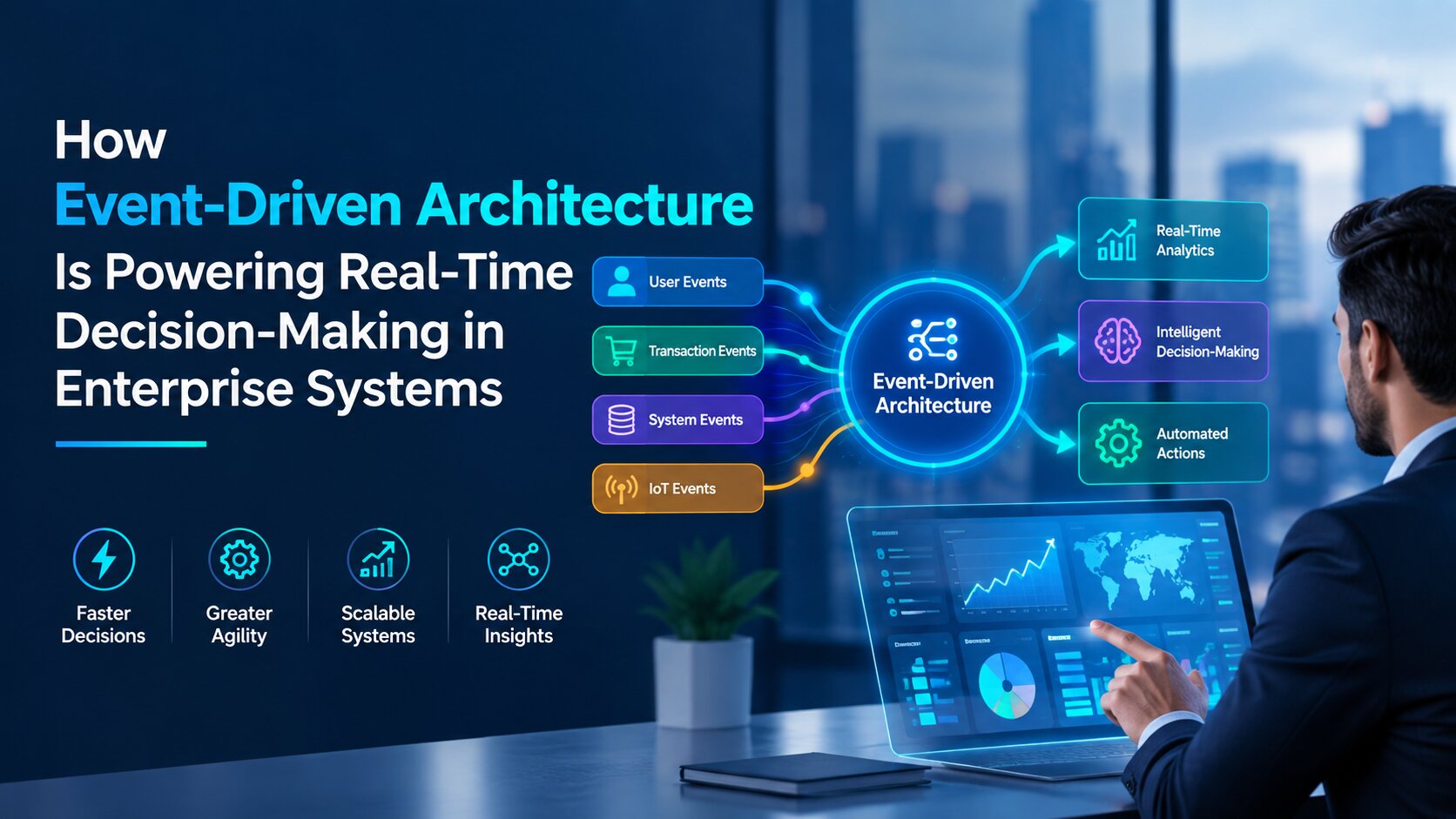
How Event-Driven Architecture Is Powering Real-Time Decision-Making in Enterprise Systems
A payment fails. Inventory drops below its threshold. A critical service starts showing signs of failure. In each case, the business needs the system to recognize what happened and respond before the consequences spread.
Traditional batch processes create a delay between the event and the response. Data may be accurate when the next processing cycle runs, but the business has already moved on by then. That delay can mean a missed fraud signal, an outdated inventory count, or a service outage that takes longer to detect.
Event-driven architecture removes much of that waiting by allowing one event to trigger the next action as it happens. The result is a system that can respond to changes as they occur, while still leaving slower processes on the batch model when real-time response adds little value.
Batch Systems Were Never Built To Notice Things As They Happen
Most enterprise systems still run on request and response. Something happens, a request goes out asking what changed, and an answer comes back later. That works fine for a monthly report. It fails as soon as a business needs to know about an issue while it's actually taking place.
The issue is present in all places where you can find it. The stock in a warehouse runs out hours before anybody sees that it does. A payment is made successfully, but nobody knows anything until the customer calls to ask what happened.
A server begins malfunctioning silently, and nobody knows about it until it affects the users. This is precisely what event-driven architecture addresses.
Inventory counts that update overnight instead of the moment a sale happens
Fraud rules that run in a batch job hours after the transaction cleared
System health checks that poll every few minutes instead of reacting instantly
What Actually Changes When Systems React To Events
Coverage from VentureBeat captured this shift through Confluent's head of AI, Sean Falconer. Most enterprise AI systems, he said, can't respond automatically to an important business event without someone prompting them first. That gap costs revenue, frustrates customers, and adds risk every time a payment fails or a network hiccups. His point goes well beyond AI. Any system built to wait for a question will always lag behind one built to notice the answer as it happens.
That's the whole case for event-driven architecture. A system built around events doesn't wait to be asked what changed. It already knows, because the change itself triggered the next step the moment it occurred.
The Complexity Nobody Puts On The Diagram
A piece in InfoWorld raises a caution worth taking seriously. Event-driven systems give teams real rigor for handling change. But that expressiveness doesn't automatically produce clarity. As a system grows, dependencies between different pieces of state often have to be inferred from dispatch logic instead of read off a diagram. Engineers end up mentally simulating how the system behaves over time, rather than simply inspecting how it's built.
That's a fair warning, not a reason to avoid the pattern. Good event-driven architecture accounts for this complexity up front, through clear event schemas and documented flows. It doesn't wait to discover the hard way why two events from the same change fired in the wrong order.
What A Real Event-Driven System Actually Requires
Getting real value out of this pattern takes more than swapping a request for an event. The systems that hold up in production tend to include:
- A message broker that can replay events instead of losing them if a consumer goes down
- Clear event schemas so every team knows exactly what a given event actually means
- Deduplication built in, since most brokers deliver events at least once, not exactly once
- Monitoring built for event flow specifically, not just general system uptime
None of this happens by accident. It takes event-driven architecture designed with these pieces from the start, not layered on after the first outage makes the gaps impossible to ignore.
Where Teams Get This Wrong
The most frequent error is thinking everything in the organization must be treated with equal immediacy. Not all processes require sub-second response time.
Running all of them through such a real-time channel creates unnecessary complication and expense, particularly when one is talking about something like the monthly reconciliations report, which no one looks at until next week.
The groups that benefit from using an event-driven system know exactly where the added complexity pays off: fraud, inventory, operations notifications. They leave the slower-moving parts of the business running on the simpler pattern that still suits them fine.
Real-Time Only Works If The Foundation Holds
The enterprises seeing genuine results here aren't chasing the fastest possible architecture everywhere. They matched the pattern to the problem, invested in the plumbing that keeps events reliable, and built the discipline to explain how the system actually behaves instead of hoping nobody asks.
That discipline is what separates working event-driven architecture from an architecture diagram that only holds up in the slide deck.
Explore how BayOne approaches this kind of work, helping enterprises build event systems that hold up under real production load, not just a clean diagram.







 Whatsapp
 Email