Job
enquiry:+91-9121642626
Job
enquiry:+91-9121642626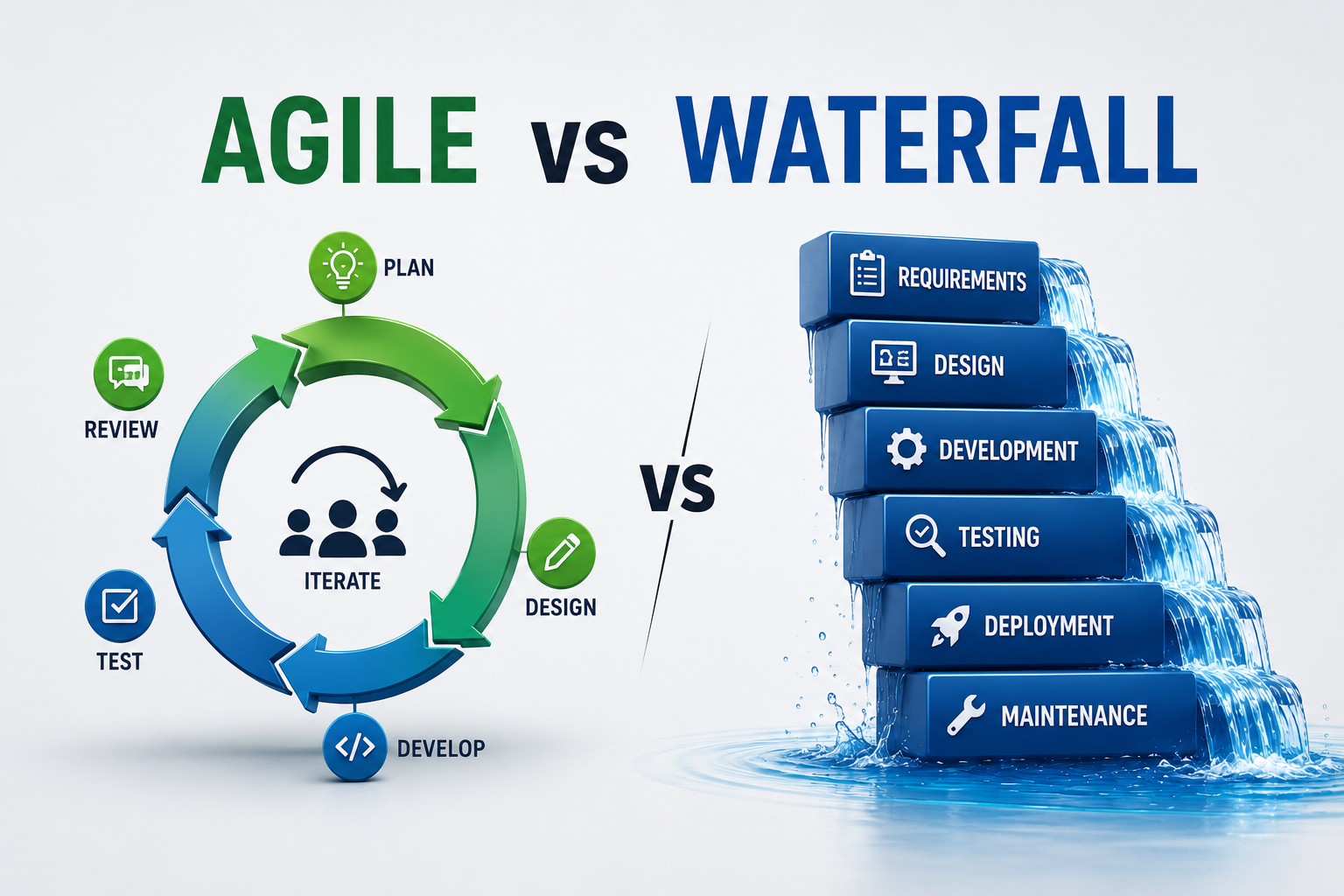
Agile vs Waterfall: Which Is Better for Enterprise Apps?
Building an enterprise application is a major investment, but choosing the right development approach can be just as important as the technology itself. One of the most common questions businesses face is whether Agile or Waterfall is the better methodology for delivering successful enterprise apps.
The answer isn't always straightforward. Some enterprise projects require flexibility, rapid updates, and continuous user feedback, while others depend on strict planning, detailed documentation, and predictable timelines. Choosing the wrong approach can lead to delays, budget overruns, and software that fails to meet business goals.
In this guide, you'll learn the key differences between Agile and Waterfall, how each methodology impacts enterprise app development, where each approach works best, and how to determine the right fit for your project. By the end, you'll have a clear understanding of which model can help your enterprise application achieve better results, faster delivery, and long-term success.
Why Development Methodology Matters in Enterprise Software Projects
Enterprise software projects are often complex. They involve multiple stakeholders, business processes, integrations, security requirements, and long-term maintenance considerations.
A development methodology acts as the framework that guides how the project moves from idea to deployment. It determines:
- How requirements are gathered
- How teams collaborate
- How changes are handled
- How testing is performed
- How progress is measured
Choosing the wrong methodology can create delays, budget overruns, and communication gaps. On the other hand, selecting the right approach helps teams stay aligned, manage risks effectively, and deliver software that meets business expectations.
For example, if your business requirements are likely to change throughout development, a rigid process may cause problems. Likewise, if your project requires extensive compliance documentation, a highly flexible approach may not provide enough structure.
What Is Agile and What Is Waterfall?
Agile Methodology
Agile Methodology is a flexible and iterative approach to software development. Instead of building the entire product at once, the project is divided into smaller stages called sprints.
During each sprint, developers build specific features, test them, gather feedback, and make improvements before moving forward.
Key characteristics of Agile include:
- Frequent releases
- Continuous feedback
- Collaboration between teams and stakeholders
- Flexibility to accommodate changes
- Ongoing testing and improvements
Agile is particularly useful when project requirements may evolve over time.
Waterfall Methodology
The waterfall development model follows a step-by-step process. Each phase must be completed before the next one begins.
The typical stages include:
- Requirements gathering
- System design
- Development
- Testing
- Deployment
- Maintenance
Since everything is planned upfront, Waterfall works best when requirements are clear and unlikely to change.
This structured approach makes project planning and budgeting easier but can make changes more difficult later in the process.
Waterfall vs Agile Custom Software Development: Key Differences
Understanding the differences between Waterfall and Agile helps businesses choose the most suitable approach for their projects.
Feature |
Agile | Waterfall |
Development Style |
Iterative | Sequential |
Flexibility |
High | Low |
Requirement Changes |
Easily managed | Difficult to implement |
Customer Involvement |
Continuous | Limited |
Testing |
Throughout development | After development |
Delivery |
Incremental releases | Final release |
Documentation |
Moderate | Extensive |
Risk Management |
Early issue detection | Risks often discovered later |
SDLC in Agile vs Waterfall Development
The Software Development Life Cycle (SDLC) is the framework used to guide software projects from concept to deployment. Both Agile and Waterfall follow the SDLC, but they approach it differently.
In a Waterfall SDLC, each phase is completed sequentially:
- Requirements Analysis
- System Design
- Development
- Testing
- Deployment
- Maintenance
In an Agile SDLC, these phases occur repeatedly throughout multiple iterations. Rather than waiting until development is complete, testing and feedback occur continuously. For enterprise software projects, understanding how Agile and Waterfall fit within the SDLC helps organizations choose the methodology that best aligns with their business requirements and project goals.
Scrum, and Kanban: Understanding the Differences
Many businesses use the terms Agile, Scrum, and Kanban interchangeably, but they represent different concepts within software development. Agile is the overall philosophy that promotes flexibility, collaboration, and iterative development. Scrum and Kanban are two popular frameworks used to implement Agile practices.
What Is Scrum?
Scrum is an Agile framework that organizes work into fixed-length sprints. Teams hold regular meetings, including sprint planning sessions, daily standups, sprint reviews, and retrospectives.
Scrum works particularly well for projects where requirements evolve frequently and teams need regular feedback cycles.
Key Scrum roles include:
- Product Owner
- Scrum Master
- Development Team
What Is Kanban?
Kanban is another Agile framework that focuses on visualizing workflows and improving efficiency. Instead of working in fixed sprints, teams continuously move tasks through different stages of completion using a Kanban board.
Kanban emphasizes:
- Continuous delivery
- Workflow visibility
- Reduced bottlenecks
- Improved productivity
Kanban vs Scrum Comparison
| Feature |
Scrum | Kanban |
| Work Structure |
Sprint-Based | Continuous Flow |
| Planning |
Fixed Sprint Planning | Ongoing Prioritization |
| Roles |
Defined Roles | Flexible Roles |
| Change Management |
Changes Limited During Sprint | Changes Allowed Anytime |
| Delivery |
Sprint Releases | Continuous Releases |
Advantages and Limitations of Agile
Benefits of Agile
Faster Delivery
Agile allows businesses to receive working software in smaller releases rather than waiting until the end of the project.
Better Flexibility
Market conditions and customer expectations can change quickly. Agile allows teams to adapt without disrupting the entire project.
Improved Collaboration
Regular meetings and stakeholder involvement keep everyone aligned throughout development.
Better Quality Control
Since testing happens continuously, issues can be identified and resolved earlier.
Higher Customer Satisfaction
Frequent feedback ensures the final product remains aligned with business needs.
Challenges of Agile
Scope Creep
Because Agile welcomes change, projects can expand beyond their original scope if not properly managed.
Ongoing Stakeholder Involvement
Agile requires active participation from decision-makers throughout the project.
Less Predictable Costs
Changing requirements can make it harder to estimate final budgets and timelines.
Team Dependency
Agile works best with experienced teams that communicate effectively and adapt quickly.
Advantages and Limitations of Waterfall
Benefits of Waterfall
Clear Planning
Everything is planned before development begins, creating a well-defined project roadmap.
Predictable Budget and Timeline
Since requirements are established upfront, cost and schedule estimates are often more accurate.
Strong Documentation
Detailed documentation supports compliance, maintenance, and future upgrades.
Easier Progress Tracking
Clearly defined phases make it simple to measure project progress.
Suitable for Regulated Industries
Organizations operating in healthcare, finance, or government sectors often prefer Waterfall because of its structured nature.
Challenges of Waterfall
Limited Flexibility
Making changes after development starts can be costly and time-consuming.
Delayed Testing
Issues may remain undiscovered until the testing phase, increasing the effort required to fix them.
Longer Delivery Times
Businesses must wait until most of the project is complete before using the software.
Risk of Outdated Requirements
If business needs change during development, the final solution may no longer fully meet expectations.
When Should Businesses Choose Agile or Waterfall?
Choosing between Agile and Waterfall depends on your project's requirements and business objectives.
Best Use Cases for Agile
Agile is often the better choice when:
- Requirements are expected to change
- Customer feedback is important
- Speed to market matters
- Innovation is a priority
- Continuous improvements are expected
Common Agile projects include:
- SaaS platforms
- Mobile applications
- Customer-facing portals
- E-commerce solutions
- Digital transformation initiatives
Best Use Cases for Waterfall
Waterfall is usually more effective when:
- Requirements are fixed
- Compliance requirements are strict
- Detailed documentation is necessary
- Budgets must remain predictable
- Stakeholder involvement is limited
Common Waterfall projects include:
- Government software systems
- Banking applications
- Healthcare management platforms
- Manufacturing systems
- Large infrastructure software projects
Can a Hybrid Agile-Waterfall Approach Work?
Many enterprises no longer see Agile and Waterfall as competing methodologies. Instead, they combine elements of both to create a hybrid approach.
For example, a company may use Waterfall during planning and budgeting phases while applying Agile practices during development.
This approach offers several advantages:
- Better project control
- Increased flexibility
- Faster delivery cycles
- Improved stakeholder visibility
- Reduced project risks
Hybrid models are becoming increasingly popular because they help organizations balance governance with adaptability.
For large enterprise projects, this combination often delivers the best of both worlds.
How to Select the Right Development Methodology for Your Project
Before selecting a methodology, ask yourself a few important questions.
Are Your Requirements Likely to Change?
If requirements are expected to evolve, Agile is usually a better fit.
Do You Need Fixed Budgets and Timelines?
If predictability is a priority, Waterfall may be more suitable.
How Involved Can Stakeholders Be?
Agile requires regular feedback and participation. Waterfall requires less ongoing involvement.
Are There Compliance Requirements?
Projects that require extensive documentation often benefit from Waterfall's structured process.
How Quickly Do You Need Results?
Agile allows businesses to launch features sooner through incremental releases.
By evaluating these factors, organizations can select the most effective enterprise software development methodology for their unique needs.
A Practical Example: Matching Methodology to Business Needs
One useful way to choose between Agile and Waterfall is to look at how the project will actually be managed day to day. For example, companies such as Tvisha Technologies work across different types of enterprise projects. A customer-facing app with changing requirements may benefit from Agile, where features are released in stages and improved through feedback. A compliance-heavy internal system with fixed specifications may be easier to manage with a Waterfall-style plan and detailed documentation.
The important takeaway is not the company name-it’s the decision process. Start by asking whether your requirements are stable, how often stakeholders can give feedback, and whether documentation or flexibility is the bigger priority. Those answers usually point to the right methodology.
Which Is Better for Enterprise Apps?
For most modern enterprise applications, Agile is often the preferred approach because it allows businesses to respond quickly to changing requirements, user feedback, and market demands. Enterprise apps frequently require integrations, feature enhancements, and ongoing updates, making Agile's iterative model highly effective.
However, Waterfall remains valuable for enterprise projects with fixed requirements, strict compliance standards, and extensive documentation needs. Industries such as healthcare, banking, and government often benefit from its structured approach.
In many cases, a hybrid Agile-Waterfall model provides the best balance, combining strategic planning with development flexibility. The ideal choice depends on the complexity, regulatory requirements, and long-term goals of the enterprise application.
Conclusion
The choice between agile vs waterfall custom software development ultimately depends on your project goals, business environment, and operational requirements.
Agile is ideal for projects that need flexibility, frequent updates, and ongoing collaboration. Waterfall works best when requirements are clearly defined and predictability is essential.
Many modern enterprises are also adopting hybrid approaches that combine the strengths of both methodologies. Rather than focusing on which model is better, businesses should focus on which approach best supports their objectives.
A thoughtful decision at the beginning of a project can improve efficiency, reduce risk, and increase the likelihood of delivering software that truly meets business needs.
Frequently Asked Questions
1. What is the main difference between Agile and Waterfall development?
The main difference is how each methodology handles development and change. Agile follows an iterative approach where software is built and improved in smaller stages. Teams can adjust requirements as the project progresses. Waterfall follows a sequential process where each phase is completed before the next begins. Changes are more difficult once development starts. Agile focuses on flexibility and continuous feedback, while Waterfall emphasizes planning, documentation, and predictable execution. The right choice depends on your project's complexity and business requirements.
2. Which methodology is better for custom enterprise software development?
There is no one-size-fits-all answer. Agile is often preferred for projects where requirements may change or where businesses want faster releases and ongoing feedback. Waterfall is better suited for projects with clearly defined requirements and strict compliance standards. Many enterprise organizations evaluate factors such as budget, timeline, stakeholder involvement, and regulatory requirements before choosing a methodology. In some cases, combining elements of both approaches through a hybrid model can provide the most effective solution.
3. Why do many enterprises prefer Agile development today?
Many enterprises choose Agile because it allows them to respond quickly to changing market conditions and customer expectations. Agile enables teams to release features faster, gather feedback regularly, and make improvements throughout development. This approach reduces the risk of building software that no longer meets business needs by the time it launches. Agile also improves collaboration between technical teams and stakeholders, helping organizations stay aligned and deliver solutions that provide real business value.
4. Is Waterfall still used for enterprise software projects?
Yes, Waterfall remains widely used in industries where requirements are stable and documentation is critical. Government agencies, healthcare providers, financial institutions, and manufacturing organizations often rely on Waterfall because it provides clear planning, structured processes, and detailed documentation. These industries frequently face compliance and regulatory requirements that benefit from Waterfall's disciplined approach. While Agile has become more popular, Waterfall continues to be a practical choice for projects with fixed objectives and limited scope changes.
5. Can Agile and Waterfall be combined in a single project?
Yes, many organizations successfully combine Agile and Waterfall methodologies through a hybrid approach. For example, businesses may use Waterfall for project planning, budgeting, and compliance documentation while using Agile for development and testing. This allows teams to maintain structure and governance while still benefiting from flexibility and faster delivery cycles. Hybrid models are particularly effective for large enterprise projects that involve multiple stakeholders, changing requirements, and complex business processes. They help balance control, adaptability, and overall project success.
Useful links:
https://agilealliance.org/agile101/the-agile-manifesto/ - Agile Methodology guide
https://www.pmi.org/learning/agile - Agile project management
https://www.ibm.com/think/topics/agile-vs-waterfall - Difference between agile and waterfall
https://learn.microsoft.com/en-us/power-platform/well-architected/operational-excellence/formalize-development-practices - How to Select the Right Development Methodology for Your Project
.png)
.png)




 Whatsapp
 Email
Email