Job
enquiry:+91-9121642626
Job
enquiry:+91-9121642626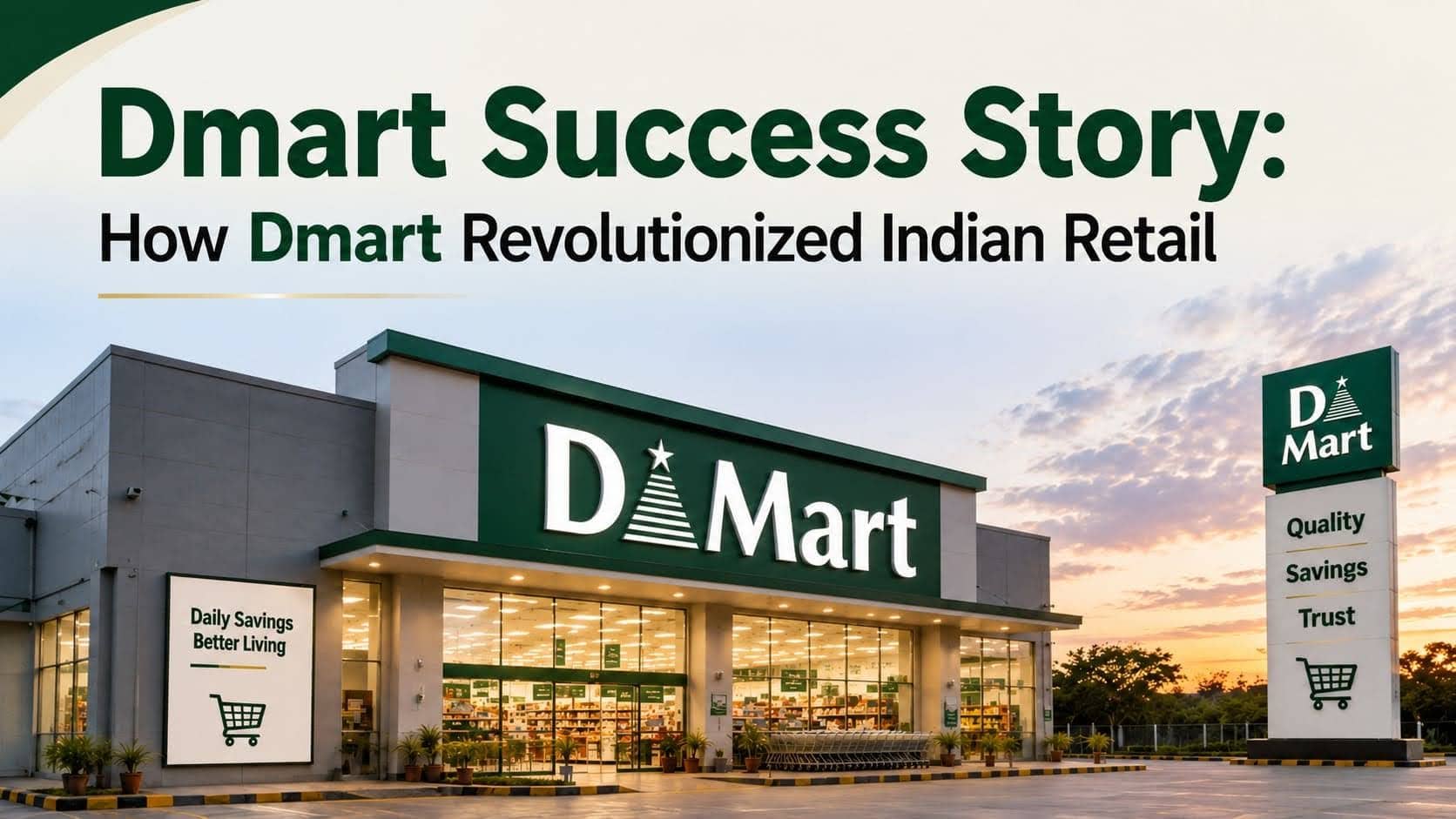
Dmart Success Story: How Dmart Revolutionized Indian Retail
The Dmart is a remarkable example of how disciplined execution, customer-first thinking, and long-term vision can build one of India's most successful retail businesses. From opening its first store in Powai, Mumbai, in 2002 to becoming a trusted supermarket chain with over 500 stores across the country, Dmart has transformed the way millions of Indians shop for everyday essentials.
Behind this extraordinary growth lies a unique business model focused on low prices, operational efficiency, strategic expansion, and financial discipline. In this blog, you'll discover how Dmart was founded, the vision of its founder, the strategies that fueled its rapid growth, its latest financial performance, the challenges it continues to face, and the key business lessons entrepreneurs can learn from its incredible journey. Whether you're a business enthusiast, entrepreneur, or retail professional, this comprehensive Dmart success story will give you valuable insights into what makes Dmart one of India's most admired retail brands.
The Beginning of Dmart
Dmart was started by Radhakishan Damani. He is a stock market investor who made a lot of money buying and selling stocks before he got into retail. Radhakishan Damani had a store called Apna Bazaar in Nerul for a while in 1999.. He did not like the way it worked.
This made him want to start his store. So Avenue Supermarts Ltd. Was started in 2000. The first Dmart store opened in Powai, Mumbai in 2002. Dmart did things differently from the beginning. It focused on stores that Dmart owned. Dmart did not just rent spaces like other stores did. Dmart wanted to grow and make money. It did not want to expand fast. This careful approach is what Dmart is, about.
Dmart Business Model
Dmart uses something called the Everyday Low Price strategy.This means Dmart does not have sales events instead it keeps prices low every day.
Everyday Low Price (EDLP) strategy: Dmart avoids flashy discount events and instead keeps prices consistently low, building long-term customer trust.
Store ownership: A large share of Dmart stores are owned rather than leased, which shields the company from rising rental costs and keeps operating expenses predictable.
Cluster-based expansion: Instead of spreading thin across the country, Dmart expands in geographic clusters, which reduces logistics costs and strengthens local brand recognition.
Focus on essentials: The company's product mix leans heavily on groceries, FMCG, and household essentials categories with consistent, repeat demand.
Lean operations: Dmart has historically operated with minimal advertising spend, relying instead on word-of-mouth and consistent value for money.
This disciplined approach to running the business is very similar to how organized startups rely on structured processes rather than improvisation, a principle explored further in this guide on top app ideas for startups, which highlights how disciplined planning shapes long-term business outcomes.
Why Dmart Became Successful
Several factors have contributed to Dmart's rise as one of India's most profitable retail chains:
Consistent pricing philosophy: Customers trust that Dmart prices are reliably low, removing the need to "wait for a sale."
Operational efficiency: Tight cost control across procurement, logistics, and store operations has kept margins healthy even in a low-margin retail sector.
Debt-free growth: Dmart has largely funded its expansion through internal accruals rather than heavy borrowing, giving it financial flexibility that many competitors lack.
Customer-first store design: Larger store formats with a wide product range reduce the need for customers to visit multiple outlets.
Vendor relationships: Dmart has built a reputation for paying vendors faster than industry norms, which strengthens supply chain reliability.
Together, these factors explain why Dmart has consistently outperformed many peers on profitability, even while growing its store count steadily rather than explosively.
Dmart Growth Timeline
- 2000: Avenue Supermarts Ltd. incorporated by Radhakishan Damani.
- 2002: First Dmart store opens in Powai, Mumbai.
- 2010: Dmart reaches around 25-29 stores across Maharashtra and Gujarat.
- 2013: Dmart crosses 65 stores and becomes the third-largest retail chain in India by revenue.
- 2016: Dmart launches its e-commerce arm, Dmart Ready.
- 2017: Avenue Supermarts goes public with a highly oversubscribed IPO.
- 2022: Dmart surpasses 300 stores nationally.
- 2026: Dmart crosses the 500-store milestone, with stores spread across 12+ states and union territories.
This steady, staged growth is a defining feature of the Dmart - the company rarely rushed its expansion, choosing instead to grow only as fast as its operational systems could support.
Dmart Financial Performance
Dmart financial performance is a reason it gets a lot of attention from investors and the market. For the year FY26, Avenue Supermarts made around ?67,000–68,800 crore. This is up from around ?57,800–59,300 crore the year. So Dmart had a growth rate of around 15–19%.
The net profit for the year was between ?2,970 crore and ?3,223 crore. This depends on how you look at the numbers. Year Dmart made around ?2,707–2,927 crore.
Dmart also opened a lot of stores and now has over 500 stores. The sales at stores that have been open for than two years went up a lot in the last part of FY26. This means that people are coming back to shop at Dmart again and again.
Even though Dmart is doing well some people who watch the stock market are not sure about it. They think the stock price is too high compared to how money Dmart will make in the near future.. Dmarts business is still very strong. It has no debt.
People were very excited, about Dmart when it first sold stock to the public in 2017. The stock was sold times over and the price went up a lot on the first day. This shows that people believed in Dmarts business model back then.
Reference Links: https://www.screener.in/company/DMART/consolidated/
Challenges Faced by Dmart
Dmart has faced some challenges despite being very successful. Here are a few:
1. Margin pressure
Dmarts profits have been under pressure even though it is making money. This is because its costs are going up and it has to keep prices to compete with other retailers.
2. Quick commerce competition
The rise of delivery services in cities has made things tougher for Dmart. People now expect to get their groceries delivered fast which has changed the way they shop.
3. commerce growth
Dmarts online grocery business, Dmart Ready has been growing slowly. It is only available in a cities because the company wants to make sure it is profitable before expanding further.
4. Valuation scrutiny
Some experts are questioning whether Dmarts stock price is justified. They think the company needs to show that its profits are growing enough to support its high stock price.
5. Real estate constraints
Dmart likes to own its stores than rent them. However finding and buying properties, in cities is hard and expensive. This makes it harder for Dmart to expand quickly compared to its competitors who rent their stores.
Dmart vs Reliance Retail
Dmart and Reliance Retail are two companies in the same industry.
| Reliance | Dmart |
| Reliance Retail works in areas like grocery, electronics, fashion and pharmacy. They have a lot of money. Are expanding quickly. |
Dmart only focuses on grocery retail. They are growing slowly. Making sure each store makes a good profit. |
| Reliance Retail is big because it has a lot of revenue. They can use money from one business to help another. |
Dmart makes profit from its grocery business. This is because they do not spend much on operations and do not have any debt. |
| Reliance Retail has types of stores like big supermarkets and small shops. |
Customers see the difference in the stores. Dmart has stores that focus on value. |
Both Dmart and Reliance Retail are leading companies in Indias market. They have ideas, about how to grow and take risks.
Dmart and Reliance Retail are players. Dmart focuses on grocery Dmart makes profit. Reliance Retail has formats Reliance Retail grows fast.
Leadership Style of Radhakishan Damani
Radhakishan Damani is widely known as a low-profile, media-shy entrepreneur who rarely gives interviews or makes public appearances. Often referred to as India's "retail king," his leadership style is built on patience, discipline, and long-term thinking rather than aggressive publicity or rapid diversification. Damani has consistently reinvested profits from existing stores to fund new ones, avoiding heavy external debt in the process.
This philosophy extended to his approach to management succession as well. After more than two decades of leadership under Managing Director and CEO Neville Noronha, Avenue Supermarts transitioned leadership to Anshul Asawa, a former Unilever executive, who took over as MD and CEO in February 2026. The transition reflects Damani's broader approach — planning leadership changes carefully and well in advance, rather than reacting to pressure.
Effective leadership transitions like this often depend on clear role definition and structured decision-making, principles closely tied to how organizations define ownership and accountability, a concept discussed in more depth in this piece on the product owner role.
Lessons Entrepreneurs Can Learn from the Dmart Success Story
The story of Dmart is really interesting. It has a lot to teach entrepreneurs and people who run businesses.
Dmart shows us that growing a business does not have to happen to be successful. The way Dmart expanded slowly and steadily is an example of how growing a business in a sustainable way can be better than growing really fast.
Being consistent is very important. Dmart always kept its prices low every day. It did not try to trick customers with special deals. This helped Dmart build trust with its customers and keep them coming for a long time.
Owning the things that're important to your business can help reduce risks in the long run. Because Dmart owned its stores it did not have to worry about rent prices going up like some other retail businesses do.
Growing a business without debt gives you freedom to make choices. Dmart was able to expand its business using its money so it did not have to answer to anyone else and it could make decisions without feeling pressured.
It is very important to be organized and disciplined when running a business. Dmart was successful not just because it had an idea but also because it was able to manage its operations well including things like getting products to stores and working with suppliers.
Dmarts success is an example of how important it is to have good systems, in place to manage a growing business. Many businesses use tools to help them stay organized and manage their tasks as they get bigger.
Future of Dmart
Looking ahead Dmart will keep opening stores in a careful and steady way. They will not rush into markets until they are ready.The companys online shopping part, Dmart Ready will focus more on delivering groceries and other items to homes in cities.Analysts think Dmart will keep growing its sales in the coming years. This growth will come from opening stores and from selling more in existing stores.However it will be important to watch how well Dmart manages its costs.The company has a CEO now. It will be interesting to see how well Dmarts basic ideas. Offering value, expanding carefully and being careful with money. Work in a retail market that is getting more competitive.Dmart will face competition, from quick-commerce companies.The company will have to balance growth with spending.
Dmarts success will depend on its ability to adapt to changing market conditions.
Conclusion
The Dmart is a clear example of how disciplined, patient execution can outperform rapid, capital-heavy expansion. From a single store in Powai to a nationwide chain of over 500 outlets, Dmart's growth reflects the vision of Radhakishan Damani and, more recently, the operational continuity being carried forward by new leadership under Anshul Asawa. As competition from quick commerce and larger retail conglomerates intensifies, Dmart's core principles of everyday low pricing, store ownership, and financial discipline remain the foundation it will continue to rely on. For more details on the company's operations, visit the official Dmart website, and for additional background on its journey, see this detailed Dmart success story analysis, the Dmart Wikipedia page, and this Forbes profile of Radhakishan Damani.
FAQs
1. Who is the founder of Dmart?
Dmart was started by Radhakishan Damani. He is a stock market investor. Radhakishan Damani got into retail after he did not like the department store franchise model he was using earlier. Radhakishan Damani started Avenue Supermarts Ltd. In 2000. Then he opened the Dmart store in Powai, Mumbai in 2002. Radhakishan Damani is known for being a leader. He is still the founder and chairman of Dmart.. Now a new CEO is in charge of the daily work.
2. How many Dmart stores are there in India as of 2026?
Dmart now has than 500 stores. These stores are in states and union territories in India. Dmart opened new stores in 2026. The company is growing slowly and steadily. Dmart is adding stores as part of its plan to expand in groups.
3. What makes Dmarts business model different from retailers?
Dmarts business model is based on keeping prices low every day. Dmart also owns its stores of renting them. Dmart expands by opening stores in groups in the area. Dmart is different from retailers because it does not have big sales events. Dmart also owns many of its properties. This helps Dmart save money on rent.
4. Who is the CEO of Dmart?
The current CEO of Dmart is Anshul Asawa. He used to work at Unilever. Anshul Asawa has been working for than 30 years. He became the Managing Director and CEO of Avenue Supermarts in February 2026. He took over from Neville Noronha. Neville Noronha was the CEO of Dmart for than 20 years. Radhakishan Damani is still the founder and chairman of Dmart.
5. Is Dmart more profitable than its competitors like Reliance Retail?
Dmart makes money than its competitors in the grocery segment. Dmart has costs and no debt. This helps Dmart make money. Reliance Retail is bigger than Dmart. Reliance Retail sells things.. Dmart is still a strong and profitable company, in Indias retail sector. Dmart and Reliance Retail are both companies.









 Whatsapp
 Email
Email