Job
enquiry:+91-9121642626
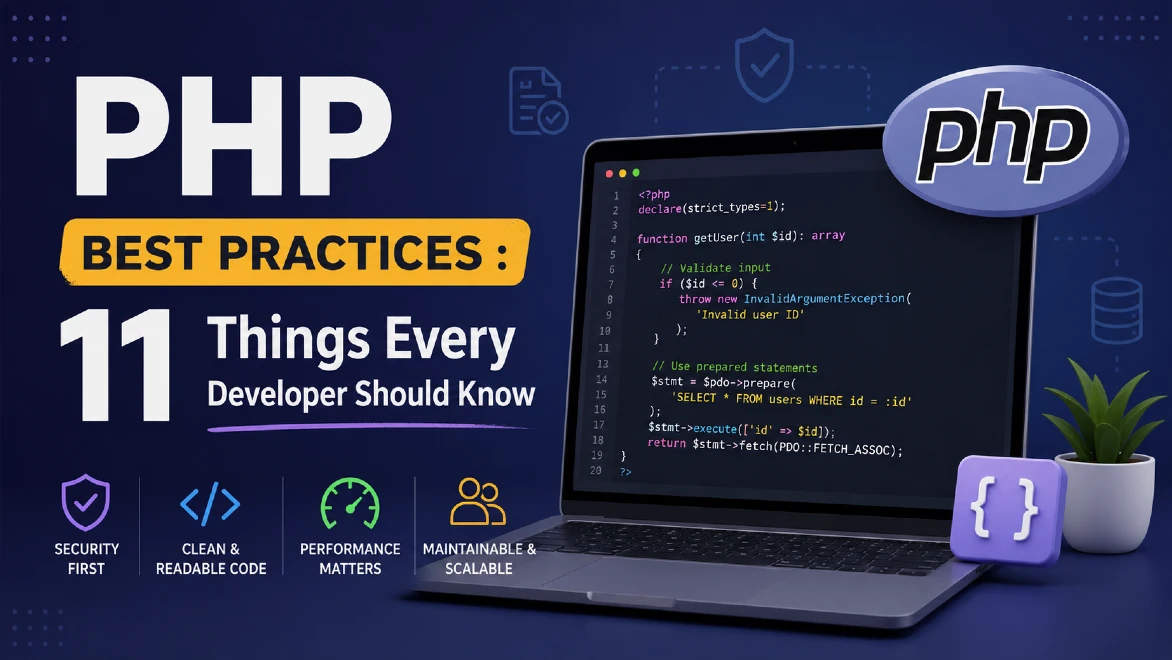
PHP Best Practices : 11 Things Every Developer Should Know
A lot of "advanced PHP" content still circulating hasn't been touched since PHP 7 was current. PHP 8.5 is the latest stable release as of early 2026, PHP 8.4 remains a solid, actively supported baseline for production, and PHP 8.1 reached end of life at the close of 2025, meaning any site still running it is now exposed to unpatched vulnerabilities. The language has moved considerably in the last few years, and a list of best practices that ignores that isn't current anymore, it's outdated.
Here's what's worth knowing, corrected from a couple of claims that were never quite accurate to begin with.
Quick summary: modern PHP development in 2026 centers on Composer for dependency management, PSR-4 for autoloading, correct use of PHP 8.x syntax (null coalescing, match expressions, enums, readonly properties), and security fundamentals like prepared statements and strict typing, not the older micro-optimizations still circulating in outdated guides.
What PHP is, briefly
PHP, short for Hypertext Preprocessor, is an open-source, server-side scripting language built for creating dynamic websites and web applications. Unlike client-side languages that run in a browser, PHP executes on the server, generating the content a browser then receives and displays. Its combination of a low learning curve, broad hosting support, and a mature ecosystem of frameworks and libraries has kept it central to web development for decades, powering everything from small business sites to large-scale platforms.
1. Security practices that matter
Always validate and sanitize user input to guard against SQL injection and cross-site scripting. Use prepared statements and parameterized queries for every database interaction involving user-supplied data, this remains the single most effective, non-negotiable defense against SQL injection specifically.
Password handling deserves its own mention, since it's a common source of real breaches when done carelessly. Never store passwords in plain text or with a fast, general-purpose hash like MD5 or SHA-1. PHP's built-in password_hash() function, using the bcrypt or Argon2 algorithm, handles salting and cost-factor tuning automatically, and password_verify() checks a submitted password against the stored hash without exposing timing differences an attacker could exploit. There's rarely a good reason to build password handling from scratch when this exists in PHP's standard library already.
Cross-site request forgery (CSRF) protection is worth naming explicitly too. Any form that changes state, updating a profile, submitting a payment, deleting a record, needs a unique, unpredictable token embedded in the form and verified on submission, preventing a malicious site from tricking a logged-in user's browser into submitting a request on their behalf. Most modern frameworks handle this automatically, but it's worth confirming it's actually enabled rather than assuming it is.
Add one more thing to this list explicitly: start every new file with declare(strict_types=1);. PHP's default type coercion, silently converting a string to a number or vice versa, is a common source of subtle bugs that strict typing catches immediately instead of letting bad data flow silently through an application.
2. Composer and dependency management
This is the single most important thing missing from most "advanced PHP" lists, and it's not really advanced anymore, it's foundational. Composer is PHP's dependency manager, and essentially no serious PHP project in 2026 manages its libraries manually. It handles installing and updating third-party packages, autoloading your own classes, and keeping dependencies version-locked and reproducible across every machine that runs the code.
Two details worth understanding beyond the basics. The composer.lock file, generated automatically, records the exact version of every dependency actually installed, not just the version range allowed. Committing this file to version control, not just composer.json, is what guarantees every developer and every deployment environment installs identical dependency versions, rather than each one potentially resolving to a slightly different compatible release. Skipping this is a common, avoidable cause of "it works on my machine" bugs.
Running composer install --optimize-autoloader (or setting the equivalent flag in a deployment pipeline) also matters for production specifically, generating a more efficient class map that speeds up autoloading meaningfully at scale, a small detail that compounds across thousands of requests on a busy application.
If you're evaluating a PHP codebase, or a PHP developer, and Composer isn't part of the conversation, treat that as a red flag rather than a stylistic preference.
3. Single and double quotes, and what the difference is
Single quotes (') treat their content as a literal string, no variable interpolation, no escape sequence processing beyond escaping a literal quote or backslash. Double quotes (") allow variable interpolation and escape sequences like \n for a newline.
The often-repeated claim that single quotes are meaningfully faster deserves a correction: with modern PHP and opcode caching, the performance difference is negligible in virtually every application. The reason to prefer single quotes when interpolation isn't needed is clarity of intent, it signals to anyone reading the code that nothing inside that string is being evaluated, which makes the code easier to reason about, not faster to run.
4. PSR-4 autoloading through Composer
Manually tracking which file holds which class doesn't scale past a small project, and it isn't how modern PHP solves this problem anymore. PSR-4, one of the PHP-FIG's standard specifications, defines a convention mapping namespaces directly to file paths, and Composer generates and manages the autoloader based on that convention. Once configured, referencing a class anywhere in a project loads the correct file automatically, no manual require statements, no guessing which file holds what.
This is worth understanding properly rather than treating autoloading as a solved problem nobody needs to think about, since a project with autoloading misconfigured tends to develop confusing, hard-to-trace bugs around class loading order.
5. Automated testing, not an optional extra
A PHP codebase without automated tests is a codebase where every change is a small act of faith. PHPUnit remains the standard testing framework for PHP, letting you write unit tests that verify individual functions and classes behave correctly in isolation, and integration tests that verify different parts of the application work correctly together.
The practical value shows up specifically when refactoring or upgrading, changing a PHP version, updating a dependency, restructuring a class, becomes something you can verify quickly rather than something you cross your fingers about. A reasonable starting discipline for a team without existing test coverage: write a test for every bug before fixing it, so the specific failure that just happened can never silently reoccur, rather than trying to retroactively test an entire application at once.
Pest, a newer testing framework built on top of PHPUnit with a more concise, readable syntax, has gained real adoption particularly in the Laravel ecosystem, worth knowing about even if PHPUnit remains the more universal default.
6. Error handling and exceptions done properly
PHP's exception system lets code signal that something has gone wrong in a structured way, and using it well is a genuine skill distinct from just wrapping code in a generic try/catch block. Catch specific exception types rather than a blanket Exception, so your error handling logic actually knows what went wrong and can respond appropriately, a database connection failure and a validation error call for genuinely different handling, not the same generic response.
Custom exception classes, extending PHP's base Exception class for your application's specific error conditions, make this concrete: a PaymentDeclinedException or an InvalidOrderStateException communicates intent far more clearly in both the code and any logs it produces than a generic exception message buried in a string.
Never silently swallow an exception with an empty catch block. If an error genuinely doesn't need handling, that's a rare enough case to deserve an explicit comment explaining why, not a default habit. An unlogged, silently caught exception is one of the most common reasons a production bug takes hours to diagnose instead of minutes, because the system had the information about what went wrong and discarded it.
7. Design patterns to know
Familiarity with a handful of common patterns improves the structure and maintainability of PHP code.
Singleton ensures a class has exactly one instance and a global access point to it, useful for something like a shared database connection. Factory creates objects without the calling code needing to know the exact class being instantiated, useful for managing a family of related objects flexibly. Observer lets an object notify a set of dependent objects when its state changes, the foundation of most event-driven system designs.
Applying these deliberately, rather than reaching for them reflexively everywhere, leads to more organized, scalable code that's easier to extend later.
8. Choosing the right editor in 2026
The tooling landscape here has shifted considerably. VS Code, free and extensible, with strong PHP support through extensions like Intelephense, has become the dominant general-purpose choice for a large share of PHP developers. PhpStorm, JetBrains' dedicated PHP IDE, remains the strongest choice specifically for larger, more complex projects, with deep refactoring tools, built-in debugging, and PHP-specific code intelligence a general-purpose editor can't fully match. Sublime Text remains a capable, lightweight option for developers who want speed over deep IDE features.
Whichever you choose, prioritize one with syntax highlighting, autocompletion, and inline error detection, catching a typo or a type mismatch before running the code saves debugging time over the life of a project.
9. Database optimization that moves the needle
A few practices consistently improve query performance. Use appropriate indexes on columns frequently referenced in WHERE, JOIN, or ORDER BY clauses, since indexing is usually the highest-leverage database performance fix available. Implement caching for frequently accessed, infrequently changing data, reducing repetitive database round-trips. Use prepared statements, which protect against SQL injection and let the database reuse query execution plans, a performance benefit alongside the security one. Consider an ORM like Doctrine or Eloquent (Laravel's ORM) to work with objects rather than raw SQL, which improves readability and makes complex relationships easier to manage, at some cost in low-level query control.
10. The PHP 8.x features worth using
This is where an up-to-date list has to spend real attention, since PHP has changed meaningfully since PHP 7.
The null coalescing operator (??) returns its left operand if it exists and isn't null, otherwise the right, replacing a clunkier isset() check. The null coalescing assignment operator (??=) takes this further, assigning a value to a variable only if it's currently null, useful for setting sensible defaults concisely. The match expression, introduced in PHP 8.0, is a stricter, more concise alternative to switch, using strict comparison by default and returning a value directly rather than requiring a variable to be assigned inside each branch. Enums, added in PHP 8.1, let you define a fixed set of possible values as a real type rather than relying on loose string or integer constants scattered through a codebase. Readonly properties, also from 8.1, let a class property be set once and never modified afterward, useful for building immutable data objects. And named arguments, from PHP 8.0, let you pass arguments to a function by parameter name rather than strict position, which makes calls with several optional parameters far more readable.
None of these are exotic. They're the everyday building blocks of PHP written by a team that's current, and a codebase ignoring all of them because it was written years ago is accumulating real technical debt, not just missing a nice-to-have.
11. Using references properly
When a function needs to modify a variable directly rather than returning a new value, the ampersand (&) creates a reference, letting two variables point to the same underlying value rather than copying it. This is useful in specific situations, particularly when working with large arrays where copying would be wasteful, but it pays to use it deliberately rather than by default, since reference semantics can make code harder to reason about if used everywhere out of habit rather than for a specific, clear reason.
Where frameworks fit into this
None of the above requires a specific framework, but it's worth knowing where the major ones sit relative to each other in 2026. Laravel remains the dominant choice for teams wanting rapid development with extensive built-in tooling, authentication, queueing, and testing support largely handled out of the box, at the cost of some opinionated structure you'll work within rather than around. Symfony offers more granular, component-based flexibility, useful for larger, more customized applications where a team wants to pick and choose specific pieces rather than adopting a full opinionated stack. Both handle the Composer, PSR-4, and testing practices covered above natively, which is part of why starting a new project on a modern framework rather than bare PHP is usually the sounder default unless there's a specific reason not to.
For projects exposing a REST API specifically, consistent JSON response structuring, proper HTTP status codes matched to actual outcomes rather than defaulting to 200 for everything, and clear API versioning from the start all matter more than they might seem to at first. An API that returns a 200 status with an error message buried in the response body forces every client integrating with it to parse content just to know whether a request actually succeeded, a small early decision that causes real friction for every integration built against it afterward.
Rate limiting is worth building in from the start too, rather than adding reactively after the first incident of a client or bot hammering an endpoint. A simple token-bucket or fixed-window limiter, tracked in a fast store like Redis rather than the primary database, protects the API from both accidental misuse and deliberate abuse without needing to rebuild the request-handling layer later once real traffic arrives.
The bottom line
The techniques that separate an expert PHP developer from a beginner in 2026 aren't a list of micro-optimizations, several of which turn out not to matter much in practice anyway. They're a command of the modern ecosystem: Composer and PSR-4 autoloading as the foundation everything else builds on, PHP 8.x's useful syntax additions, and database and security practices grounded in what affects a real application rather than folklore repeated long after it stopped being accurate.
If you're evaluating a PHP project, or need one built by developers working in the current version of the language rather than techniques that were current a decade ago, that's exactly the kind of expertise to confirm directly with a PHP development partner before committing to a build. It pays to pair that conversation with a look at how modern PHP frameworks fit into the broader decision, and, for a project that extends beyond PHP alone, how it connects to your wider custom software development plans.
Frequently Asked Questions
What PHP version should a new project use in 2026? PHP 8.5, the current stable release as of early 2026, is the right default for a new project where hosting and dependencies support it. PHP 8.4 remains a solid, actively supported baseline through 2026 as well. Avoid PHP 8.1 and earlier entirely, PHP 8.1 reached end of life at the close of 2025 and no longer receives security patches, which makes running it an ongoing security risk. Test any version upgrade in a staging environment first, as part of a proper DevOps pipeline, rather than upgrading production directly.
Is Composer really necessary for PHP development? Yes, essentially universally in current professional practice. Composer manages third-party library installation and updates, handles autoloading through the PSR-4 standard, and keeps dependencies version-locked and reproducible across every environment the code runs in. A PHP project without it is working outside how the language is used in production today.
Are single quotes actually faster than double quotes in PHP? Not meaningfully, despite the claim's persistence. With modern PHP and opcode caching, the performance difference is negligible in virtually any application. The reason to prefer single quotes when interpolation isn't needed is code clarity, signaling to anyone reading it that the string's content is literal, not a performance optimization.
What are the most useful PHP 8.x features for everyday development? The null coalescing operator (??) and null coalescing assignment (??=) for concise default-value handling, the match expression for cleaner conditional logic than switch statements, enums for representing a fixed set of values as a real type, readonly properties for building immutable data objects, and named arguments for more readable function calls with multiple optional parameters.
Does reducing whitespace in PHP code improve performance or security? No. This is a persistent but inaccurate claim. Whitespace in PHP source code has no meaningful effect on runtime performance with modern opcode caching, and it has no relationship to security vulnerabilities at all. Code should be formatted for readability, following a standard like PSR-12, rather than compressed under the mistaken belief that it improves performance or safety.
Is automated testing really necessary for a PHP project? Yes, for anything beyond a small, short-lived script. PHPUnit remains the standard testing framework, and having real test coverage is what makes refactoring, dependency upgrades, and PHP version changes something you can verify quickly rather than something you hope doesn't break silently. Teams without existing coverage can start practically by writing a test for every bug before fixing it, rather than attempting to test an entire application retroactively at once.
What's the right way to handle errors in PHP? Catch specific exception types rather than a generic Exception class, so error handling logic actually knows what went wrong and can respond appropriately. Custom exception classes for application-specific error conditions communicate intent clearly in both code and logs. Never silently swallow an exception with an empty catch block, an unlogged, silently caught exception is one of the most common reasons a production bug takes hours to diagnose instead of minutes.
Should I build a PHP project with a framework or from scratch? Starting with a modern framework like Laravel or Symfony is usually the sounder default. Both handle Composer-based dependency management, PSR-4 autoloading, and testing support natively, and building these foundations manually from bare PHP rarely offers a meaningful advantage unless there's a specific, unusual reason to avoid a framework's structure entirely.






 Whatsapp
 Email