Job
enquiry:+91-9121642626
Job
enquiry:+91-9121642626
Remote Work Best Practices: How to Build a Productive and Successful Team
Remote work isn't going anywhere. And honestly, I don't think most companies fully understood what they signed up for when they went distributed. It looked, on the surface, like a logistics problem get people laptops, set up video calls, call it done. But the teams that struggled weren't the ones with bad tools. From what I've seen, they were the ones that never figured out how to stay aligned without a shared room to do it in.
The shift has been permanent. Organizations across industries now lean on distributed teams to find talent they couldn't hire locally, cut overhead, and stay resilient when something breaks. Flexibility went from being a nice perk to a genuine expectation. Most professionals I know wouldn't trade it back.
But successful remote work is harder to pull off than it looks. Without solid communication, real accountability, and security that doesn't depend on people being in the same building teams drift. This guide covers the practices that actually move the needle in 2026, whether you're running a fully remote team or juggling a hybrid model that's somehow both easier and more complicated than either extreme.
What Are Remote Work Best Practices?
Remote work best practices are proven methods, processes, and guidelines that help employees and organizations work effectively outside traditional office environments.
They focus on the things that break down first when teams go distributed:
• Communication
• Productivity
• Collaboration
• Accountability
• Employee engagement
• Cybersecurity
• Performance management
• Team culture
The goal isn't to recreate the office in a digital wrapper. It's to build something that works on its own terms where people stay productive, connected, and actually pointed at the same objectives regardless of where they're sitting.
Quick Answer
The most effective remote work best practices include establishing clear communication guidelines, setting measurable goals, focusing on outcomes rather than hours, using task management tools well, prioritizing cybersecurity, supporting employee well-being, and building a culture where accountability and trust actually coexist. Getting all of those working at the same time is the hard part.
Why Remote Work Matters More Than Ever in 2026
The demand for flexibility hasn't peaked. If anything, it keeps increasing. Employees expect it now in a way they didn't five years ago, and organizations that can't offer it are quietly losing ground in the talent market to ones that can.
Companies that get remote work right tend to see things like:
• Higher employee satisfaction
• Better work-life balance
• Improved retention rates
• Increased productivity
• Lower facility costs
• Access to global talent
• Stronger business resilience
Organizations that don't adapt risk losing the skilled professionals they've already got. Not in a dramatic, resignation-wave kind of way more like a slow, steady departure to employers who've figured out what people actually want from work now.
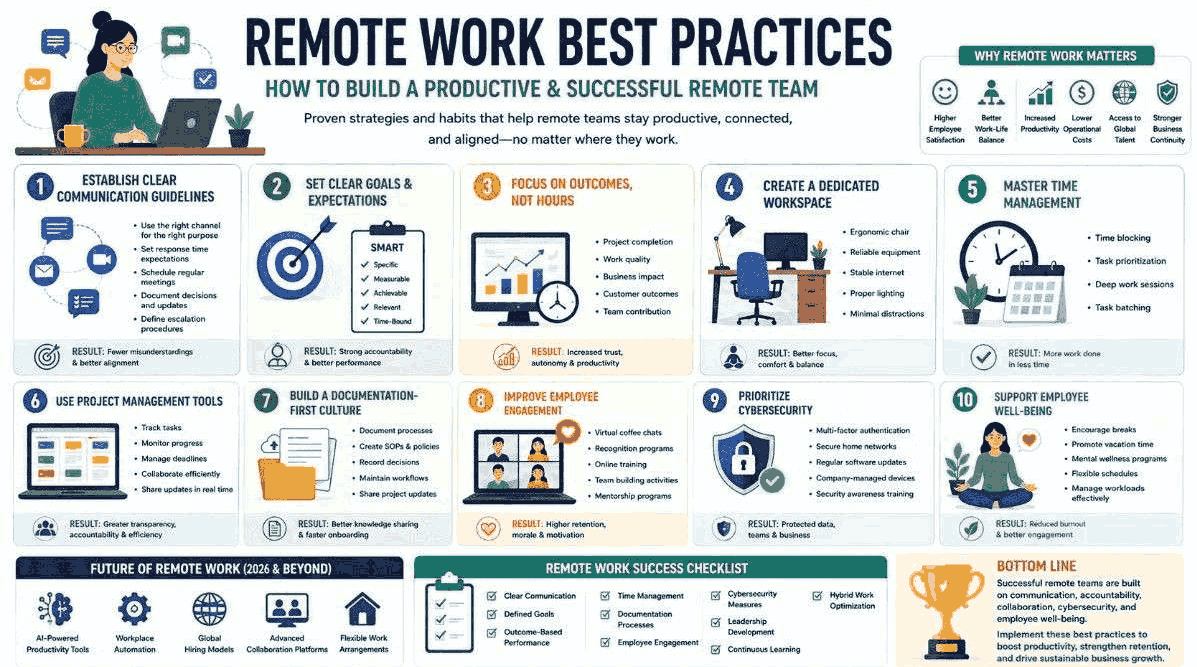
1. Establish Clear Remote Work Communication Guidelines
Communication is where most remote teams quietly fall apart. When people are spread across locations and time zones, information fragments in ways that are hard to notice until something actually goes wrong.
Organizations should nail down:
• Preferred communication channels for different types of messages
• Expected response times and what actually counts as urgent
• Meeting schedules and who needs to be there
• Escalation procedures when something's stuck
• Documentation standards so nothing lives only in someone's head
Instant messaging handles quick questions. Email supports anything formal or that needs a record. Video calls are where actual collaboration happens. Project management platforms track work so people don't have to chase updates manually. None of that is complicated but a lot of teams skip defining it and then wonder why things keep falling through the cracks.
Why It Matters
Strong communication cuts misunderstandings, improves transparency, and keeps teams from spending half their time figuring out what's actually happening. That's not a small thing. Most remote team dysfunction I've seen traces back to this, one way or another.
2. Set Clear Expectations and Measurable Goals
People perform better when they know what's actually expected of them. That sounds obvious, but remote work has a way of making vague expectations feel even more vague. Managers should spell out responsibilities, deadlines, performance metrics, team objectives, and company priorities and not assume people absorbed any of it from a Slack announcement.
The SMART framework still holds up:
• Specific
• Measurable
• Achievable
• Relevant
• Time-bound
Clear expectations reduce the kind of confusion that leads to people working hard on the wrong things. And in distributed teams, that kind of misalignment can run for weeks before anyone notices.
3. Focus on Outcomes Instead of Hours Worked
Traditional offices rewarded visibility. You were at your desk, therefore you were working. Remote work breaks that logic entirely, and the teams that haven't updated their assumptions about it are the ones micromanaging people into misery.
What actually matters is results. Successful organizations shift to evaluating employees on:
• Project completion
• Work quality
• Business impact
• Customer outcomes
• Team contribution
This approach requires trusting people to manage their own time — which turns out to work better than monitoring it did. It encourages autonomy, cuts the performative busyness, and tends to bring out better work from people who know they're being judged on what they actually produce.
4. Create a Dedicated Workspace
One of the more practical work-from-home best practices is also one that gets skipped the most: actually setting up a space that's built for working. Sitting on the couch with a laptop works for a day. It degrades fast after that.
A setup worth building includes:
• Ergonomic seating - back pain is a productivity issue
• Reliable internet access
• Proper lighting
• Minimal distractions
• Whatever equipment the job actually requires
A dedicated workspace also helps with the boundary problem. When your office is your home, it's genuinely hard to stop working. A physical separation — even a corner of a room — gives the brain something to switch off from.
5. Develop Consistent Daily Routines
Remote environments don't have the natural structure that offices do. Nobody's commute signals the start of the day. Nobody else getting up for lunch reminds you to take a break. Routine has to be built deliberately, and the teams that do it well tend to coordinate more smoothly because of it.
Routines that seem to work:
• Consistent working hours the team can actually plan around
• A short daily planning session before diving in
• Scheduled breaks not just remembered ones
• Focused work periods with notifications off
• An end-of-day review to close things out mentally
The consistency matters more than the specific routine. When people know when their colleagues are available and when they're heads-down, coordination stops being a guessing game.
6. Use Project Management Tools Effectively
Managing remote employees is significantly easier when work is visible. That's the whole job of project management tools — making tasks, deadlines, and responsibilities transparent so nobody has to dig through Slack threads to figure out what's actually happening.
Good project management systems help teams:
• Track tasks without chasing people
• Monitor progress before things are late
• Manage deadlines in one place
• Collaborate without meetings
• Share updates asynchronously
When everyone can see project status and who owns what, communication gets faster, decision-making improves, and the usual 'I didn't know that was stuck' conversations happen a lot less often.
7. Improve Remote Work Productivity Through Time Management
Remote work productivity depends heavily on how people manage their time — and left to their own devices, a lot of people don't manage it well. The distractions are different at home but they're just as real.
Time Blocking
Allocate specific blocks for focused work and protect them. Block time on the calendar the same way you'd block a meeting.
Task Prioritization
Figure out the most important work before starting the day. Not during it.
Deep Work Sessions
Dedicate uninterrupted periods to the high-value stuff. Notifications off, tabs closed, the whole thing. Most people I know don't do this nearly enough.
Task Batching
Group similar activities together to reduce context switching. Jumping between ten different types of work all day is exhausting and slow in ways that are hard to see in the moment.
8. Build a Documentation-First Culture
Documentation becomes critical when teams are distributed, and most teams underinvest in it until something breaks. When everyone's in the same building, institutional knowledge lives in conversations. Remote work exposes how fragile that is.
Organizations should document:
• Processes
• Policies
• Decisions and why they were made
• Workflows
• Project updates
The benefits are real and compound over time:
• Faster onboarding because new people can actually find things
• Better transparency across the team
• Knowledge sharing that doesn't depend on the right person being available
• Fewer meetings to explain things that could just be written down
• Scalability when the team grows
A strong documentation culture doesn't happen naturally. It requires some deliberate effort, and usually a few champions who push for it before it sticks.
9. Conduct Purpose-Driven Virtual Meetings
Meeting overload is one of the most common complaints from remote workers, and honestly, it's usually self-inflicted. Most meetings that happen could have been an async message. The ones that can't should have a clear purpose and a defined outcome before they're scheduled.
Practices worth building in:
• Agendas sent in advance not ten minutes before
• Starting and ending on time, every time
• Assigning action items before anyone leaves
• Recording important discussions
• Sharing written summaries after
Purpose-driven meetings improve collaboration without eating the work hours. The goal is to make meetings the exception, not the default response to any unresolved question.
10. Strengthen Remote Employee Engagement
Engagement in remote teams is harder to maintain and easier to lose than most managers expect. It has a direct impact on retention, performance, and morale and by the time it shows up in the data, it's often already been a problem for a while.
Organizations should create real opportunities for:
• Recognition that's visible across the team
• Professional development not just access to courses
• Team interaction that isn't just work
• Career growth with a clear path
• Social connection without it feeling forced
Virtual coffee chats, online workshops, recognition programs, mentoring initiatives, team-building activities these work when they're genuine and consistent, not when they're rolled out as a response to a bad survey score. Employees who feel connected to their organization tend to stay. And that's not a small thing when replacing someone costs as much as it does.
11. Build Trust Through Transparency
Trust is what actually holds remote teams together. And it works in both directions — it has to, or it doesn't work at all.
Managers should:
• Share company updates regularly, not just when something's wrong
• Explain decisions clearly instead of expecting people to accept them
• Encourage open discussion without punishing it
• Provide constructive feedback often enough that it doesn't feel like an event
Employees should:
• Communicate proactively instead of waiting to be asked
• Report progress honestly, including when something's stuck
• Raise concerns early before they become bigger problems
Transparency strengthens the relationships that make distributed work actually function. And without those relationships, even the best tool stack won't hold a team together.
12. Prioritize Employee Well-Being
Remote work blurs the line between professional and personal life in a way that's subtle at first and corrosive over time. Most people don't notice it happening until they're already burnt out.
Organizations should actively support:
• Regular breaks that people actually take
• Flexible schedules where the work structure allows
• Mental wellness initiatives that aren't just a list of resources nobody clicks
• Vacation usage meaning managers shouldn't visibly never take it
• Workloads that are actually sustainable
Supporting well-being isn't just the right thing to do. It directly affects engagement and productivity. Teams that are burned out don't produce great work, and they don't stick around long enough to improve.
13. Implement Remote Work Security Best Practices
Cybersecurity is one of those areas that gets treated as an IT problem until it becomes an everyone problem. Distributed workforces expand the attack surface considerably, and the security habits of individual employees matter in ways they didn't when everyone was on the same corporate network.
Important practices:
Multi-Factor Authentication
Adds a layer of protection for accounts and systems that a stolen password alone can't bypass. Non-negotiable at this point.
Secure Home Networks
Encrypted connections and strong passwords. Most employees' home networks are significantly less secure than they realize.
Software Updates
Regular updates close vulnerabilities before they get exploited. Most breaches aren't sophisticated — they hit systems that were running known vulnerabilities for months.
Company-Managed Devices
Approved devices improve control over sensitive data. Personal laptops used for work are a real risk.
Security Awareness Training
Employees need to understand phishing, social engineering, and what safe online behavior actually looks like in practice. Knowing the theory isn't enough.
Strong security protects business operations, customer data, and the organization's reputation. Most of these measures aren't complicated — the challenge is consistency.
14. Improve Remote Team Management Skills
Managing remote teams isn't just regular management with video calls added. It requires a different set of instincts — less oversight, more intentional communication, and a genuine investment in each person's situation.
Effective remote managers:
• Set clear expectations without micromanaging how they get met
• Provide feedback regularly enough that it's useful, not just formal
• Remove obstacles instead of adding approval layers
• Encourage autonomy and actually mean it
• Support employee growth even when it's not immediately productive for the team
Strong leadership keeps remote teams focused, motivated, and aligned with where the business is actually going. That's harder to do from a distance, but it's also more visible when it's missing.
15. Promote Continuous Learning and Development
The pace of change in most industries right now means skills go stale faster than they used to. Organizations that don't invest in learning end up with teams that are technically capable of doing what they've always done — which is a fine position until something shifts.
Worth investing in:
• Professional certifications
• Leadership development for people who'll need it before they ask for it
• Technical training that's actually relevant to the work
• Industry education
• Online learning programs that people can fit into their actual schedule
Continuous learning helps employees stay competitive while building the organizational capability that makes growth possible. Teams that keep developing tend to retain better too, which isn't a coincidence.
16. Optimize Hybrid Work Best Practices
Hybrid models are, in my experience, more complicated than they look in the pitch deck. They're not just remote work with some office days added back in. They create a two-tier dynamic — office employees who are physically present and remote employees who aren't — and if that's not actively managed, the office employees start getting more face time, more visibility, more informal information. The remote employees notice.
Successful hybrid teams focus on:
• Equal access to information, not just technically available but actually accessible
• Consistent communication standards that don't vary by location
• Shared documentation that everyone uses, not just the remote folks
• Flexible scheduling
• Inclusive meeting practices that don't treat remote participants as an afterthought
The goal is to make location genuinely irrelevant to someone's ability to contribute and grow. Most hybrid teams aren't fully there yet. Some of them are working on it.
Common Remote Work Challenges and Solutions
Communication Gaps
Use centralized communication systems and document important decisions. If a decision only exists in someone's memory, it'll get relitigated later.
Employee Isolation
Increase team interaction and engagement opportunities. This takes more deliberate effort than it sounds, especially for people who find remote work more draining than they expected.
Productivity Issues
Establish clear goals, accountability systems, and performance metrics. Vague expectations produce vague outputs.
Time Zone Differences
Use asynchronous communication and create overlapping collaboration hours. Trying to force real-time coordination across very different time zones usually just exhausts everyone.
Security Risks
Implement cybersecurity training, multi-factor authentication, and device management policies. Security habits are learnable — they just require consistent reinforcement.
Lack of Visibility
Use project management platforms that provide real-time progress tracking. If nobody can see what's happening without asking, something's getting missed.
Remote Work Best Practices Checklist
Use this to check whether your remote work strategy actually covers the basics:
• Clear communication guidelines
• Defined goals and expectations
• Outcome-based performance measurement
• Dedicated workspaces
• Effective time management systems
• Project management tools
• Documentation processes
• Employee engagement initiatives
• Cybersecurity measures
• Leadership development programs
• Continuous learning opportunities
• Hybrid work optimization
The Future of Remote Work
Remote work will keep evolving throughout 2026 and probably beyond in ways nobody's fully mapped out yet.
Key trends worth watching:
• AI-powered productivity tools
• Digital workplace automation
• Advanced collaboration platforms
• Global hiring strategies
• Flexible work arrangements
• Employee experience technologies
Organizations that adapt early will have real advantages in talent acquisition, retention, productivity, and operational efficiency. The ones that wait tend to find out what they missed by watching the companies that didn't. Remote work isn't just about where people sit anymore. It's about whether the systems, culture, and leadership exist to support people doing their best work from wherever they are.
Conclusion
Getting remote work right isn't a checklist problem. It's a culture problem. Technology helps, but the teams that really make it work have figured out something that's harder to name: how to stay genuinely connected to each other and to the work when nobody's physically in the same room.
That requires getting communication right, building real accountability, supporting people's well-being in ways that go beyond policy statements, and investing in security that doesn't assume everyone's on the same network. It requires managers who adapt their approach instead of just moving their office habits online.
By focusing on remote work communication, productivity, employee engagement, virtual team collaboration, remote team management, and security best practices, businesses can build teams that deliver from anywhere. The organizations that get there first tend to attract better talent, perform better, and grow more sustainably. And the ones that treat remote work as a temporary accommodation are still figuring that out.
Frequently Asked Questions (FAQs)
What are the best practices for remote work?
The best practices for remote work include establishing clear communication guidelines, setting measurable goals, using project management tools, maintaining a dedicated workspace, prioritizing cybersecurity, documenting processes, and focusing on employee engagement. Organizations that actually follow through on these not just document them tend to see better productivity, stronger collaboration, and higher employee satisfaction. The gap between teams that treat these as policies and teams that build them into how they actually work is pretty wide.
How can managers improve remote team management?
Managers can improve remote team management by setting clear expectations, focusing on outcomes rather than hours, providing regular feedback, encouraging open communication, and genuinely supporting employee development. The best remote leaders build trust through transparency, create real accountability frameworks, and make sure team members have what they need to succeed. Managing remotely is a learnable skill. But it requires unlearning some habits that worked fine in an office.
How do employees stay productive while working remotely?
Employees can improve remote productivity by building a dedicated workspace, keeping consistent hours, prioritizing tasks before the day starts, minimizing distractions, and using time management techniques like time blocking and deep work sessions. Regular breaks help more than most people expect. Clear daily goals and actual communication with teammates are the other things that tend to make the real difference. Most productivity problems I've seen in remote work trace back to one of those being missing.
Why is communication important in remote work?
Communication in remote work carries a lot more weight than it does in an office, because teams rely almost entirely on digital interactions to share information, collaborate, and stay aligned. Without it, misunderstandings compound, project visibility drops, and people start making decisions in isolation. Effective communication reduces that friction it keeps teams coordinated, maintains accountability, and makes sure people are actually pointed at the same objectives. Most remote team dysfunction traces back to communication somewhere.
What are the most important remote work security best practices?
Multi-factor authentication, secure internet connections, regular software updates, protected company devices, strong passwords, and consistent cybersecurity education for employees. These measures prevent unauthorized access, reduce the risk of data breaches, and protect sensitive business information. None of it is complicated the challenge is doing it consistently rather than treating security as something to set up once and forget.
How can companies improve remote employee engagement?
Companies can improve remote employee engagement by recognizing achievements in ways that are actually visible, encouraging real team interaction, providing meaningful professional development, conducting regular check-ins that aren't purely status updates, and supporting well-being in ways that go beyond a wellness stipend. Building a culture of inclusion and appreciation helps remote employees feel connected to the organization. Whether it works depends a lot on whether leadership models it, not just announces it.
What is the difference between remote work and hybrid work?
Remote work means working entirely outside a traditional office. Hybrid combines remote and in-office work. The difference matters operationally because hybrid creates a two-tier dynamic that takes real effort to manage fairly. Hybrid best practices focus on making sure remote and office-based employees have equal access to communication, collaboration, resources, and career opportunities not just theoretically, but in practice. That's harder than it sounds. Most hybrid models are still working out what that actually looks like.






 Whatsapp
 Email
Email