Job
enquiry:+91-9121642626

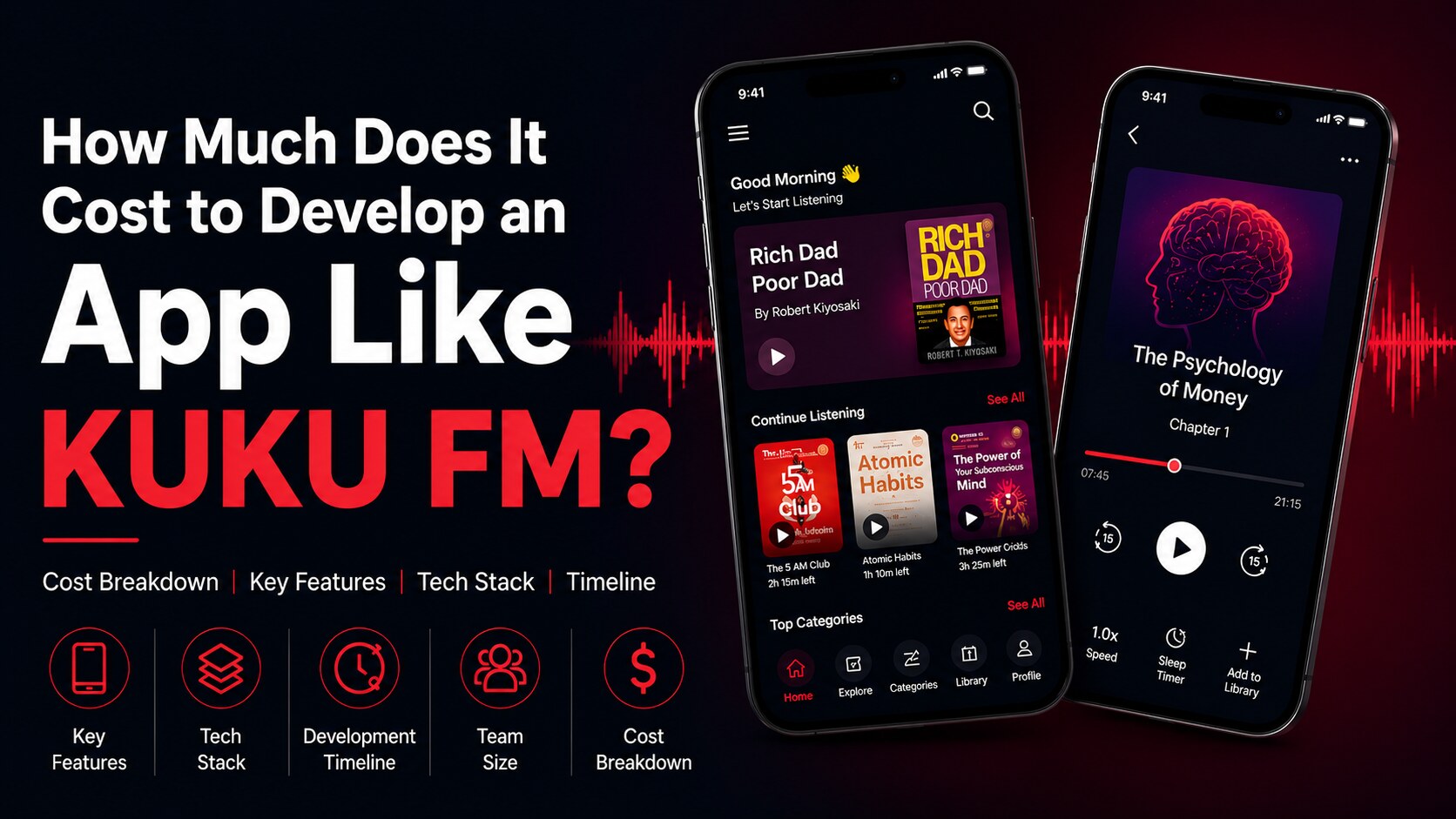
Music App Development: Real Costs, Licensing, and Features
The global music streaming market is worth roughly $23 billion in 2026 and is projected to grow toward $325 billion by 2031. Spotify alone holds about 32 percent of that market, and the top five platforms together control roughly 72 percent of industry revenue. Those numbers explain why building a music app is tempting. What most guides on this topic never explain is the one thing that actually determines whether your project succeeds or gets shut down before it launches: music licensing.
Quick answer: development alone runs $15,000 to $350,000 depending on scope, but that's only half the real number. Licensing, performance rights, master recordings, mechanicals, is a separate cost most estimates leave out entirely, and it's frequently the larger risk of the two. The practical path most successful platforms actually took: launch with independent, artist-owned content that needs no licensing at all, prove the concept, then license broader catalog later.
Here's what building a real music app actually involves, honest costs for both development and licensing, and the practical strategy behind that quick answer.
The part every guide skips: licensing
You cannot build an app and simply start streaming commercially released music. Doing so requires actual legal rights. Getting this wrong doesn't just cost money. It can shut a platform down entirely before it has a chance to grow.
There are four distinct types of licensing to understand. Performance rights, obtained from performing rights organizations like ASCAP, BMI, and SESAC in the US (PRS in the UK, IPRS and PPL in India), cover the right to stream music publicly. Master recording licenses grant rights to stream the actual recorded version of a song, negotiated directly with record labels. Mechanical licenses, administered in the US by the Mechanical Licensing Collective under the Music Modernization Act of 2018, cover the right to reproduce a composition digitally. These matter specifically for offline downloads. Sync licenses are required if music appears alongside video content in your app.
The current US statutory mechanical rate for physical and download reproductions sits at 13.1 cents per unit as of 2026, set by the Copyright Royalty Board. Streaming works differently: mechanical royalties for streaming are calculated as a percentage of service revenue rather than a flat per-stream rate, part of a broader royalty pool that also covers performance rights. PRO fees are commonly structured the same way, as a percentage of platform revenue, often in the 4 to 7 percent range. For a platform reaching real scale, this adds up to a genuine, ongoing cost line, not a one-time fee.
The strategy nearly every successful new platform used
This is the part worth taking seriously if you're starting from zero. Most startups cannot realistically negotiate master recording licenses with major labels at launch, and the successful platforms that started small didn't try to.
SoundCloud launched as a platform for artists to share their own music, no licensing needed, since creators uploading content they own require no third-party license. Bandcamp built an artist-owned sales and streaming platform on the same principle. Audiomack focused specifically on independent hip-hop artists uploading their own tracks. All three reached millions of users before ever dealing with major label licensing.
Building for independent, artist-uploaded content first isn't a compromise. It's the correct product strategy for most new entrants. Once a platform proves real traction, licensing through aggregators like DistroKid, TuneCore, or CD Baby offers access to a broader indie catalog. That's a genuine middle step before, or instead of, full major-label deals, and it costs a fraction of direct label negotiations.
What building the app itself requires
Beyond licensing, the technical foundation has real substance too. Audio streaming needs adaptive delivery similar in principle to video, though considerably lighter on bandwidth. An hour of audio at standard quality runs well under 100 megabytes. That means even a platform with tens of thousands of active listeners faces a real but manageable CDN cost, well short of the scale a video platform deals with. A proper backend needs to handle catalog search, playback state, and reliable streaming without interruption, genuinely difficult to get right at scale even though it sounds simple.
What this costs
Real figures, split honestly between development and licensing, since conflating the two is where most cost estimates go wrong.
Development alone, for an indie-focused platform with offline playback, basic AI recommendations, and subscription billing, typically runs $15,000 to $60,000 for a focused build using an aggregator-based licensing route. A mid-level platform with fuller features and infrastructure typically runs $60,000 to $150,000. A full-featured platform with direct licensing relationships and broader catalog access runs $120,000 to $350,000. Competing seriously with Spotify or Apple Music at real scale, including substantial licensing negotiation, realistically runs $300,000 to $1 million or more.
Licensing costs separately. Initial setup through aggregators for a smaller platform typically runs $5,000 to $50,000, depending on target market and catalog size. That's on top of the ongoing per-stream mechanical rate and PRO revenue-share fees covered above. Anyone quoting a "Spotify clone" for a flat fee with no separate licensing conversation is missing the single largest real cost category in this entire project.
Core features, done properly
Personalized recommendations remain one of the most important features in this category. They're now commonly powered by AI analyzing actual listening behavior rather than simple genre tags, closer to Spotify's Daily Mix or an AI DJ feature than a basic playlist suggestion.
Audio quality tiers, correctly specified. Standard options typically run 96, 160, and 320 kbps. Premium tiers increasingly offer lossless or hi-res audio, a genuine current differentiator for platforms like Apple Music, Amazon Music, and Tidal, not the non-standard rate older guides sometimes cite.
Offline playback lets subscribers download tracks for listening without a connection, commonly capped in the range of several thousand tracks across a limited number of devices on real platforms. It saves data and covers the genuinely common case of poor connectivity.
Collaborative and social listening, shared or collaborative playlists and real-time listening-together features, have become a real expectation rather than a nice-to-have. This follows features popularized by Spotify Blend and similar tools.
Podcast integration is now standard on major platforms rather than a separate category, worth planning for from the architecture stage if you want to compete credibly rather than adding it as an afterthought.
Playlist recovery, letting a user restore an accidentally deleted playlist, remains a genuinely useful, low-effort feature that meaningfully reduces support complaints and user frustration.
Payments and monetization
Subscription remains the dominant model, accounting for roughly 64 percent of industry revenue, though ad-supported tiers are growing faster as platforms compete for price-sensitive users. Building for both from the start, rather than committing to subscription-only, keeps the door open as your user base and strategy evolve.
For payment infrastructure specifically, the options have moved well past a single vendor recommendation. Razorpay, founded by Harshil Mathur and Shashank Kumar, has become one of the most widely used payment gateways for Indian platforms specifically, alongside PayU and global options like Stripe for platforms operating internationally. Real attention to checkout friction matters here regardless of which you choose. Our breakdown of common customer pain points in payments covers exactly the kind of subscription and billing friction that quietly costs a music platform real subscribers.
The bottom line
Building a genuinely competitive music app means treating licensing as seriously as the app itself. It's frequently the larger cost and the larger risk of the two. Starting with independent, artist-owned content, the same path SoundCloud, Bandcamp, and Audiomack all took, is usually the smarter way to prove the concept before taking on the cost and complexity of major label deals.
The technical build itself needs real attention to modern features too, AI-driven recommendations, lossless audio, social listening, that define what a competitive music app actually looks like now.
If you're evaluating what a music app would genuinely cost for your specific concept, that's worth a real conversation. A music app development partner should walk through the licensing strategy honestly alongside the technical build, rather than quoting a number that quietly assumes the licensing problem away.
Frequently Asked Questions
How much does it cost to build a music streaming app in 2026? Development alone typically runs $15,000 to $60,000 for a focused indie-catalog platform, up to $150,000 for a mid-level build, and $120,000 to $350,000 for a full-featured platform with direct licensing. Competing seriously with Spotify or Apple Music at scale can reach $300,000 to $1 million or more. Licensing is a separate cost, commonly $5,000 to $50,000 for initial aggregator-based setup, plus ongoing per-stream and revenue-share fees.
Do I need major label licensing deals to launch a music app? Not at first. Most successful new platforms, including SoundCloud, Bandcamp, and Audiomack, launched with independent, artist-uploaded content requiring no third-party licensing at all. They proved the product before pursuing broader licensing. This is a legitimate, common strategy, not a compromise.
What types of music licenses does a streaming app need? Four main types: performance rights (from PROs like ASCAP, BMI, and SESAC, covering public streaming), master recording licenses (negotiated directly with labels for specific recordings), mechanical licenses (covering digital reproduction, administered in the US by the Mechanical Licensing Collective), and sync licenses (required if music accompanies video content).
What audio quality should a music app offer? Standard tiers typically run 96, 160, and 320 kbps. Premium subscriptions increasingly offer lossless or hi-res audio as a genuine differentiator, following the direction platforms like Apple Music, Amazon Music, and Tidal have taken.
Should a music app use subscriptions or advertising for revenue? Both, ideally. Subscriptions remain dominant, accounting for roughly 64 percent of industry revenue, but ad-supported tiers are growing faster as platforms compete for price-sensitive users. Building for both models from the start keeps options open as the platform and user base grow.
What features matter most for a competitive music app today? AI-driven personalized recommendations, offline playback, lossless or high-quality audio tiers, collaborative and social listening features, and podcast integration are close to standard expectations now, not differentiators, on any platform trying to compete seriously in this category.


 Whatsapp
 Email