Job
enquiry:+91-9121642626
Job
enquiry:+91-9121642626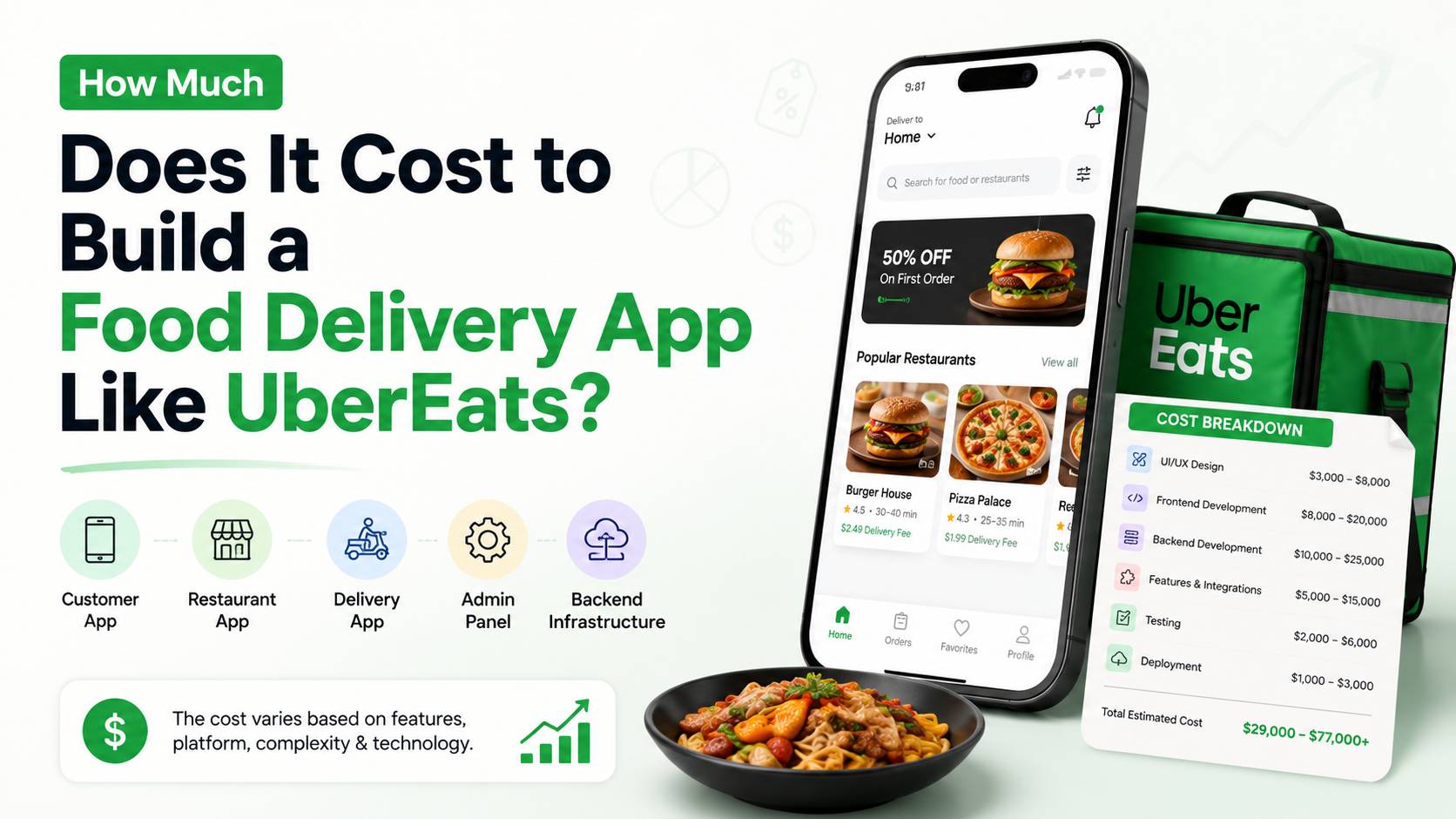
How Much Does It Cost to Build a Food Delivery App Like Uber Eats?
Food delivery is now a global industry worth hundreds of billions of dollars, and it's still growing — which is why so many restaurants, startups, and entrepreneurs want to build their own app like UberEats, DoorDash, Swiggy, or Zomato. The first question is almost always the same: what will it cost? This guide gives you real 2026 numbers, a breakdown of where the money goes, the features you'll need, and how these apps make money.
The short answer
Building a food delivery app like UberEats typically costs between $30,000 and $250,000+, depending on how much you build and where your team is based. As a rough guide:
- Basic MVP (core ordering, one platform, essential features): $30,000 – $60,000
- Mid-range platform (multi-restaurant, real-time tracking, both iOS and Android): $60,000 – $150,000
- Full custom platform (advanced features, AI dispatch, built to scale): $150,000 – $300,000+
If you've seen claims that you can build an app like this for a few thousand dollars, be careful. That price only buys a white-label clone script — a pre-built template with your logo on it, limited customization, and no real ownership of the platform. It's fine for testing a market, but it isn't a custom UberEats-style app.
Why food delivery apps cost more than most apps
A food delivery app isn't one app — it's a system of four connected parts, and that's the single biggest reason it costs what it does. You're building and synchronizing:
- The customer app — where people browse restaurants, order, pay, and track their food.
- The restaurant app or dashboard — where partner restaurants receive orders, manage their menu, and update availability.
- The delivery driver app — where drivers get assigned orders, navigate routes, and update delivery status.
- The admin panel — your control centre, where you manage restaurants, drivers, payments, commissions, and the whole operation.
Each of these needs its own design, development, and testing, and they all have to work together in real time. That's why a food delivery build is one of the more involved app projects you can take on.
Must-have features (and the ones that drive cost)
A competitive 2026 app needs a solid set of features across those four parts. The basics include registration and login, restaurant search and menus, cart and checkout, order management, and ratings and reviews.
The features that add the most to the cost are the technically demanding ones:
- Real-time GPS tracking — so customers can watch their order move toward them, and you can manage drivers. This is core to the experience and one of the bigger cost drivers.
- In-app payments — integrating secure payment gateways and handling multiple methods (cards, digital wallets, and so on), with the compliance that comes with handling money.
- Push notifications — order updates, offers, and driver alerts.
- Live order assignment and dispatch — matching orders to nearby drivers efficiently. Increasingly this is AI-assisted, which costs more but can meaningfully cut delivery times.
The more of these you include, and the more polished you want them, the higher the development hours — and hours are what you're really paying for.
How team location changes the price
Because cost is largely development hours times the team's hourly rate, where your team is based has a big effect. A platform like UberEats can take 2,000+ development hours across all four apps. At Western rates of $100–$150 an hour, that pushes well past $200,000. At Indian or Eastern European rates of roughly $25–$50 an hour, the same build can cost a fraction of that.
This is why many successful food delivery startups use a hybrid model: product ownership and design in their home market, paired with an offshore development team for the engineering. It's a practical way to control cost without giving up quality.
You can also reduce cost by building cross-platform (with Flutter or React Native) instead of separate native apps, which typically cuts development time and budget by 30–50% — a sensible choice for most food delivery MVPs.
How food delivery apps make money
Worth thinking about early, because your revenue model shapes what you build:
- Commission from restaurants — the most common model. The platform takes a percentage of each order, often somewhere between 15% and 30%.
- Delivery fees — charged to the customer for the delivery service.
- Subscription plans — a monthly fee for perks like free or reduced delivery (the model UberEats and DoorDash use with their membership tiers).
- In-app advertising and promoted listings — restaurants pay to appear more prominently.
- Surge or peak pricing — higher fees during busy periods.
Most platforms combine several of these rather than relying on one.
Don't forget the ongoing costs
The build is just the start. Plan for:
- Maintenance — around 15–25% of your build cost per year for updates, fixes, and security.
- Infrastructure — cloud hosting, maps, and payment processing fees, often $500–$2,000 a month early on, rising as your order volume grows.
- Marketing — acquiring both customers and restaurant partners is a significant ongoing cost in a competitive market.
A realistic budget accounts for the first year of running the app, not just building it.
Frequently asked questions
How much does it cost to build a food delivery app like UberEats? Roughly $30,000 to $250,000+. A basic MVP runs about $30,000–$60,000, a mid-range multi-restaurant platform $60,000–$150,000, and a full custom build $150,000–$300,000+, depending on features and team location.
How long does it take to build a food delivery app? A basic MVP typically takes around 4–6 months. A full-featured platform across all four apps can take 8 months or more.
Why are food delivery apps so expensive to build? Because they're really four apps in one — a customer app, a restaurant dashboard, a driver app, and an admin panel — that all have to work together in real time, plus demanding features like GPS tracking and payments.
Is it cheaper to build an app like Swiggy or Zomato? The cost is similar — Swiggy, Zomato, UberEats, and DoorDash are all aggregator-style platforms with the same four-part structure, so they fall in the same range.
Can I build a food delivery app on a small budget? You can start with a lean MVP or a white-label script to test the market, then invest in a custom build once the idea proves out. That's a common, lower-risk path.
Planning your food delivery app
The cost of a food delivery app comes down to how much you build, how advanced the features are, and who builds it. The clearest way to get a real figure is to map out your features and get an itemised estimate.
We build on-demand and food delivery apps end to end — customer, restaurant, driver, and admin. Learn more about our food delivery app development services, or read our general guide to app development cost for the bigger picture. Ready to talk specifics? Get in touch for a free consultation.






 Whatsapp
 Email
Email