Job
enquiry:+91-9121642626
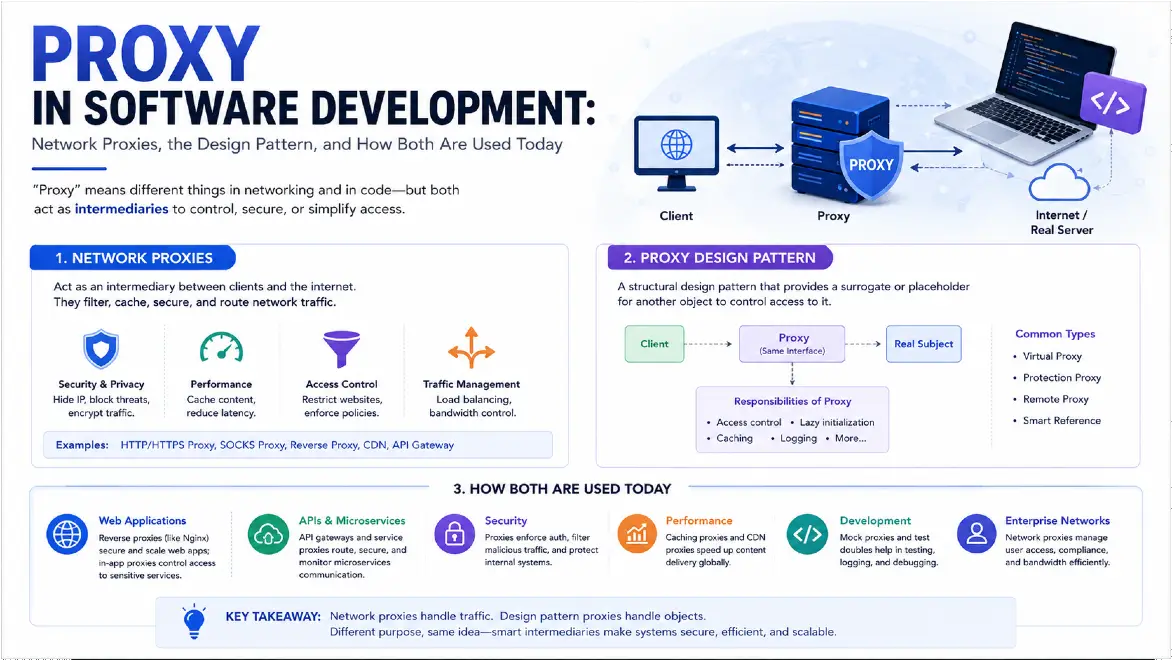
Proxy in Software Development: Network Proxies, the Design Pattern, and How Both Are Used Today
The word "proxy" actually covers two distinct things in software development, and most articles on this topic only ever explain one of them. There's the network proxy, a server that sits between a client and a destination, intercepting, forwarding, or modifying traffic. And there's the Proxy design pattern, an object-oriented pattern where one object stands in for another, controlling access to it. They share a name because they share a concept, standing in for something else, but they solve different problems at different layers of a system, and a genuinely complete explanation of "proxy in software development" needs to cover both.
This guide does that, and also covers where proxies show up in the parts of software development that have changed the most recently: service mesh architecture in modern microservices, and the increasingly central role proxies play in how teams manage AI and large language model API traffic.
Network proxies: the four types that matter
At the network level, a proxy is an intermediary that sits between a client (a browser, an app, a script) and a server, intercepting, modifying, or forwarding requests. This "middleman" function lets engineers inspect traffic, simulate server responses, inject faults for resilience testing, and isolate network components in ways that would otherwise be impractical or insecure.
Forward proxy. Sits in front of a client, forwarding that client's requests out to the internet, often used for anonymization, access control, or routing traffic through a specific network path. Common in web scraping, API testing, and situations where a client's own IP or location needs to be masked or controlled.
Reverse proxy. Sits in front of one or more servers, receiving client requests and routing them to the appropriate backend. This is the workhorse of production infrastructure: load balancing across multiple server instances, SSL termination, and request routing. Tools like NGINX and HAProxy have handled this role for years and remain widely used, particularly for simpler, more traditional deployments.
Transparent proxy. Intercepts traffic without the client needing any configuration change, commonly used for content filtering, monitoring, and policy enforcement at a network or organizational level, tools like Cisco Umbrella or Zscaler operate this way.
Intercepting proxy. Purpose-built for inspecting and modifying traffic on the fly, the tool of choice for debugging. Charles Proxy and Fiddler are the standard tools here, letting a developer route an app's traffic through the proxy and see, or alter, every request and response in real time.
| Proxy Type | Primary Use Cases | Common Tools |
|---|---|---|
| Forward Proxy | API testing, web scraping, request anonymization | Proxifier, Squid |
| Reverse Proxy | Load balancing, SSL termination, route management | NGINX, HAProxy, Envoy |
| Transparent Proxy | Content filtering, monitoring, policy enforcement | Cisco Umbrella, Zscaler |
| Intercepting Proxy | Debugging, mobile API monitoring, request manipulation | Charles Proxy, Fiddler |
The Proxy design pattern: a different meaning, equally important
Separate from network infrastructure entirely, "Proxy" is also one of the classic structural design patterns from object-oriented programming, where a proxy object controls access to another object, standing in for it and adding behavior around it without the calling code needing to know the difference.
Three variants come up most often in real systems:
Virtual proxy. Delays creating an expensive object until it's actually needed. A common example is an image gallery where full-resolution images aren't loaded into memory until the user actually scrolls to them, a lightweight proxy object stands in for each image until that point, and creates the real, resource-heavy object on demand.
Protection proxy. Controls access to an object based on permissions, checking whether the calling code is authorized before forwarding a request to the real object, useful for adding an authorization layer without scattering permission checks throughout a codebase.
Remote proxy. Represents an object that lives in a different address space, often on a different server entirely, making a remote call look and behave like a local method call from the calling code's perspective. This is conceptually the bridge between the design pattern and the network proxy discussed above, a remote proxy is often implemented using the same interception principles a network proxy uses, just expressed as an object in code rather than infrastructure sitting between servers.
Understanding both meanings matters in practice. A team discussing "adding a proxy layer" during an architecture conversation could reasonably mean either one, and confusing them, treating a design pattern conversation as though it's about network infrastructure, or vice versa, leads to real miscommunication during technical planning.
Proxies for testing and debugging
This is where proxies earn their reputation as one of the more genuinely useful tools in a developer's kit. Testing a modern software system without them means giving up a meaningful amount of visibility into what's actually happening on the wire.
Want to test how an app handles slow or dropped connections? A proxy can simulate that directly, without needing to actually degrade your real network. Need to debug a mobile app's API calls? Route the traffic through an intercepting proxy, and every request and response becomes visible and inspectable, including headers, payloads, and timing, information that's otherwise invisible from inside the app itself.
This is a genuinely common technique in mobile app debugging specifically: a misformatted header, an unexpected payload shape, or a timing issue that only appears under specific network conditions is often invisible in application logs but immediately obvious once traffic is routed through Charles Proxy or Fiddler. This kind of deep, request-level visibility is a core part of the diagnostic toolkit any experienced mobile app development company relies on when a client's app is misbehaving in ways that don't show up cleanly in standard error tracking.
One of the most powerful applications here is man-in-the-middle (MITM) testing, where the proxy inspects and, if needed, modifies HTTP traffic in transit rather than just observing it. This lets a developer simulate server responses that would otherwise be difficult to reproduce, an error condition, an edge-case payload, a slow response, directly, rather than waiting for the real backend to happen to produce that scenario naturally.
Proxies in microservices and service mesh architecture
If a project involves microservices, proxies become central to how the whole system actually communicates, and this is an area where the standard advice on this topic has genuinely moved on in the last few years.
Traditional reverse proxies like NGINX and HAProxy still handle load balancing, SSL termination, and routing at the edge of a system, and they remain solid, widely used choices, particularly for simpler architectures. But the more current pattern in serious microservices deployments is the service mesh, where a lightweight proxy, most commonly Envoy, runs alongside every individual service instance as a "sidecar," handling all inbound and outbound traffic for that service.
This sidecar pattern, orchestrated by a service mesh control plane like Istio or Linkerd, decouples networking concerns, retries, timeouts, circuit breaking, mutual TLS encryption between services, observability, from application code entirely. Instead of every service implementing its own retry logic and its own encryption handling, the sidecar proxy handles it uniformly across the whole system, which is a meaningfully cleaner architecture than the older pattern of embedding this logic directly into each service.
This connects directly to a challenge worth being honest about: distributed systems, whether built as microservices or not, are genuinely harder to debug and secure than a single monolithic application, and a well-implemented service mesh is one of the more effective ways teams manage that complexity at scale, giving uniform visibility and control over inter-service traffic rather than each service handling networking concerns independently and inconsistently.
Proxies also help with something less glamorous but genuinely useful day to day: simulating different environments, staging, development, QA, by rerouting requests without touching backend logic, letting a team test against different configurations without the overhead of maintaining fully separate infrastructure for each one.
Proxies for AI and LLM applications
This is the area where proxies have become newly important in the last couple of years, and it's a use case most existing content on this topic hasn't caught up with yet.
API cost and rate limit management. LLM API calls are billed per token and rate-limited per provider, and a proxy layer sitting between an application and the underlying LLM provider is now a common way to manage both. Rather than every part of an application calling an AI provider directly, a centralized AI proxy can track usage, enforce budget limits per feature or per customer, cache repeated or similar queries to avoid paying for the same computation twice, and apply consistent rate limiting so one runaway process can't exhaust an entire API quota.
Multi-provider routing. Teams increasingly use more than one LLM provider, for cost, for redundancy, or because different models genuinely perform better on different tasks. A proxy layer can route a given request to the appropriate provider based on the task, automatically fail over to a backup provider if the primary is down or rate-limited, and give the rest of the application a single, consistent interface regardless of which underlying model actually handled the request.
Security and access control for AI agent tool-calling. As AI agents are increasingly given the ability to call external tools and APIs autonomously, a proxy layer sitting between the agent and those tools provides a genuine control point, logging every call the agent makes, enforcing which tools and endpoints it's actually permitted to reach, and catching unexpected or malicious behavior before it reaches a production system. This is a rapidly growing area of concern as AI agents take on more autonomous responsibility, and it's exactly the kind of architectural discipline a genuine AI software development company needs to build in from the start, not retrofit after an agent does something unexpected.
Caching AI responses. Because LLM calls are comparatively slow and expensive relative to a typical API call, a caching proxy that recognizes similar or repeated queries and serves a cached response where appropriate can meaningfully cut both latency and cost, particularly for applications with predictable, frequently repeated query patterns.
This is a genuinely fast-moving area, and it's worth treating AI-related proxy infrastructure as its own deliberate architectural decision rather than assuming the same reverse proxy setup handling normal web traffic is automatically well suited to it, the traffic patterns, cost structure, and failure modes of LLM API calls are different enough to warrant real, separate design attention.
Securing applications at the edge
Security is not a checkbox in modern development, it's an architectural priority, and proxies play a real role here. They shield origin servers from direct exposure, enforce authentication protocols before traffic reaches application logic, and filter unwanted traffic before it ever hits a backend service.
Rate limiting and DDoS protection are core to this. Placing a proxy at the entry point of a system gives direct control over how clients interact with the underlying infrastructure, reducing the risk of abuse or overload before it ever reaches application code.
Proxies are also increasingly paired with Web Application Firewalls (WAFs) to form a genuine two-layer defense. A WAF blocks common, well-known attack patterns like SQL injection or cross-site scripting, while a proxy ensures sensitive endpoints aren't directly exposed to begin with. Together, this meaningfully reduces the attack surface, particularly for public-facing APIs that need to be reachable by legitimate clients while staying protected from everything else.
Using proxies for global testing and development
Need to test geolocation features, validate performance across regions, or gather region-specific data? Proxies make this possible without needing infrastructure physically located in each target region. By routing traffic through different geographical nodes, a team can simulate diverse user scenarios and catch hardcoded assumptions about network behavior or regional availability before they become real production bugs affecting actual users in those regions.
When integrating proxy infrastructure into a real production stack, dedicated proxy providers like proxys.io offer a range of proxy types built specifically for development, testing, and automation use cases, worth evaluating alongside self-managed options depending on your team's operational capacity and specific requirements.
Why every development team should have a real proxy strategy
Pulled together, here's what a deliberate approach to proxies actually buys a team:
- Simulating different environments and edge cases without touching application code
- Monitoring and debugging traffic with real, request-level precision
- Isolating services for cleaner, more maintainable architecture
- Automating testing across regions and varied network conditions
- Enforcing security and limiting unnecessary exposure at the edge
- Managing AI and LLM API costs, routing, and access control deliberately rather than ad hoc
Proxies in software development aren't a niche infrastructure detail anymore, they're foundational to how modern systems are tested, secured, and, increasingly, how AI capability is integrated responsibly. Whether the conversation is about a reverse proxy handling production traffic, a sidecar proxy in a service mesh, an intercepting proxy debugging a mobile app's API calls, or a proxy layer managing cost and access control for LLM traffic, the underlying principle is the same: a deliberate intermediary layer, placed correctly, gives a team visibility and control that would otherwise be difficult or impossible to get.
Frequently Asked Questions
What is a proxy in software development? A proxy is an intermediary that stands in for something else. At the network level, it's a server that sits between a client and a destination, intercepting, forwarding, or modifying traffic, used for testing, security, and performance. In object-oriented programming, the Proxy design pattern is a structural pattern where one object controls access to another, used for things like lazy loading, permission checks, or representing a remote object as if it were local.
What's the difference between a forward proxy and a reverse proxy? A forward proxy sits in front of a client and forwards that client's outgoing requests, commonly used for anonymization or controlled access to external resources. A reverse proxy sits in front of one or more servers and routes incoming client requests to the appropriate backend, commonly used for load balancing, SSL termination, and traffic management in production systems.
What is the Proxy design pattern used for? It's used to control access to an object without the calling code needing to know the difference. Common variants include virtual proxies (delaying creation of an expensive object until it's actually needed), protection proxies (checking permissions before allowing access), and remote proxies (making a call to an object on a different server look like a local method call).
How are proxies used in microservices architecture? Beyond traditional reverse proxies handling load balancing and routing at the edge, modern microservices deployments increasingly use a service mesh, where a lightweight sidecar proxy (commonly Envoy, orchestrated by Istio or Linkerd) runs alongside each service instance, handling retries, encryption, and observability uniformly across the whole system rather than each service implementing this logic independently.
How are proxies used with AI and LLM applications? Increasingly, as a control layer between an application and the underlying AI provider: managing API costs and rate limits, routing requests across multiple providers for redundancy or task-specific performance, enforcing security and access control for AI agents calling external tools, and caching repeated queries to reduce latency and cost. This is one of the fastest-growing use cases for proxy infrastructure as more applications integrate AI capability.
Do proxies improve application security? Yes, meaningfully. Proxies shield origin servers from direct exposure, enforce authentication before traffic reaches application logic, and enable rate limiting and DDoS protection at the entry point of a system. Paired with a Web Application Firewall, a proxy layer forms a genuine two-layer defense that reduces the attack surface for public-facing applications and APIs.







 Whatsapp
 Email