Job
enquiry:+91-9121642626
Job
enquiry:+91-9121642626
Software Development Life Cycle (SDLC): Phases, Models, and Best Practices
The Software Development Life Cycle (SDLC) is the foundation of every successful software project. Whether you're developing a mobile app, enterprise platform, SaaS product, or custom business solution, following a structured software development process helps ensure better quality, faster delivery, and reduced project risks.
However, many businesses struggle to choose the right SDLC model, understand the different development phases, or determine which methodology best fits their project requirements. From traditional Waterfall development to modern Agile and DevOps approaches, each model offers unique advantages depending on project goals and complexity.
In this guide, you'll learn what the Software Development Life Cycle is, why it is important for businesses, the seven key SDLC phases, popular SDLC models, differences between Agile and Waterfall methodologies, testing and quality assurance practices, common implementation challenges, and best practices for successful software development. We'll also explore how Tvisha Technologies follows a structured SDLC approach to deliver scalable, secure, and high-performing software solutions.
What Is SDLC?
Software Development Life Cycle (SDLC) refers to a systematic approach employed in the tech world in the development of software. In simpler terms, SDLC refers to a framework designed to ensure that work is done efficiently, costs reduced, and ensures that all software developed conforms to set standards. The systematic process ensures that there are specific measures set out to determine what should be done throughout the development process.
Ultimately, the aim is to develop a quality software product that not only meets expectations but does so within set budgets and timelines. In addition, SDLC makes the entire process much easier for developers. The systematic process avoids looking at the coding process as a one-time unpredictable process and instead views it as a journey that ensures that software produced is updatable and secure.
Why Businesses Need a Software Development Life Cycle
Using the proper software development process is absolutely necessary for every business striving to maintain itself on the contemporary IT market. In case there is no process, various problems could emerge during project implementation. One might encounter cost overruns, delays, or even software failing to satisfy customers' expectations. The proper software development process provides all stakeholders with the vision of the whole project, which will help managers allocate tasks, estimate time frames, and solve problems.
In addition, an appropriate process allows different participants collaborate successfully within a single project. It becomes easier for product managers, graphic designers, developers, and testers to understand each other. What is more important, the proper process guarantees the security of software products. All security aspects will be tested and analyzed constantly during the process of software building.
The 7 Phases of the Software Development Life Cycle
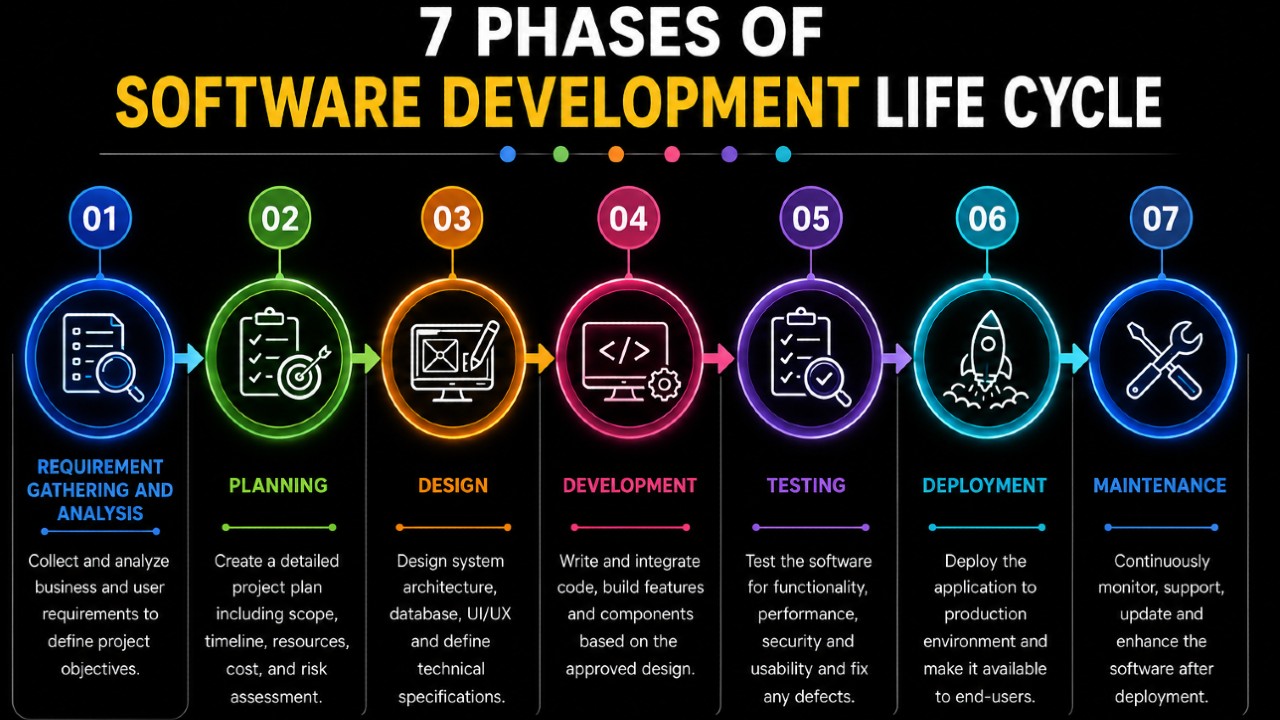
To build great software, the SDLC breaks the work down into seven connected steps. Each step relies on the work done in the step before it.
1. Gathering and Analyzing Requirements
During the first stage, the whole team of project members including business executives, product managers, and clients discuss all the requirements to ensure that the software corresponds to users' needs and meets all the requirements set up by the organization. The team studies the necessary technologies, integration with external applications and databases, and the app's speed. All the data is summarized in one requirements document that will guide the team throughout the whole process and avoid changes in its initial plan.
2. Planning
After defining the objectives, business executives and senior software developers consider the scale of the project, staff number, budget, and deadlines. Possible risks such as delay in timeframes or shortage of tools are discussed as well. A precise schedule is made which makes it possible for business owners to clearly understand how their money is spent.
3. Design
At this stage, conceptual ideas translate into technical documents. Designers come up with high-level diagrams describing the overall structure of the system together with detailed designs for specific functionalities. Meanwhile, designers develop rough layouts and clickable prototypes ensuring usability of the software. Then senior specialists verify all the documents to ensure the future product will be highly performant, secure, and scalable until development begins.
4. Development
During this process, coders develop the source code based on the designs. The project team divides its efforts among developers working on the front-end codebase, backend, and database. Software engineers stick to basic and clear coding conventions that simplify maintenance in the long term. Moreover, developers conduct peer reviews to eliminate logical errors and automate tests.
5. Testing
After developing the application, it is sent to the testing team. The testers examine the software for any glitches, potential security risks, and lengthy loading times. They also test the application on several devices to check for integration issues and then send it back to developers with fixes. It is then passed on to the subsequent phase when all quality and user requirements have been met
6. Deployment
Once the application has passed through the testing phase, it is now time to deploy the software. Teams use automation to ensure deployment is smooth and does not interrupt services. Depending on the software infrastructure in place, they either do a full release to limited users or roll out updates silently. The server team ensures the software is scalable enough to handle high loads for global access.
7. Maintenance
The journey does not stop when the app is launched. After release, a support team watches over the app to make sure it stays running. They fix any surprise bugs, add security updates, and keep server costs low. They also listen to user feedback to plan future updates, making sure the app stays useful and popular for a long time.
Popular Software Development Life Cycle Models
Different teams use different SDLC models depending on how complex the project is, how big the team is, and how quickly the software needs to be built.
Waterfall Model
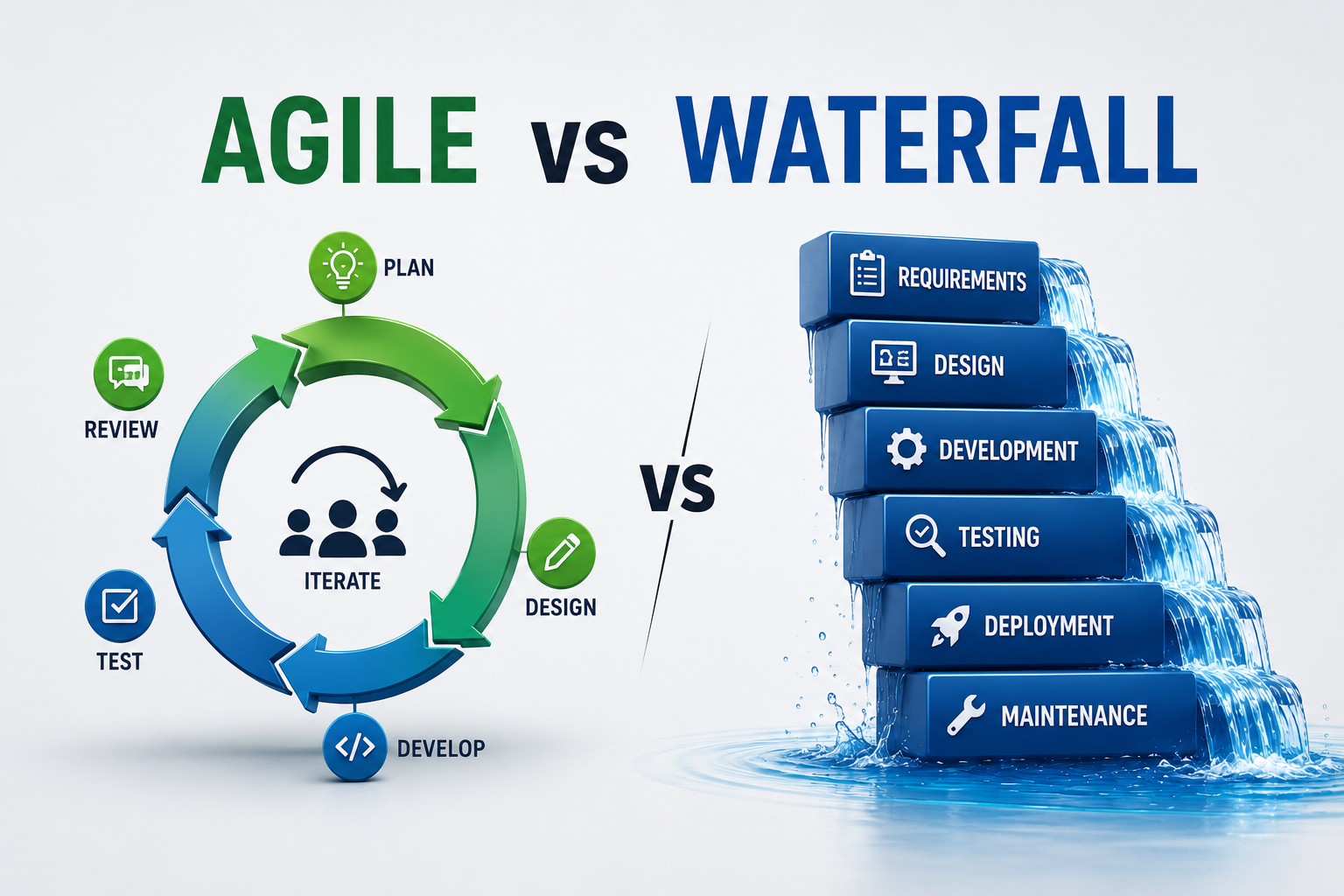
This is a traditional, step-by-step method where you must finish one phase completely before moving to the next. You cannot go backward or overlap steps. All requirements are locked in at the very start. While this makes the project very easy to plan and understand, it makes it very hard and expensive to change your mind or add new features later on.
Agile Model
This Agile Model, is flexible method where teams build software in small, repeated chunks called "sprints" (usually lasting two to four weeks). Instead of waiting until the very end to release the whole app, the team releases small working pieces continuously. This allows them to easily adapt to user feedback, lower risks, and improve the app step by step with close teamwork.
Iterative Model
The Iterative model focuses on getting a basic version of the software out quickly, then improving it over and over in cycles. Instead of knowing every single detail on day one, the team builds a core set of features, sees how it performs, and adds more functions in the next cycle. This works well for large apps where you want to test the main idea first.
Spiral Model
This model mixes the repeating cycles of Agile with the strict steps of Waterfall, with a strong focus on spotting risks early. The project goes through four steps over and over: planning, risk check, building, and review. This helps teams build better versions of the software while keeping an eye out for budget or technical problems. It is great for huge, critical projects.
V Model
The V-model builds on the step-by-step Waterfall method but pairs every building step with a testing step. The process looks like the letter "V". One side goes down to plan and build the app, and the other side goes up to test it. This means testing starts from day one, which helps catch mistakes early and makes the software much more reliable.
Incremental Model
This model breaks the project into small, separate pieces. The team builds, tests, and releases one piece at a time. Each new step adds a working feature to the main app. This lets businesses launch a basic version quickly while building the extra features later, saving money and time.
DevOps Model
This model brings the programming team and the IT operations team together. It relies on automated testing, quick releases, and constant system monitoring. By automating everything, teams can push updates out safely, quickly, and without breaking the app. It makes the whole software creation process fast and smooth.
Agile vs Waterfall in the Software Development Life Cycle
Choosing between Agile and Waterfall Model is a big decision for any tech team. It changes how you manage time, people, and risks.
|
Feature |
Agile Model |
Waterfall Model |
|
How it works |
Done in short, flexible steps. |
Done in strict, one-way steps. |
|
Requirements |
Can change based on feedback. |
Locked in at the start. |
|
Release schedule |
Small updates released often. |
One big release at the very end. |
|
Managing risk |
Low; bugs are found quickly. |
High; big problems can pop up late. |
|
Client involvement |
High; talking and reviewing daily. |
Low; mostly at the start and end. |
Pros and Cons
The Agile Model is great at adjusting to changes, getting the product out fast, and keeping customers happy. However, it can lead to endless changes if you are not careful, and it requires team members to be available to talk every day.
The Waterfall Model is very easy to plan, with clear budgets and simple handbooks for new team members. The downside is that it is rigid. Changing anything late in the project is very costly, and clients do not see the app until the very end.
Which Model Should Businesses Choose?
Pick the Waterfall model if your project is simple, requirements will not change, and you need to follow strict industry rules. Pick the Agile model if you are building something new where you need to adapt to user feedback, launch quickly, and update features regularly.
SDLC Testing and Quality Assurance
It is important to keep in mind that testing does not come towards the end when preparing to launch the application; it is a continuous process. It is best to be modern and conduct testing at an early stage. A simple bug discovered early is less expensive than fixing corrupted code at the final stage.
Efficient testing implies both automated and manual testing processes. In the first case, software is being tested automatically, while humans take care of the actual experience of using the app. Testing is conducted in terms of performance, security, and stability in order to prevent crashes under heavy loads.
Common Challenges in the Software Development Life Cycle
Even with a solid plan, teams often run into common problems:
- Scope Creep: Adding new features without increasing the budget or time. This slows down the project and exhausts the team.
- Bad Communication: When clients, managers, and programmers do not talk clearly, you end up with an app that nobody wants to use.
- Ignoring Risks: Forgetting about technical limits or old systems early on leads to missed deadlines and surprise costs.
- Technical Debt: Rushing code to meet a deadline without cleaning it up later. This creates fragile software that costs a lot to fix in the future.
Note: To avoid these problems, teams need clear change rules, organized project
files, and regular meetings.
Best Practices for Successful SDLC Implementation
To get the most out of your software development process, follow these simple rules:
- Set Clear Rules: Make sure every feature request is clear and has an approved checklist before programmers start typing code.
- Keep Code Clean: Use style guides and check each other's work so the code is easy for anyone to read and update.
- Automate Your Work: Set up tools to build and test code automatically. This cuts down on human mistakes and saves time.
- Focus on Security Early: Look for security issues while writing code, rather than waiting until the end.
- Document Everything: Keep your system plans and user guides up to date so the app is easy to maintain later.
How Tvisha Technologies Follows the Software Development Life Cycle
Tvisha Technologies uses a clear, proven process to build safe, fast, and scalable software that matches their clients' business goals.
Requirement Analysis Approach
Project management at Tvisha Technologies begins with thorough listening sessions. Specialists and clients get together to analyze the demands of the business and the users. Everything that comes up in the process gets recorded in a requirement document to ensure accuracy and a proper road map right from the beginning.
Agile Development Methodology
Tvisha Technologies uses Agile to build software flexibly. They split large projects into short, manageable steps. This allows clients to see working features early, give feedback, and change directions smoothly without spending extra money.
Quality Assurance Process
Quality checking is built into every step of Tvisha Technologies' workflow. Testers plan their checks from the first day of the project. By mixing automated testing with manual reviews, the team ensures every release is secure, fast, and works on all devices.
Post-Deployment Support
After deploying your application, Tvisha Technologies remains with you to monitor performance, debug any unforeseen glitches, and update the system. This ensures smooth functioning and future scalability of the systems.
Future Trends in Software Development Life Cycle
The approach to developing software has changed with technology. Perhaps the most important factor of change is artificial intelligence (AI), whose tools assist programmers in coding quickly, designing tests, and spotting defects prior to their doing any harm.
Also, more simplified tools are emerging which allow firms to design basic environments without hiring a large number of developers. At the same time, security features have been integrated into the initial coding process – this is called DevSecOps. With the rise of cloud environments, changes have emerged concerning software architecture, making it efficient, scalable, and globally accessible.
Conclusion
The Software Development Life Cycle continues to serve as the foundation of software development that is exceptional. It is important due to the way it allows organizations to split complex processes into smaller, more structured tasks, thus ensuring that teams have what it takes to manage their projects effectively. Regardless of whether one prefers the traditional Waterfall model, Agile, or DevOps, a good approach will be crucial in dealing with various risks associated with software development.
FAQs
1. Which phase in the Software Development Life Cycle is considered the most important one and why?
Requirement gathering is the most important phase in the SDLC process because all its aspects and constraints are established there. In case the participants fail to make an accurate decision or overlook some aspects during this initial stage, all following steps will be affected negatively causing problems such as improper software design, poor coding, unnecessary costs, and overdue release schedule. Drafting a well-written requirement plan ensures the communication between business and IT departments, which becomes the key foundation for the whole project.
2. What distinguishes the DevSecOps model from other SDLC methodologies?
In previous development processes, security testing was done only at the end of a project, just prior to launching. The problem with this approach is that it might cause significant delays if any major security gaps were detected at the last stage. In the DevSecOps methodology, security tests are performed during all phases of the software development life cycle. Automatic scanning of security is done behind the scenes while programming. As a result, programmers are able to detect security vulnerabilities and fix them straight away.
3. Explain the concept of scope creep in software development and how SDLC can help prevent it.
Scope creep refers to the uncontrolled addition of features to the software during the development process while leaving the budget and deadline the same. The SDLC approach helps counter this phenomenon by having a strict requirement document set from the beginning of the software development process. In case someone wants to add any feature, he or she must go through a formal review process on the basis of which its time and cost implications are determined. This helps preserve the time of the team members and makes things clear.
4. Under what circumstances would you recommend the use of the V-model instead of Waterfall methodology in a business environment?
It would be best to consider the V-model approach rather than Waterfall if there is need to develop projects in which quality is essential and there is no tolerance for any fault. Moreover, it is required that the requirements should remain the same throughout the process of development. The reason behind it is the fact that V-model links the phases of developing the software to its testing phases right from the start.
5. Why is Post Deployment Maintenance stage crucial for enterprise software applications?
The launch of the app does not mark the end but only the beginning of its existence. It is important to have a phase of maintenance in order to ensure safety, stability, and speed of the enterprise software application over time. Bugs will be found by real users, changes in external systems may happen, as well as demands on the server will increase. This phase includes monitoring of the app, fixing vulnerabilities, updating data bases, and ensuring code compatibility with other devices.
Useful links:
https://www.ibm.com/think/topics/sdlc - (Software Development Life Cycle (SDLC)
https://aws.amazon.com/devops/what-is-devops/ - ( DevOps methodology)
https://www.atlassian.com/agile -( Agile software development)
https://devguide.owasp.org/en/02-foundations/02-secure-development/ -(secure software development practices)
https://www.gartner.com/en/information-technology -(software development methodologies)
https://www.udemy.com/course/complete-sdlc-software-development-life-cycle-sdlc/ - ( sdlc certification course)


.png)





 Whatsapp
 Email
Email