Job
enquiry:+91-9121642626
Job
enquiry:+91-9121642626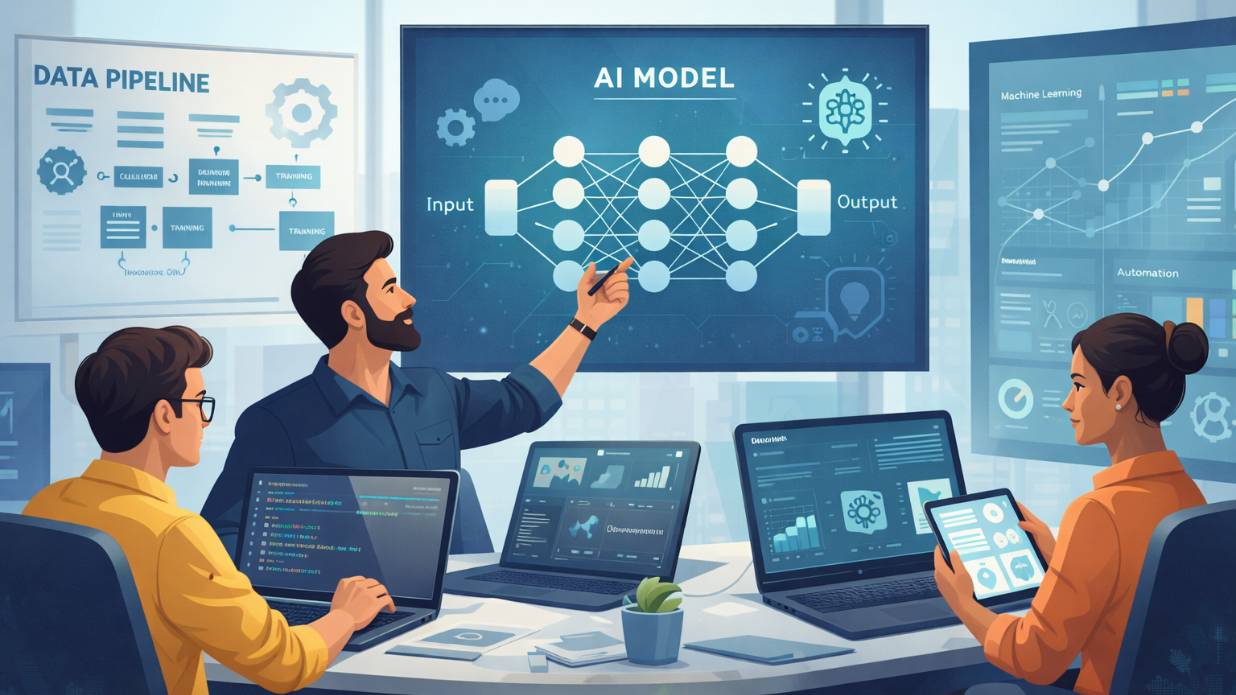
How AI Software Development is Transforming Enterprises in 2026
By 2026, artificial intelligence is not only a research and development technology that is normally found in innovation labs. AI has become one of the integral components of software development that is changing the face of how businesses function and compete on an entirely new digital platform of efficiency and innovation.
Businesses in different sectors such as manufacturing, finance, healthcare, retail, logistics, and SaaS are increasingly adopting AI within their software infrastructure to address key business issues. The uniqueness of 2026 lies in the fact that it does not only have access to better models of AI but to well-developed architecture for AI in business.
This in-depth resource is set to uncover the ways in which AI Software Development is altering the business model for enterprises in the year 2026 and the upcoming future of it.
Understanding AI Software Development in the Enterprise Context
AI software development: This denotes developing, creating, implementing, or maintaining software applications for learning, reasoning, predicting, or making decisions through artificial intelligence solutions. In business terms, AI development encompasses far more than just chatbots or automaton solutions.
It includes:
- Machine learning models to make predictions and recommendations.
- Text and speech understanding by means of NLP
- Computer vision to interpret images and video
- Intelligent Automation and Robotic Process Automation
- Generative AI for content, code, and insights
Enterprise-grade AI software is scalable, secure, compliant, and deeply integrated with business workflows. That's why AI in enterprise software has turned out to be a strategic investment rather than a tactical experiment.
Why 2026 Is a Turning Point for Enterprise AI
Several factors have conspired to make 2026 a landmark year for AI-driven digital transformation:
1. Maturity of AI Models
Modern AI models are more accurate, explainable, and adaptable than ever before. Enterprises now trust AI systems to support high-stakes decisions.
2. Cloud-Native and Hybrid AI Architectures
AI software development has evolved to support hybrid and multi-cloud environments, making deployment flexible and cost-effective.
3. Enterprise Data Readiness
There has been significant investment in data engineering, governance, and analytics by organizations that have enabled AI systems to provide important insights.
4. Responsible & Compliant AIFrameworks
Today, ethics in AI, data privacy, and regulatory issues are being made part of corporate-world AI development solutions.
These contribute cumulatively to speeding up the future development of AI in large-scale businesses.
Key Ways AI Software Development Is Reshaping Businesses
1. Intelligent Automation of Business Processes
Among the most direct effects that AI software development has offered for organizations is intelligent automation. Unlike traditional automation, such systems are able to change, evolve, or improve by learning.
Examples include:
- Automating invoice processing using NLP And ML
- AI-powered customer services systems able to answer customer inquiries on their own
- Intelligent workflow management across different departments
This helps in cutting costs, eliminating the possibility of errors, and giving staff time to concentrate on high-level tasks.
2. Predictive Analytics and Smarter Decision-Making
The use of artificial intelligence predictive analytics has revolutionized the way enterprises undertake decision-making processes. Before this technology, enterprises used to focus on reporting and reviewing past results but now look ahead before actions are taken.
AI enables:
- Demand forecasting in supply chains
- Predictive maintenance in manufacturing
- Risk analysis in finance and insurance
- Customer churn prediction in SaaS and telecom
By combining business intelligence with AI, enterprises gain real-time insights that drive proactive decision-making.
3. Personalized Customer Experiences at Scale
In 2026, personalization is no longer optional. AI software development allows enterprises to deliver highly customized experiences across digital touchpoints.
Use cases include:
- AI-driven recommendation engines
- Dynamic pricing models
- Targeted marketing campaigns
- Advanced CRM systems which forecast customer requirements
The extent of personalization shown in this level enhances customer satisfaction, customer retention, and customer lifetime value.
4. Digital Transformation of Various Departments with AI
AI is not restricted to the IT department but is transforming all functions of the enterprise:
- HR: Recruitment, Screening, & Staffing Planning using AI
- Finance: Automated forecasting & fraud analysis, expense management
- Sales: Lead scoring and predictions for revenues
- Activities: Smart resource allocation and process optimization
This is the holistic approach to adoption, which defines the genuine application of AI-enabled
5. Cyber Security & Risk Management Enhancements
With the escalating nature of cyber attacks, organizations use the assistance of artificial intelligence in order to protect themselves from risks in real-time. The security systems powered by artificial intelligence can Anomaly detection in network traffic
- Predict potential security breaches
- Automate incident response
- Enhance identity and access management
This makes AI an essential component of enterprise security strategies.
Real-World Enterprise AI Use Cases in 2026
Manufacturing
- Predictive maintenance using sensor data
- Computer vision for quality inspection
- AI-optimized production scheduling
Healthcare
- AI-assisted diagnostics
- Intelligent patient data management
- Predictive analytics for treatment outcomes
Retail and E-commerce
- Personalized shopping experiences
- Demand forecasting and inventory optimization
- AI-powered visual search
Finance and Banking
- Fraud detection and risk scoring
- Algorithmic trading
- Automated compliance monitoring
Logistics and Supply Chain
- Route optimization
- Predictive demand planning
- AI-powered warehouse automation
These examples highlight how enterprise AI solutions deliver measurable business value.
Benefits of AI Software Development for Enterprises
Improved Operational Efficiency
AI automates repetitive tasks and optimizes workflows, reducing costs and increasing productivity.
Data-Driven Growth
Enterprises leverage AI insights to identify new opportunities and improve performance.
Competitive Advantage
Organizations adopting AI early gain agility and innovation leadership.
Scalability
AI systems scale with enterprise growth without proportional increases in resources.
Improved Customer Interaction
Artificial intelligence-driven personalization helps to increase brand loyalty.
Enterprise Adoption of AI: Future Considerations
Although the advantages outweigh the drawbacks in AI software development for the business sector, there are challenges that need to be
Data Quality & Integration
AI needs high-quality and properly structured information offered by various sources.
Talent and Skill Gaps
The development and maintenance of AI software call for expert knowledge.
Ethical Dilemmas & Governmental
Bias, transparency, and compliance are still major concerns.
Integration with Legacy Systems
There are still many businesses with legacy infrastructure in place that makes it difficult to deploy AI systems. To overcome these challenges is a key factor in achieving success.
Best Practices for Successful AI Software Development
1. Align AI Initiatives with Business Goals
AI projects should solve real business problems, not just showcase technology.
2. Invest in Data Foundations
Strong data governance and engineering are prerequisites for AI success.
3. Start Small and Scale Strategically
Pilot projects help validate AI use cases before full-scale deployment.
4. Prioritize Responsible AI
Ensure transparency, fairness, and compliance throughout the AI lifecycle.
5. Foster Cross-Functional Collaboration
AI success requires collaboration between IT, business, and leadership teams.
The Future of AI Development in Enterprises
Looking beyond 2026, enterprise AI will continue to evolve in several directions:
- Greater adoption of autonomous AI systems
- Deeper integration of generative AI into enterprise workflows
- Increased focus on explainable and trustworthy AI
- Expansion of AI-powered decision intelligence platforms
The future of AI development is aimed at creating businesses that are not only digitally transformed but also intelligence-driven.
How Enterprises Can Prepare for AI-First Growth
To master this challenge, companies should:
- Create architectures that are ready to
- Upskill workers on AI & Data Literacyendent
- Create long-term AI roadmaps
- Be as objective as possible in analyzing the performance of your AI
Companies which focus on AI as a core competence, and not as means to an end, will steer the way in their respective industries.
Final Thoughts -
AI software development has ceased to remain an activity of the future, it has now become a need for businesses in 2026. Through AI software development, businesses can tap into the world of innovation, intelligence, and automation. AI is transforming business success through advancements like analytics and personalization, security, and optimized business operations. Those organizations that are willing to invest in AI solutions today shall not only optimize their performance but also ensure that they are future-proof in a competitive digital environment that is evolving every day.
FAQs
1. What is AI Software Development in Enterprises?
Enterprise AI software development entails designing intelligent systems for process automation, analysis of large data sets, and decision making. The process comprises machine learning, predictive analytics, natural language processing, and AI-powered automation implemented in enterprise software to maximize efficiency, accuracy, and results.
2. How is the world of corporate software evolving with the advent of AI ?
In 2026, the influence of artificial intelligence on enterprise software is creating a new landscape of intelligent automation, prediction, personalization, and self-directed decision-making. Companies apply artificial intelligence to maximize operations, improve customer engagement, enhance security, and achieve data-driven growth in various enterprise departments.
3. What are the advantages of enterprise AI solutions?
Enterprise AI solutions enhance efficiency, cut costs, and boost the quality of business decisions and scalability. They assist businesses in automating manual and repetitive tasks, forecasting trends, personalizing customer engagements, and leveraging data for differentiation.
4. Why should enterprises choose Tvisha for AI software development?
Enterprises choose Tvisha because it is a proven player in AI software development with enterprise-grade delivery standards, transparent processes, and a long-term approach towards technology partnership. Tvisha strives to deliver intelligent solutions that drive sustainable business growth.
5. Is AI software development secure within enterprise environments?
Yes, AI software development is secure for enterprise environments when implemented correctly. AI improves cybersecurity through the detection of anomalies, fraud prevention, and automation of threat responses. Enterprises also have to adhere to strict data governance, compliance, and security best practices.










 Whatsapp
 Email
Email