Job
enquiry:+91-9121642626
Job
enquiry:+91-9121642626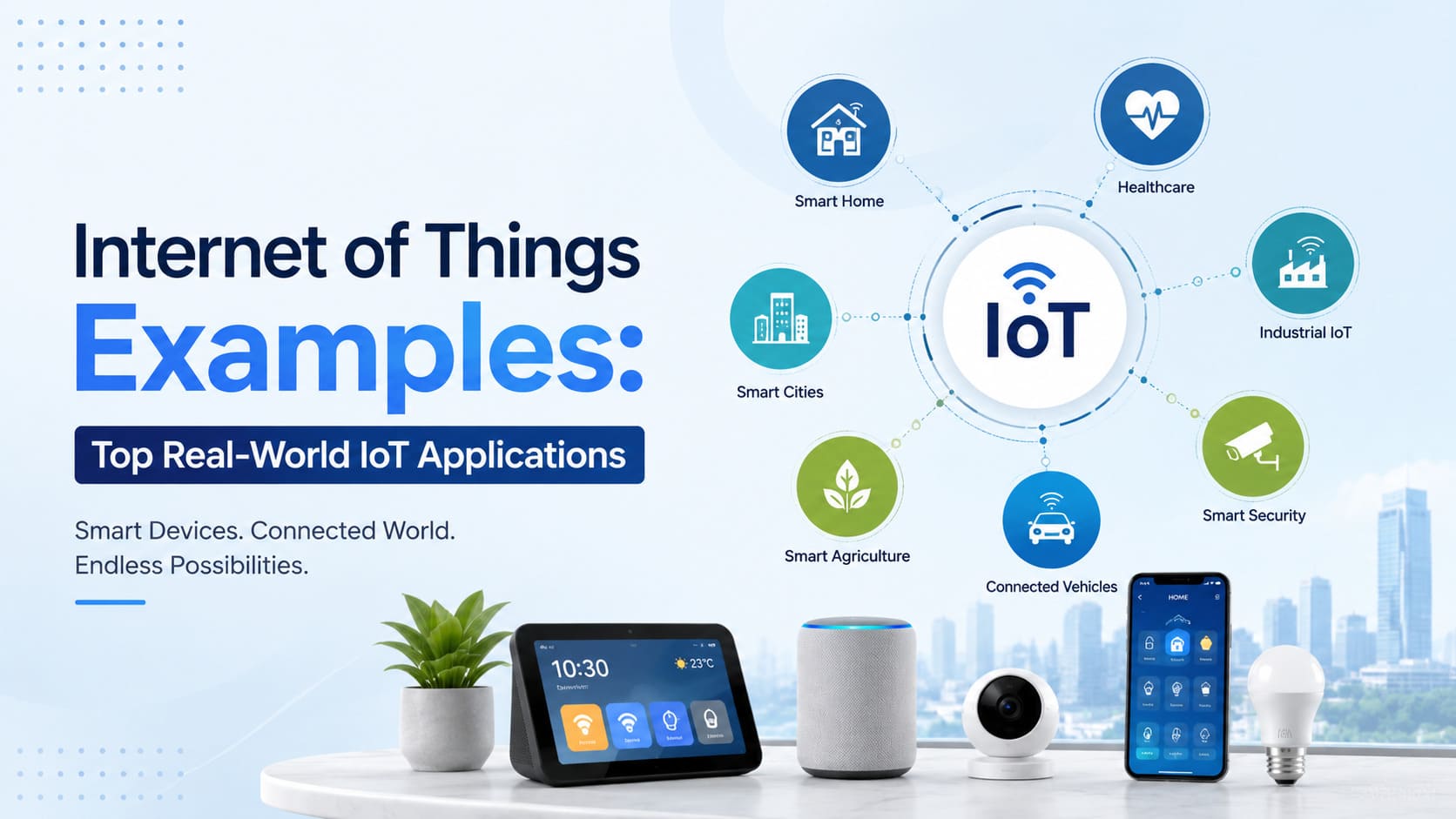
Internet of Things Examples: How IoT Is Transforming Everyday Life
Most people interact with the Internet of Things before they've even had coffee. The fitness band that logged their sleep, the thermostat that warmed the house before they woke up, the coffee maker that started brewing on schedule, none of that used to talk to anything. Now it all does, quietly, in the background, and most of us barely notice anymore.
This is the interesting aspect of the Internet of Things (IoT). Being one of the most widely discussed innovations in the last ten years, it doesn't make its presence known, and simply presents itself in the form of something that you had before, but with added intelligence. This article will tell you everything you should know about the Internet of Things, including the importance of it and the actual applications of 25 examples of it.
What Is the Internet of Things (IoT)?
Internet of Things is the name for networks of physical devices like sensors, home appliances, vehicles, or machines which gather data and share it on the Internet without anyone having to manually type anything in the system. The device qualifies for being part of IoT when it senses something in the physical environment and sends out that data, thus performing some action in return.
Three things make a device part of the IoT: a sensor or way of gathering data, a connection (Wi-Fi, Bluetooth, cellular, or low-power networks like LoRaWAN), and some form of processing either on the device itself or in the cloud that turns raw data into a decision or an alert. A smart bulb that turns on when you say so is IoT. A pacemaker that reports irregular rhythms to a cardiologist in another city is also IoT, just with a lot more at stake.
Why Is the Internet of Things Important?
The significance of IoT is that it brings together the physical and digital worlds. In the absence of pervasive sensor technology, decisions were taken based on guesswork, set timetables, or in response to a problem that has already occurred. A factory replaced parts on a calendar, not because they were failing. A farmer watered fields on a routine, not based on actual soil moisture. IoT flips that decisions get made on real, current data instead of guesswork.
The economic clout here cannot be overlooked. Billions of interconnected devices have been deployed across the globe, and their numbers only grow yearly due to decreasing costs of sensors and increased accessibility of connectivity solutions. In business, the benefits include reduced costs of operation, minimized risk of unexpected failures and responses based on the real world, not forecasts.
Top 25 Internet of Things Examples
1.Smart Homes
Lights, locks, thermostats, and speakers that interact and converse with one another, and with you; the lights being switched off while the movie starts or the door being locked automatically by itself during the night. The smart home ecosystem comprises Google Home, Amazon Alexa, and Apple Homekit.
2.Smart Watches & Fitness Trackers
A device worn on the wrist which measures the heartbeat, number of steps, different stages of sleep and even blood oxygen level, all feeding data into an app on the phone. Now some can detect abnormal heart rhythm and warn people to see a doctor all from such a tiny device.
3.Smart TVs
In addition to the streaming applications, current televisions connect to your household network for firmware upgrades, integration with voice control, and even to function as home automation controllers, managing other connected home gadgets through one device.
4.Connected Cars
Vehicles that report engine diagnostics, request software updates over the air, alert drivers to maintenance needs, and in some cases, communicate with nearby vehicles and traffic infrastructure to improve safety and routing.
5.Smart Traffic Management
Sensors embedded in roads and intersections track vehicle flow in real time, adjusting signal timing to reduce congestion and prioritize emergency vehicles something fixed-timer traffic lights could never do.
6.Smart Parking Systems
Ground sensors or cameras detect open parking spots and feed that information to apps, cutting down the time drivers spend circling a block looking for a space a small annoyance that adds up to real fuel waste at city scale.
7.Smart Street Lights
Lights that automatically turn down when there's nobody around but light up when they sense movement, saving a lot on municipal power expenses as opposed to being permanently lit, and at the same time automatically notify of any power outage without a resident's call.
8.Remote Patient Monitoring
Devices such as blood pressure monitors, glucose sensors, or cardiac monitors connected through Internet that transmit the patient’s measurements to the healthcare provider without the need for hospital admission for chronic diseases treatment.
9.Wearable Healthcare Devices
Beyond consumer fitness trackers, medical-grade wearables monitor specific conditions continuous glucose monitors for diabetics, or fall-detection devices for elderly patients living independently.
10.Smart Hospitals
The RFID technology helps to trace the location of the device in real time (reducing the time nurses spend on searching a wheelchair or IV pump), and patient monitors connected to computers notify when vital signs exceed certain boundaries.
11.Industrial IoT (IIoT)
The industrial component of the IoT network that uses sensors in machines, pipes, and manufacturing equipment to generate data for monitoring and evaluation purposes is what forms the core of many of the following manufacturing applications of the IoT network.
12.Predictive Maintenance
Vibration, temperature, and pressure sensors on machinery detect early signs of wear, letting companies repair equipment before it breaks down rather than after often saving far more in avoided downtime than the sensors themselves cost.
13.Smart Factories
Production lines with full connectivity, whereby machines, robots, and quality-control mechanisms exchange information in real-time and control production output, detect errors, and redirect work flow automatically without human intervention.
14.Precision Agriculture
Sensors that monitor soil moisture content, soil nutrients, and weather conditions provide information to farmers, enabling them to use water, fertilizers, and pesticides where they really need to be used rather than throughout the whole field.
15.Smart Irrigation
A more specific slice of precision agriculture irrigation systems that turn on based on real soil-moisture readings rather than a timer, cutting water usage substantially in regions where water scarcity is a genuine constraint.
16.Livestock Monitoring
The sensors attached to animals like cattle will allow farmers to monitor their locations, body temperature, and physical activities, allowing them to identify diseases at an early stage and even estimate the calving time.
17.Smart Retail Stores
Shelf sensors and computer-vision cameras track stock levels in real time, while some stores now let customers walk in, pick up items, and walk out without a checkout line the till itself disappearing from the store.
18.Inventory Management
RFID tags and connected sensors track goods across warehouses automatically, reducing the manual stocktaking that used to eat up staff hours and catching shortages before they turn into missed sales.
19.Smart Supply Chain
Shipping containers and pallets are equipped with sensors which detect their position, temperature, and humidity during the journey; if the shipment gets delayed, or any cold chain item such as vaccines gets exposed to any risky temperature.
20.Fleet Management
The use of GPS systems and diagnostics sensors to monitor the course, fuel usage, and driving behavior of delivery trucks allows for greater savings in fuel expenses.
21.Smart Energy Grids
The utility networks, which are enabled by sensors in the grid for real-time balancing of electricity generation and consumption while also allowing for automatic re-routing of power during blackouts and effective integration of renewable energy sources.
22.Smart Meters
Electricity, water, and gas meters that report usage automatically instead of requiring a manual reading, giving both households and utilities far more granular insight into consumption patterns.
23.Smart Waste Management
Sensors inside public bins detect fill levels and notify collection services only when a bin is actually full, replacing fixed collection schedules that often meant trucks emptying half-full bins.
24.Smart Security Systems
Connected cameras, motion sensors, and smart locks that send real-time alerts to a phone the moment something unusual happens, whether that's a package at the door or a window left open.
25.Smart Buildings
Buildings and offices that use sensors for adjusting their lights, heating, and air conditioning depending on the presence of occupants, thus eliminating the need for constant power supply irrespective of the number of occupants.
Internet of Things Applications Across Different Industries
IoT applications in healthcare include remote patient monitoring, diagnosis using wearable devices, and hospital equipment connectivity that helps decrease response times in critical cases. In manufacturing, IIoT is used for predictive maintenance and automated quality checks, which often comprise the primary driver of ROI from IIoT implementation in manufacturing facilities. In agriculture, IoT is employed through the implementation of sensor networks to optimize the use of both water and fertilizer, a vital necessity in areas where resources are genuinely scarce. In retail, IoT is implemented to track inventories and provide seamless checkout experience. In transportation and logistics, IoT is used to reduce costs through optimizing fleet management and traffic flow. Lastly, energy companies utilize IoT to manage their supply and demand.
Internet of Things Examples in Daily Life
Away from industry jargon, IoT shows up in smaller, more personal ways. A smartwatch nudging someone to stand up after sitting too long. A video doorbell that shows who's outside before anyone answers it. A smart plug that turns off a forgotten iron from across the city. A robot vacuum that maps a house and cleans it on a schedule. Even a car that warns a driver about low tire pressure before it becomes a flat. None of these feel like "technology" in the dramatic sense they're just conveniences that happen to run on sensors and connectivity most people never think about.
Benefits of Internet of Things
The most obvious advantage is efficiency in machinery that notifies about issues before something goes wrong, homes that consume the amount of energy they really need, and logistics in which problems will be detected during the transportation process and not after the delivery of goods. Financial gains come second, because of the fact that predictive maintenance and automated monitoring allow saving money by minimizing resource waste and unexpected downtime. Moreover, the Internet of Things technology increases safety, especially when it comes to hospitals and industries, where the early notification allows avoiding dangerous situations. Finally, for any company, the information obtained from interconnected devices creates a new cycle, which did not exist before.
Challenges of Internet of Things
None of this comes free of complications. Security is the biggest one every connected device is a potential entry point for attackers, and many IoT devices ship with weak default protections that users never bother to change. Privacy concerns follow closely, especially with health wearables and home cameras collecting continuous personal data. Interoperability is another sticking point devices from different manufacturers don't always speak the same language, which is part of why smart home setups can feel more fragmented than advertised. And then there's scale: managing, updating, and securing millions of individual devices is a genuinely harder operational problem than managing a handful of servers.
Future of Internet of Things
The next era of IoT relies much on the merger of IoT with AI – sensors not only collecting but analyzing data and making decisions right where the data is collected, rather than sending it back to the cloud in a round trip. Edge computing technology enables such processing and helps reduce latency in applications like autonomous driving and industrial safety systems, where even one-second lag can be crucial. The deployment of 5G and then 6G will allow greater number of devices to connect per square inch of space – important for smart cities using hundreds of sensors at intersections.
Best Practices for Implementing IoT Solutions
Start with a clear problem, not a device catalog the most common IoT failures come from bolting on sensors without a defined use case. Prioritize security from day one: change default credentials, encrypt data in transit, and keep firmware updated, since a single unpatched device can compromise an entire network. Choose connectivity standards based on the actual environment (a rural farm needs different infrastructure than an urban office building). Plan for scale early, since adding a thousand devices creates management challenges that ten devices never reveal. And build in redundancy for anything safety-critical, a monitoring system that fails silently is often worse than no monitoring at all.
Conclusion
The Internet of Things isn't a single product or a single industry story, it's a shift in how the physical and digital worlds share information. Whether it's a fitness tracker on a wrist, a sensor buried in a farm field, or a machine on a factory floor reporting its own wear and tear, the underlying idea stays the same: fewer decisions made on guesswork, more made on real data, as it happens. The technology will keep getting smaller and cheaper. What's more interesting is how invisible it's becoming which, for a technology this significant, might be the clearest sign it's actually working.
Frequently Asked Questions
What are the best Internet of Things examples?
Smart home devices, wearable fitness trackers, connected cars, industrial predictive maintenance systems, and smart city infrastructure like traffic management are among the most widely deployed and impactful IoT examples today.
What are the applications of IoT?
IoT applications span smart homes, healthcare monitoring, industrial automation, precision agriculture, retail inventory management, transportation and fleet tracking, and energy grid management.
How is IoT used in everyday life?
IoT shows up through smartwatches, smart thermostats, voice assistants, video doorbells, connected cars, and smart appliances — mostly working quietly in the background rather than requiring active attention.
What are IoT devices?
IoT devices are physical objects fitted with sensors, software, and network connectivity that let them collect and exchange data, ranging from simple smart plugs to complex industrial machinery.
What industries use IoT?
Healthcare, manufacturing, agriculture, retail, logistics, energy, and transportation are among the industries with the deepest IoT adoption, each using it to solve fairly different operational problems.








 Whatsapp
 Email
Email