Job
enquiry:+91-9121642626
Job
enquiry:+91-9121642626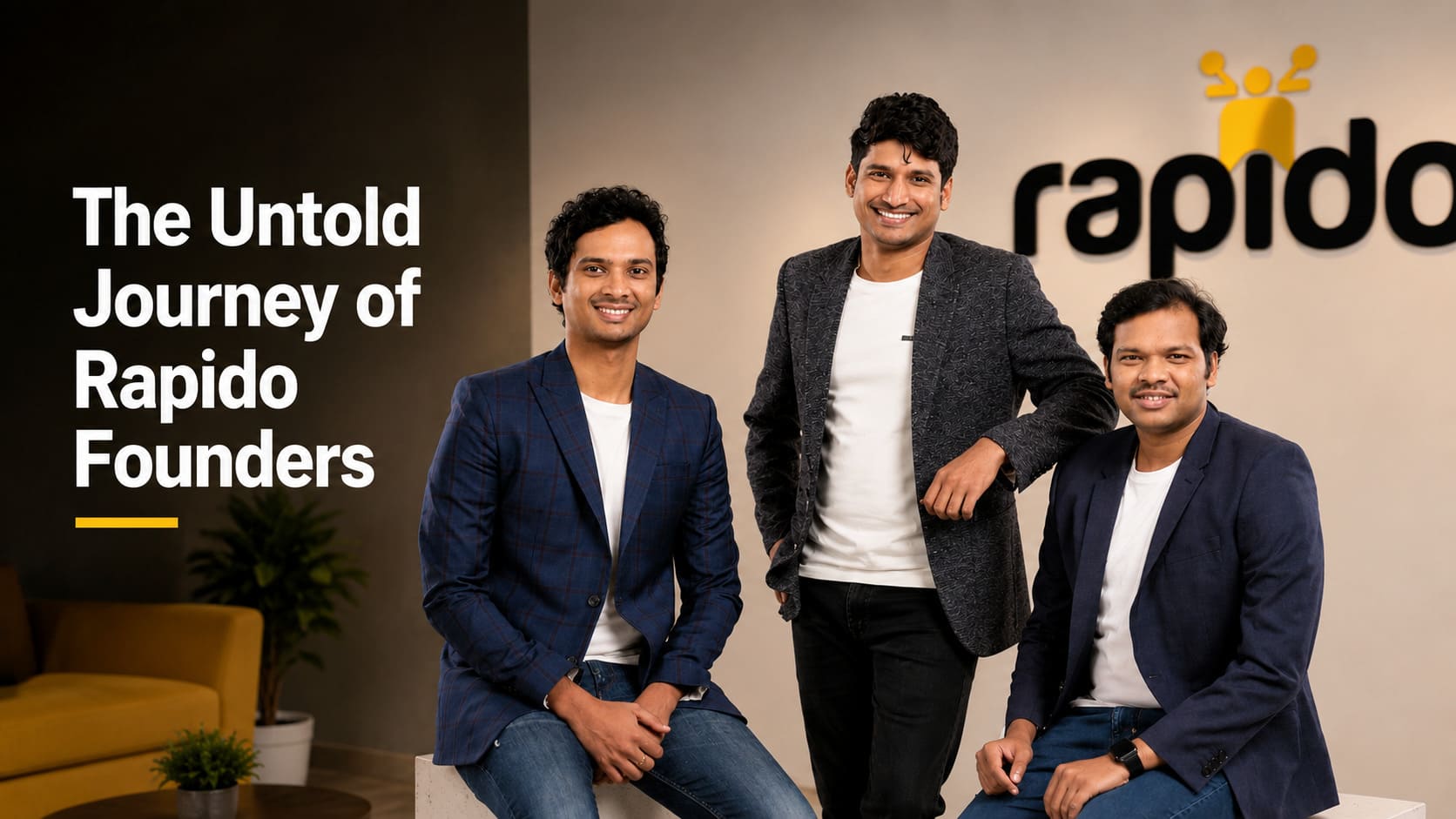
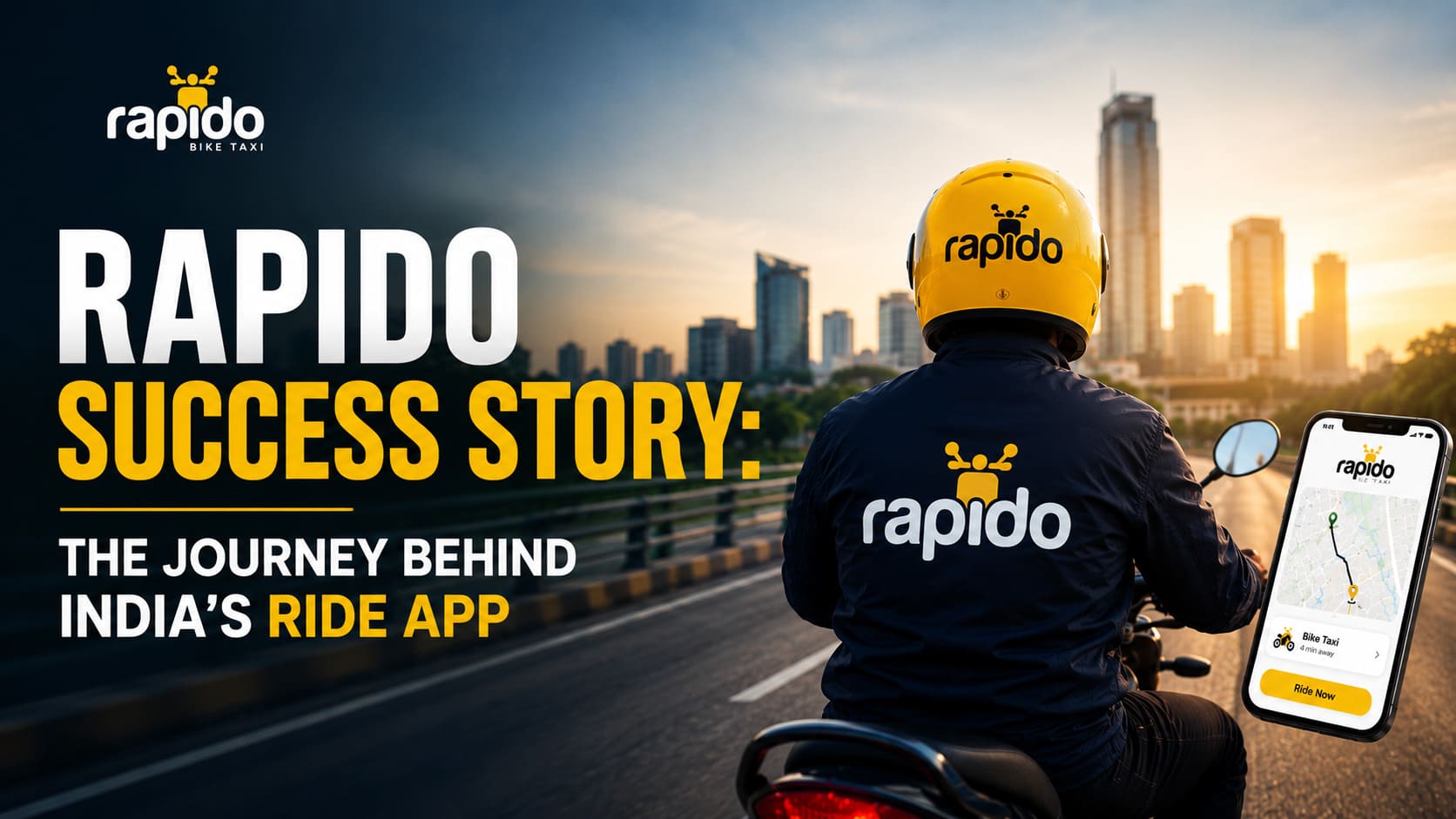
Rapido Founder Story: How Three Visionaries Built India's Leading Bike Taxi Startup
Every few years, an Indian startup comes along that changes how an entire country moves literally. Rapido is one such company, The humble startup that originated as an idea out of the traffic problems of Bengaluru has blossomed into a behemoth of mobility worth billions of dollars that ferries millions of people everyday through hundreds of cities in India.
Behind every "overnight success" is a longer, messier story. The Rapido founder story is one of rejection, reinvention, and grit. Aravind Sanka, Pavan Guntupalli, and Rishikesh SR didn't set out to build a unicorn but they set out to solve a problem they lived with daily: getting from point A to point B in cities never built for this many people. This blog walks through their journey, the company they built, and the lessons founders can take from it.
Who Are the Founders of Rapido?
The founders of Rapido are three engineers who became friends through their respective professional and educational networks and were frustrated with the problems of commuting in Indian cities.
Aravind Sanka
Aravind Sanka is a mechanical engineer and currently works as the CEO of Rapido. Aravind Sanka is considered to be the face of Rapido when it comes to discussions with investors or media as he talks about expanding the services of Rapido.
Pavan Guntupalli
Pavan Guntupalli brings experience in technology and product development to the company’s founders. Before starting his journey at Rapido, Pavan had already tried his hand at entrepreneurship and his background as an engineer plays a role in the technology and captain systems at Rapido.
Rishikesh SR
Rishikesh SR forms the third member of the original three founders. He had tried to set up his own startups before Rapido and knew what it was like to go through the successes and challenges of starting businesses in India.
Their Roles in Building the Company
While all three co-founded the company together, their responsibilities split naturally by strength , Aravind leading strategy and fundraising, Pavan focused on technology and product, and Rishikesh handling operations and execution. This complementary split is often cited as a reason Rapido survived its brutal early years, when most investors weren't willing to bet on it.
Early Life and Education of Rapido Founders
Aravind Sanka
Aravind studied mechanical engineering at IIT Bhubaneswar. Before starting up, he worked in supply chain finance at Flipkart, where he gained exposure to logistics planning and large-scale operations knowledge that would later prove useful in building Rapido's ride allocation systems.
Pavan Guntupalli
Pavan did his Bachelor’s degree in Electronics & Communication Engineering from the IIT Kharagpur. Pavan was working as a Software Developer with Samsung Research India prior to becoming an entrepreneur.
Rishikesh SR
Rishikesh obtained his degree in computer and information sciences from PES University located in Bengaluru. Before starting Rapido, he had started other ventures, implying that he was entering the field of bike taxi service knowing the hardships of creating something from scratch.
How the Idea of Rapido Was Born
The Problem They Identified
The Indian cities have always been congested with traffic. It is quite common for people traveling a mere few kilometers to shift from one mode of transport to another and waste both their money and time. It was known to the founders that the cab aggregators provided solutions only for comfort and nothing else.
Inspiration Behind the Startup
The initial idea that the founders played around with involved logistics within the city, but they soon shifted their focus to mobility for people. Seeing the two-wheelers move freely in traffic congestion while cars were just sitting there sparked the idea that perhaps you can book a bicycle like a taxi.
Why They Chose Bike Taxis
The bikes were more economical to run, more scalable, and incredibly fast in traffic conditions within urban areas. They were less capital intensive for the driver partners than automobiles, which made it possible to create a huge fleet very quickly. The economics, speed, and scalability were key to the competitive advantage of Rapido.
Rapido's Journey: From Startup to Market Leader
1. Launch
Rapido launched in Bengaluru in 2015, starting as a small bike-taxi pilot before expanding city by city.
2. Early Challenges
It was not an easy journey at the beginning as the founders encountered many investors who turned them down since the majority did not believe that a bike taxi concept would do well in a market that had Ola and Uber dominating it.
3. Expansion
A crucial tipping point came when the management of Hero MotoCorp decided to back Rapido, providing the necessary funds and credibility. Rapido subsequently expanded into cities after cities, provided additional services, and expanded its network of captains to the millions.
4. Key Milestones
Rapido crossed the unicorn threshold in 2024 after a large round led by WestBridge Capital, and has scaled rapidly since expanding into hundreds of cities and diversifying well beyond its bike-taxi roots.
Rapido Business Model Explained
Rapido operates an asset-light, commission-based marketplace connecting riders with driver-partners, known as "captains," across multiple vehicle categories.
1. Bike Taxis
The original and still core offering, bike taxis remain Rapido's largest and most differentiated service line, especially in traffic-heavy metro cities.
2. Auto Services
Rapido expanded into auto-rickshaw hailing to capture a larger share of short-distance urban commutes.
3. Cab Services
More recently, the firm forayed into the market of four-wheeler taxis and went head-to-head with Ola and Uber in becoming a full-stack mobility company.
4. Captain Earnings
Captains earn per completed ride, with Rapido charging a commission on transactions, and has also tested subscription-style models in some markets.
5. Revenue Streams
Core revenue comes from ride commissions across bikes, autos, and cabs, supplemented by advertising and newer ventures such as food delivery.
Rapido Funding History
| Funding | Investors (Key Names) | Amount | Year |
| Seed | Early angel investors | ~$0.2M | 2015 |
| Series A | Nexus Venture Partners and others | Undisclosed | 2017–2018 |
| Series B | WestBridge Capital, Pawan Munjal | Undisclosed | 2019 |
| Series C | Shell Ventures and others | Undisclosed | 2021 |
| Series D | Swiggy (lead), TVS Motor Company | $180 million | 2022 |
| Series E | WestBridge Capital, Nexus, Prosus | ~$120–150 million | 2024 |
| Series F | Prosus (lead), WestBridge, Accel | $240 million | 2026 |
Note: Several early rounds had undisclosed amounts. Rapido's cumulative funding has crossed several hundred million dollars, with reported totals varying by source depending on how primary and secondary transactions are counted.
Rapido Valuation and Growth
Latest Valuation
The valuation of Rapido has surged significantly in the past few years, from about $1 billion in its unicorn funding round close to 2024, to $3 billion in its fundraising round in 2026 backed by Prosus.
Unicorn Status
Rapido entered the unicorn club in 2024, becoming one of the rare Indian mobility startups — alongside Ola — to reach that milestone.
Market Expansion
The business now works in hundreds of Indian cities and holds a significant market share in India's total volume of ridesharing, including bikes and autos, thereby putting pressure on Uber and Ola.
Rapido Revenue, Profit and Financial Performance
| Financial Year | Revenue (? Crore) | Loss (? Crore) |
| FY22 | 145 | 440 |
| FY23 | 443 | 675 |
| FY24 | 648 | 370 |
| FY25 | 934 | 258 |
Rapido's financial trajectory shows a company narrowing losses year after year while growing revenue at a fast clip — a pattern that has fueled speculation about a potential IPO in the coming years.
Challenges Faced by Rapido Founders
Regulatory Issues
There had been conflicting laws regarding the bike taxi operations in various states of India, where there is prohibition or restriction in some places, making the founders to adhere to the laws of the state.
Competition
Going up against deep-pocketed players like Ola and Uber meant Rapido had to compete on unit economics and niche positioning rather than marketing spend.
COVID-19
The pandemic hit ride-hailing hard, pushing Rapido to pivot temporarily into logistics and last-mile delivery to stay afloat during lockdowns.
Scaling Operations
Managing a fast-growing captain network across hundreds of cities while keeping service quality and safety consistent has remained an ongoing challenge.
Rapido vs Ola and Uber: What Makes Rapido Different?
| Factor | Rapido | Ola | Uber |
| Pricing | Generally most affordable, especially for bikes | Mid-range | Often premium-priced |
| Core Services | Bike taxis, autos, cabs, delivery | Cabs, autos, EVs | Cabs, premium rides |
| Business Model | Commission-based marketplace, asset-light | Mixed, includes EV manufacturing | Global marketplace model |
| Market Presence | Strong in bike/auto segment, hundreds of cities | Strong across India | Strong in metros, global brand |
Rapido's biggest differentiator has been its bike-taxi-first approach, which none of its larger rivals prioritized early on, allowing it to build a defensible niche before expanding into their territory.
Awards and Achievements of Rapido
Rapido has been featured on numerous industry lists honoring emerging young entrepreneurs and rapidly growing startups, while the entrepreneurs of Rapido have themselves won awards for entrepreneurship. Getting listed among unicorns and providing hundreds of millions of rides per year is considered its greatest achievement.
Leadership Lessons from Rapido Founders
Entrepreneurship
The founders' willingness to pivot from an early logistics idea to bike taxis shows the value of staying close to the actual problem rather than a single solution.
Innovation
Choosing bikes over cars in a market obsessed with car-based ride-hailing was a contrarian bet that paid off by tapping an underserved need.
Risk-Taking
Facing dozens of investor rejections and pushing forward anyway reflects a level of conviction many founders talk about but few sustain.
Customer-First Mindset
Rapido's continued focus on affordability and speed, even while expanding into cabs and other services, reflects a founding philosophy that has held through the company's growth.
Future Plans of Rapido
Expansion
Rapido has stated ambitions to expand its city footprint further, targeting hundreds of additional towns across India in the coming years.
New Services
Beyond mobility, the company has moved into adjacent categories such as food delivery, signaling ambitions to become a broader everyday-services platform.
Technology
Continued investment in route optimization, safety features, and captain-side technology remains central to Rapido's roadmap as competition intensifies.
International Opportunities
Although Rapido has concentrated mainly on India, its growing size and profitability have generated some talk about possible expansion into other emerging countries that face similar traffic and pricing problems.
Key Takeaways from the Rapido Founder Story
The success story of Rapido, a startup that started as a bike taxi ride business and went on to become a billion-dollar company, proves that great ideas don’t always need lots of money but a problem worth solving, an innovative solution, and founders with patience to survive years of rejections. This was done by Aravind Sanka, Pavan Guntupalli, and Rishikesh SR, who made a brand for themselves in the Indian mobility sector.
Frequently Asked Questions
Who is the founder of Rapido?
Rapido was co-founded by Aravind Sanka, Pavan Guntupalli, and Rishikesh SR in the year 2015. The trio founded the company to resolve urban transportation woes through their bike taxi rides at an economical cost. Rapido’s unique concept led to the growth of the startup into one of the fastest growing mobility ventures in India.
Who is the CEO of Rapido?
Aravind Sanka serves as the CEO and is among the co-founders of Rapido. It is through his leadership that Rapido has managed to grow and operate in hundreds of Indian cities, launch several mobility services, raise funds, and establish itself as a major player in the ride-hailing market of India.
When was Rapido founded?
The company Rapido was incorporated in November 2015 in Bengaluru, Karnataka, by Aravind Sanka, Pavan Guntupalli, and Rishikesh SR. It had initially started operations with the name “theKarrier” but was subsequently renamed to Rapido with a specialized focus on bike taxi services in India.
Is Rapido a unicorn?
Yes, Rapido became a unicorn in 2024 following substantial financing from renowned investors. This accomplishment placed the value of the company at more than $1 billion, thus earning a reputation as one of the most successful startups operating in mobility in India. Expansion, rising revenues, and gaining market share have only increased the value of Rapido.
What services does Rapido offer besides bike taxis?
Apart from bike taxis, Rapido provides auto-rickshaw bookings, cabs, delivery and logistics services in several cities in India. This shows that the firm has diversified its operations by adding more modes of transport through its platform, which makes it cheaper and easier for many people to move around the cities.
How is Rapido different from Ola and Uber?
In contrast to Ola and Uber, both of which commenced their business operations by using cars for providing rides, Rapido was founded as an enterprise that offered speedy and cheaper bike-taxis as opposed to any other ride-hailing app out there. One of the key factors that led to its success is the cost-effectiveness it offers.








 Whatsapp
 Email
Email