Job
enquiry:+91-9121642626
Job
enquiry:+91-9121642626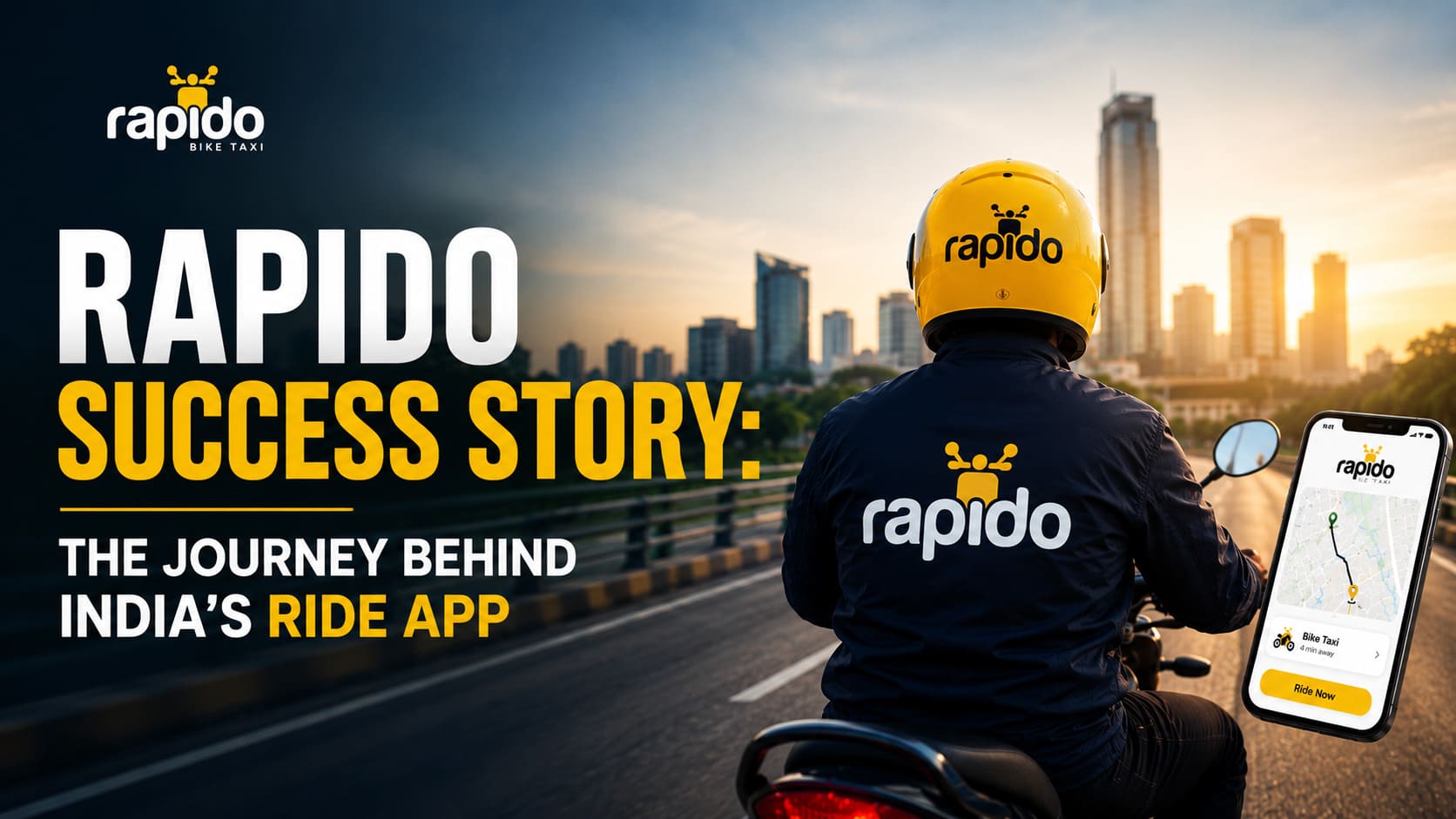
Rapido Success Story: The Rise of India's Leading Bike Taxi Platform
Now and then, some companies rewrite the rules of their whole industry. Rapido is that kind of company. This concept which started off with connecting commuters to bike owners turned out to be one of the hottest topics within Indian transport, right next to companies such as Uber and Ola.
Rapido’s success story isn’t one of an app that lets you book your bike rides. Rather, it is one of identifying an unexplored need, developing for affordability and not targeting premium customers, and being patient while waiting for the market to catch up to them after years of uncertain regulations. Currently, Rapido serves hundreds of cities across India, transporting millions of customers every single day and earning a valuation that makes it one of the most valued startups in the country.
In this blog, We'll walk through how rapido started. How its business model actually works, its funding journey, revenue growth, valuation, the challenges it overcame, and the example every entrepreneur can direct from its rise.
How Rapido Started Its Journey
Rapido was founded in 2015 in Bengaluru by three IIT graduates Aravind Sanka. Pavan Guntupalli, and Rishikesh S R. The founders noticed a very Indian problem; traffic-choked cities, expensive cab rides, and millions of underused motorcycles parked outside homes and offices.
Their approach was simple yet radical; to make normal bike owners drive their bikes for short periods, providing services to those commuters who needed affordable point-to-point transport. In an era where ride-hailing was done using four wheels, thinking of ride-hailing with two wheels was considered rather unusual, and investors had many reservations about this model at first.
The early days weren't smooth. Bike taxis existed in a legal grey zone in many states, and Rapido had to navigate patchy regulations city by city. But the founders stuck to their core belief: India's traffic and affordability problems needed a two-wheeler solution, not another expensive cab service. That conviction laid the foundation for what would eventually become India's largest bike taxi platform.
Rapido Business Model Explained
The Rapido business model is built around one central idea affordability at scale. Instead of buying or leasing vehicles, Rapido runs on an asset-light marketplace model that connects riders with "Captains" (Rapido's term for its driver-partners) who already own two-wheelers, autos, or cars.
Here's how the Rapido business model generates revenue:
- Commission on bike rides: Rapido charges roughly 15–20% commission on every bike taxi ride booked through the platform. This is one of the biggest reasons behind its total revenue generation.
SaaS - Model Based on Subscription for Autos and Cabs: There was a major change that Rapido incorporated into its business operations and that was in the form of offering its autos and cabs category without any commission at all. In this case, the Captains need to pay a small amount daily and take the total money collected as their earning.
- Multi-category expansion: Rapido is expanding beyond the bike taxis segment to include auto rickshaw cabs, car rental service, parcel deliveries, and even food deliveries by using Ownly app.
- Deep penetration into Tier-2 and Tier-3 cities: Unlike other companies that chose to compete directly with Uber and Ola in the metro towns, Rapido entered into the less crowded Tier-2 and Tier-3 towns.
This layered approach commission-based bike rides, subscription-based autos and cabs, and diversification into adjacent services , is what makes the Rapido business model genuinely different from a typical ride-hailing playbook.
Rapido Funding Journey
The fundraising history of Rapido is an indication of the trust which has been invested by investors in Rapido’s growth from being an upstart to becoming a billion-dollar mobility player.
Rapido has raised funding across multiple rounds since its early days, backed by investors including Nexus Venture Partners, WestBridge Capital, Prosus Ventures, Shell Ventures, Swiggy, and Accel, among others. Key milestones in the Rapido funding journey include:
2021: A $52 million round with participation from Shell Ventures, WestBridge Capital, and Mirae Asset, which helped Rapido expand its Auto category and cross the 100-city mark.
2022: A $180 million round that pushed Rapido into unicorn territory for the first time, with the company crossing 5 million registered Captains and 35 million users.
2024 (Series E): A $200 million round led by WestBridge Capital, valuing Rapido at $1.1 billion and cementing its unicorn status.
2025: A significant secondary transaction saw Swiggy sell its roughly 12% stake in Rapido for around $270 million, reflecting a strong return on its earlier strategic investment. This transaction pushed Rapido's valuation to $2.3 billion.
2026 (Series F): Rapido raised $240 million in fresh funding led by Prosus, with participation from WestBridge Capital and Accel, as part of a larger $730 million primary and secondary financing round. This round pushed Rapido's valuation to $3 billion.
Across these rounds, Rapido has raised several hundred million dollars in aggregate funding, positioning it as one of the best-capitalized mobility startups in India as it prepares for its next phase of growth.
Rapido Revenue and Financial Growth
The growth trajectory of Rapido’s revenues in the last couple of years is an intriguing narrative of economies of scale. There was a huge jump in revenues from around ?145 crores in FY22 to about ?648 crores in FY24. And then, in FY25, Rapido surpassed the revenue threshold of ?1,000 crores owing primarily to their business in autos and cabs.
This growth has been fueled by a few key factors:
- Rising ride volumes across bike, auto, and cab segments
- Expansion into new cities, particularly Tier-2 and Tier-3 markets
- The subscription-based model for autos and cabs, which has driven faster adoption among Captains
- Entry into adjacent categories like parcel delivery and food delivery through Ownly
Rapido has also emphasized a path toward operational profitability, distinguishing itself from several competitors in the space that have relied heavily on continuous cash burn to sustain growth.
Rapido Valuation and Market Position
The valuation story of Rapido is one of the most notable ones in India's startup scene. With the company becoming a unicorn in 2024 with a valuation of $1.1 billion, Rapido's valuation has increased to $2.3 billion in 2025 through Swiggy selling off their stake, and $3 billion in 2026 after the company's latest investment round by Prosus.
As far as positioning in the market is concerned, it seems that Rapido has outshone Ola as the second-biggest service provider in the ride-sharing sector of India in terms of market share after Uber. It continues to hold a very prominent position in the bike taxi segment, where bike rides have made a considerable contribution to its total rides, whereas auto-rickshaws have contributed most to its gross merchandise volume.
This rising valuation and market share reflect investor confidence in Rapido's diversified, multi-modal strategy and its ability to serve price-sensitive Indian commuters better than traditional cab-first platforms.
Key Milestones in Rapido's Growth Story
Rapido's growth story has been marked by several defining milestones:
2015: Rapido founded in Bengaluru by Aravind Sanka, Pavan Guntupalli, and Rishikesh S R
2021: Crossed 100+ cities and launched its Auto category
2022: Achieved unicorn status for the first time with a $180 million funding round, crossing 5 million Captains and 35 million users
2024: Formally entered the unicorn club again with a $200 million Series E round at a $1.1 billion valuation
2025: Swiggy exits its stake in a secondary sale; Rapido launches Ownly, its food delivery app, entering a market dominated by Swiggy and Zomato
2026: Raised $240 million in a Series F round at a $3 billion valuation, with plans to begin formal IPO preparations by late 2026 or early 2027
Each of these milestones reflects a company that expanded methodically bike taxis first, then autos, then cabs, and finally adjacent categories like delivery rather than spreading itself too thin too early.
Challenges Rapido Faced and How It Overcame Them
Rapido's journey has not been without significant hurdles. Some of the biggest challenges include:
- Regulatory uncertainty: Bike taxis operated in a legal grey area across many Indian states for years, with some state governments restricting or banning commercial two-wheeler rides. Rapido had to navigate this patchwork of regulations city by city, working with policymakers to build a case for legalizing bike taxis nationally.
- Investor skepticism: In its early years, Rapido's founders faced numerous rejections from investors who doubted whether a bike-based ride-hailing model could scale in India. It took persistence and a clear articulation of the market opportunity to change investor sentiment.
- Intense competition: Uber, Ola, and homegrown platforms like Namma Yatri have all expanded into the two- and three-wheeler segment, intensifying competition. Rapido has responded by deepening its Captain relationships, introducing its subscription-based zero-commission model for autos and cabs, and expanding into new service categories.
- Balancing growth with profitability: Unlike many startups that prioritize growth at any cost, Rapido has focused on sustainable expansion, aiming for operational profitability rather than continuous heavy cash burn a strategy that has helped it maintain investor confidence through multiple funding cycles.
Overcoming these challenges required a combination of regulatory patience, product innovation, and a relentless focus on affordability, all of which have become defining traits of the Rapido success story.
What Makes Rapido Different from Competitors
Several factors set Rapido apart from Uber, Ola, and other mobility platforms in India:
- Two-wheeler-first approach: While competitors focused primarily on cabs, Rapido built its foundation around bike taxis, a category perfectly suited to India's congested cities and price-sensitive commuters.
- Subscription-based commission model: Rapido's zero-commission SaaS model for autos and cabs, where Captains pay a nominal fee and keep the full fare, has proven more attractive to driver-partners than traditional commission structures.
- Deep Tier-2 and Tier-3 city presence: Rapido expanded into smaller cities much earlier and more aggressively than its larger rivals, capturing markets with little organized competition.
- Multi-modal diversification: From bike taxis to autos, cabs, rentals, parcel delivery, and food delivery through Ownly, Rapido has built a broader ecosystem rather than remaining a single-category player.
- Focus on Captain earnings: Rapido has consistently emphasized fair earnings for its driver-partners, positioning itself as a platform that creates livelihoods, not just a service that moves people.
Rapido's Impact on India's Urban Mobility
Rapido’s effect is far more than making life easier for commuters. Through its ability to give thousands of motorcycle owners a chance to earn some extra cash by becoming Captains, Rapido has helped create an additional source of income for gig workers in India. It has provided commuters with a much cheaper option to traveling through cars and autos.
The app is also responsible for contributing towards making discussions about the formal legalization of bicycle taxis in various Indian states possible. With the launch of initiatives such as e-vehicles and bike pink for women, the impact that Rapido has had on how Indians commute on a daily basis can only be expected to increase further.
Key Lessons from Rapido's Success Story
The Rapido success story offers valuable takeaways for founders and businesses alike:
1. Solve a real, local problem: Rapido didn't try to copy Uber's model; it built a solution specifically suited to India's traffic, cost sensitivity, and existing two-wheeler ownership.
2. Affordability can be a market-creation strategy: Pricing for daily, mass-market use rather than occasional premium use unlocked a completely different scale of demand.
3. Expand sequentially, not scattered: Rapido went deep into bike taxis before expanding into autos, and deep into autos before launching cabs each new category leveraged existing Captain relationships and infrastructure.
4. Driver-partner relationships matter as much as customer relationships: The subscription approach of Rapido demonstrates how making common incentives with supply side partners could be a real source of competitive advantage.
5. Patience with regulation pays off: Instead of trying to avoid regulatory gray zones, Rapido navigated through them over many years, gaining an advantage on the market when regulations finally got clear.
Future Plans and Growth Strategy
As for the future, Rapido’s road ahead is well-defined. The startup seeks to keep up with its rapid growth trajectory even as it edges closer to becoming profitable, thereby standing out from a number of its rivals that continue to face a major problem of high burning of money. Rapido’s Series F funding round planned in 2026 will enable it to expand into emerging Tier-2 and Tier-3 regions.
Rapido is also investing in electric vehicle integration for its Captain fleet, deeper metro city penetration, and continued growth of Ownly, its food delivery arm. According to company leadership, Rapido intends to begin formal preparations for an initial public offering (IPO) by late 2026 or early 2027, a milestone that would mark the next major chapter in its journey.
Conclusion
The Rapido success story is an example of how great potential lies in areas that everyone ignores. The company succeeded in its venture through investing in bikes when this approach was unusual, creating a specific business model catering to the low cost aspect of India, and gradually expanding into different categories and cities. Thus, Rapido managed to become a prominent player in India’s mobility space.
As it prepares itself to go ahead with its IPO plans and continues building up its multi-modal system of mobility services, the history of Rapido provides some useful insights on how a seemingly simple idea of connecting bike owners to city commuters can revolutionize urban mobility.
Frequently Asked Questions (FAQs)
What is Rapido's business model?
Rapido operates an asset-light marketplace connecting riders with Captains (driver-partners). It earns commission on bike taxi rides and uses a subscription-based, zero-commission SaaS model for its auto and cab segments, where Captains pay a nominal fee and keep the full fare.
What is Rapido's revenue?
Rapido's revenue grew from around ?145 crore in FY22 to about ?648 crore in FY24, and crossed ?1,000 crore in FY25, driven by growth across bike, auto, and cab segments.
What is Rapido's valuation?
As of its 2026 Series F funding round, Rapido is valued at $3 billion, up from $2.3 billion in 2025 and $1.1 billion when it first became a unicorn in 2024.
Who is the CEO of Rapido?
Aravind Sanka, one of Rapido's co-founders, serves as the company's CEO.
How many cities does Rapido operate in?
Rapido operates in several hundred cities across India, with reports indicating a presence in more than 400 cities as it continues expanding into Tier-2 and Tier-3 markets.








 Whatsapp
 Email
Email