Job
enquiry:+91-9121642626
Job
enquiry:+91-9121642626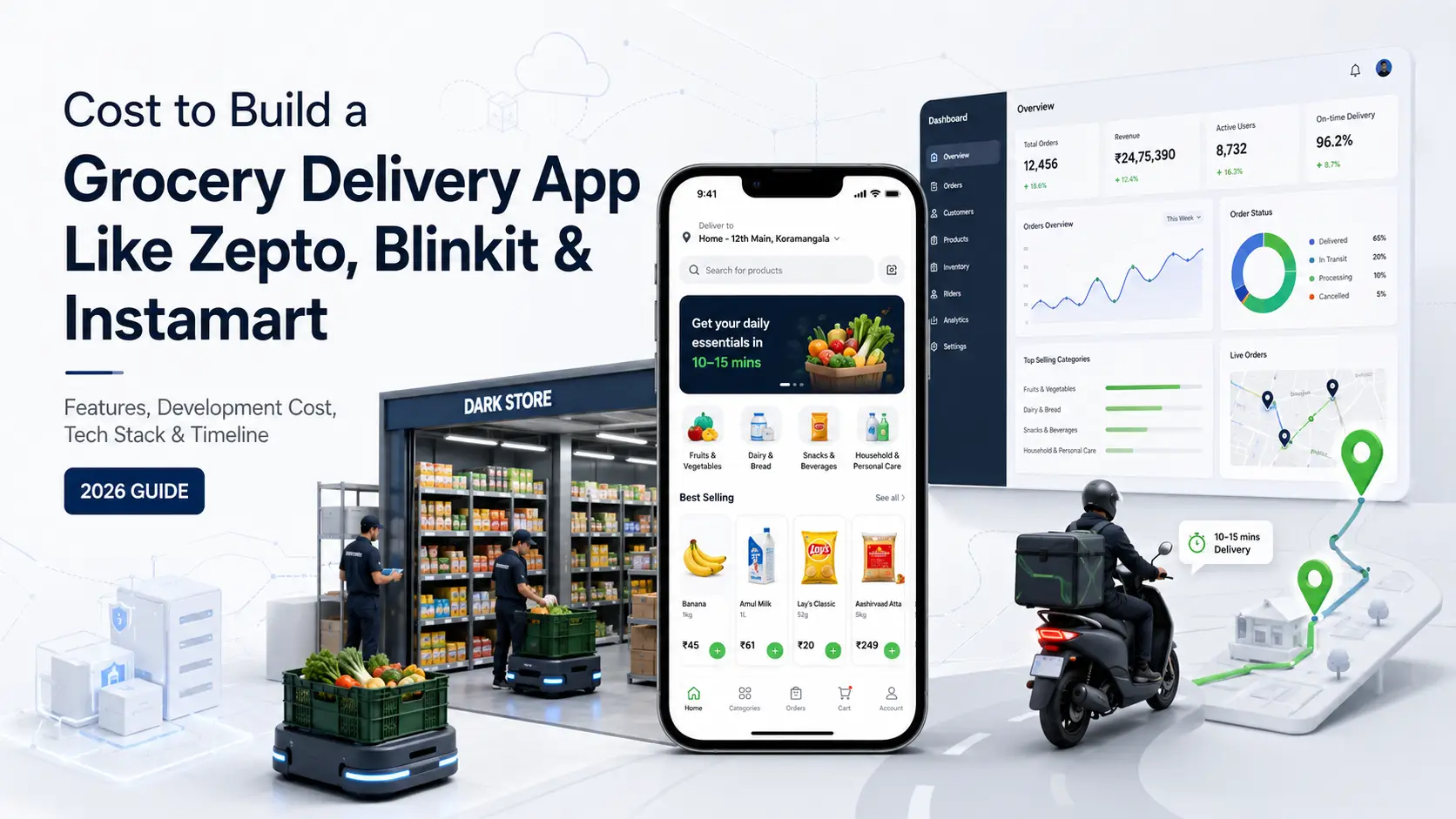
Cost to Build an On-Demand Grocery Delivery App Like Zepto, Blinkit & Instamart in 2026
A few years ago, ordering a packet of coriander online and getting it in ten minutes sounded absurd. Today, millions of households in Indian cities treat it as routine. Quick commerce has gone from a venture-funded experiment to a habit baked into daily life, and that shift has created one of the most talked-about business opportunities of the decade.
If you are a founder, retailer, or investor reading this, you have probably already asked the question that everyone asks first: what will it actually cost to build something like Zepto?
I have spent years advising teams who set out to build on-demand and hyperlocal platforms, and I will tell you upfront that the honest answer is not a single number. It is a range, and where you land inside that range depends on decisions you make in the first few weeks. This guide walks you through those decisions the way I would if we were sitting across a table, sketching the plan on a notepad.
Let's get into it.
The Rise of Quick Commerce: Why Founders Keep Asking This Question
India's quick-commerce sector has scaled at a pace that surprised even the people building it. The market crossed roughly $5–7 billion in gross order value in recent years and is projected by various industry reports to reach somewhere between $10 billion and $13 billion by 2029. For a category that barely existed in 2020, that is remarkable.
Three names dominate the conversation. Blinkit (owned by Eternal, formerly Zomato) sits at the front with close to half the market and over two thousand dark stores. Zepto, the company two college dropouts built around a ten-minute promise, has scaled into a strong number two and is preparing for a public listing. Swiggy Instamart rides on top of Swiggy's existing food-delivery base and has pushed hard into more than a hundred cities. Behind them, Amazon Now, Flipkart Minutes, and BigBasket's BB Now are all fighting for the next slice.
What makes this interesting for a new entrant is not the headline growth. It is the fact that the model is still being figured out. Margins are thin, profitability is fragile, and the regulatory ground is shifting (in early 2026 the government even asked the big players to stop advertising "10-minute" delivery over rider-safety concerns). That combination of huge demand and unsettled economics is exactly why so many founders see an opening, particularly in specific cities, regional markets, or product categories the giants are not serving well.
So the cost question is really a strategy question in disguise. Before we talk rupees and dollars, you need to understand what you are actually building.
Quick Answer: How Much Does It Cost to Build an App Like Zepto?
Here is the short version for people who scrolled straight here.
| Development Level | Estimated Cost (USD) | Estimated Cost (INR) |
|---|---|---|
| MVP | $25,000 – $50,000 | 20 – 40 lakh |
| Startup Version | $50,000 – $90,000 | 40 – 75 lakh |
| Growth-Stage Platform | $90,000 – $180,000 | 75 lakh – 1.5 crore |
| Enterprise Quick-Commerce Platform | $200,000 – $400,000+ | 1.6 – 3.3 crore+ |
A quick word on what each tier means in practice.
The MVP is a single-city, single-dark-store proof of concept. You get a customer app, a basic store-fulfilment screen, a delivery app, and a simple admin panel. Enough to take real orders and learn whether your unit economics work. This is where I tell almost every founder to start.
The startup version adds polish and reliability: smoother UX, more payment options, real-time tracking, push notifications, and an admin dashboard that an operations team can actually run a business on.
The growth-stage platform is built to scale across multiple dark stores and neighbourhoods, with proper inventory syncing, route optimisation, analytics, and the kind of backend that does not fall over during a festival rush.
The enterprise platform is the full Zepto-class ecosystem: multi-city operations, warehouse management, AI-driven recommendations, predictive inventory, business intelligence, and franchise or multi-vendor support.
Notice the jump between tiers. That jump is almost entirely about complexity and the number of moving parts, not about adding a few extra screens. Understanding why is the rest of this article.
Understanding the Quick-Commerce Business Model
People often assume quick commerce is just "grocery e-commerce, but faster." It is not. The speed promise forces a completely different operating model, and that model is what your software has to support.
At the centre sits the dark store - a small, dense, neighbourhood warehouse that the public never enters. It exists only to fulfil online orders. Instead of one big distribution centre serving a whole city, you run many small ones, each covering a two-to-three-kilometre radius. That proximity is what makes ten-to-thirty-minute delivery physically possible.
The model is hyperlocal by design. An order is matched to the nearest dark store that has the items in stock, picked and packed by staff inside, and handed to a rider waiting nearby.
It is also inventory-driven. Unlike a marketplace that lists other people's products, most quick-commerce players own their stock. That gives them control over availability and freshness but means real-time inventory accuracy is non-negotiable. If your app shows milk in stock and the shelf is empty, you have an unhappy customer and a refund.
Then there is fleet management - matching riders to orders, optimising routes, tracking deliveries live, and managing earnings and shifts for a workforce that is constantly in motion.
Here is the order journey in its simplest form:
Customer → Dark Store → Picker → Packer → Rider → Customer
Every arrow in that chain is a place where software either saves seconds or wastes them. And in a business where the promise is built on minutes, those seconds are the product.
The Applications Required to Build a Zepto-Like Platform
This is the single biggest misconception I run into. Founders say "I want to build an app like Zepto" as if Zepto is one app. It is not. It is an ecosystem of connected applications, each serving a different user. Budgeting for one and discovering you need five is how projects blow past their estimates.
A complete platform usually needs the following.
1. Customer Mobile App
This is the face of your business - the only piece your customers ever see. It has to be fast, clean, and frictionless, because in quick commerce people decide whether to order in seconds.
Core features include:
- Registration and login
- Product search
- Category browsing
- Smart recommendations
- Cart and checkout
- Payments
- Live order tracking
- Ratings and reviews
- One-tap reorder
- Notifications
The reorder feature deserves a special mention. Grocery is a high-frequency, habitual purchase. People buy the same milk and bread every week. Making that repeat purchase effortless is one of the biggest levers you have for retention.
2. Store / Dark Store Management App
This is the component most founders forget, and it is arguably the most important one. It is the app your store staff use to actually fulfil orders, and its speed directly determines your delivery time.
Features typically include:
- Inventory management
- Product catalogue
- Real-time stock updates
- Barcode scanning
- Order picking
- Packing management
- Order processing
- Shelf and bin management
- Product returns
- Low-stock alerts
- Vendor management
- Multi-store operations
Think about it this way. A customer might place an order in fifteen seconds, but if it takes a picker four minutes to find the items because the app does not tell them which shelf to walk to, you have lost your speed advantage before the rider even arrives. Fast fulfilment is an engineering problem as much as a logistics one, and this app is where you solve it. Skimp here and your whole promise wobbles.
3. Delivery Partner App
The rider's app keeps the last mile moving.
Features include:
- Rider login and verification
- Order assignment
- Route optimisation
- GPS navigation
- Earnings dashboard
- Delivery confirmation (OTP or proof of delivery)
- Customer communication
- Shift and availability tracking
A good rider app reduces idle time and rejected orders, which directly improves both your costs and your delivery speed.
4. Admin Dashboard
This is mission control for the people running daily operations.
Features include:
- User management
- Product management
- Inventory monitoring
- Order management
- Delivery tracking
- Promotions and discounts
- Revenue reports
- Customer support tools
5. Super Admin Panel
Once you are operating across multiple cities or running a franchise model, you need a layer above the day-to-day admin.
Enterprise features include:
- Multi-city operations
- Warehouse management
- Franchise management
- Business intelligence
- Revenue forecasting
- Vendor management
- Role-based access control
You do not need all five from day one. But you should know all five exist before you sign off on a budget, because each one is real engineering work.
Key Factors That Affect Grocery App Development Cost
Now to the levers that move your number up or down.
App Complexity
A simple ordering app with a catalogue and checkout is one thing. A real-time, inventory-synced, multi-app platform with live tracking and route optimisation is another entirely. Complexity is the dominant cost driver, and most of it is invisible to the end user - it lives in the backend.
Number of Applications
This connects directly to the previous section. Each application - customer, store, delivery, admin - is a separate build with its own screens, logic, testing, and maintenance. Going from a single customer app to a four-app ecosystem does not double your cost; it can triple or quadruple it. This is the factor founders most consistently underestimate.
Platform Choice
You have three broad options:
- Android only - the cheapest path, and a sensible starting point in India where Android dominates.
- iOS only - rarely the right first move for a mass-market grocery product here.
- Cross-platform (one codebase for both) - the option most startups choose, because it covers both platforms at close to the cost of one.
For a new quick-commerce venture, cross-platform development almost always offers the best balance of reach and budget.
UI/UX Design
In a category where users decide in seconds, design is not decoration. A confusing checkout costs you sales. A cluttered home screen buries the products people want. Good UX shows up directly in conversion and retention, which is why I never advise treating design as the place to cut corners.
Backend Infrastructure
This is where most of the serious money goes, and rightly so. Your backend has to handle real-time inventory syncing across stores, push notifications at scale, live delivery tracking, and sudden traffic spikes during sales or festivals. A backend that works fine for a hundred orders a day and collapses at ten thousand will cost you far more to fix later than to build properly now.
Third-Party Integrations
A quick-commerce app stitches together several external services:
- Payment gateways (Razorpay, Stripe, UPI)
- SMS and OTP providers
- Maps and navigation
- Push notification services
- Analytics tools
Each integration adds development time, and several of them carry ongoing per-transaction or per-message fees - which brings us to a hidden-costs discussion later.
Security and Compliance
You are handling payments, personal data, and location information. That means PCI-DSS-aligned payment security, proper data protection and privacy practices, and secure handling of user information. This is not optional, and building it in from the start is far cheaper than retrofitting it after a problem.
Detailed Development Cost Breakdown
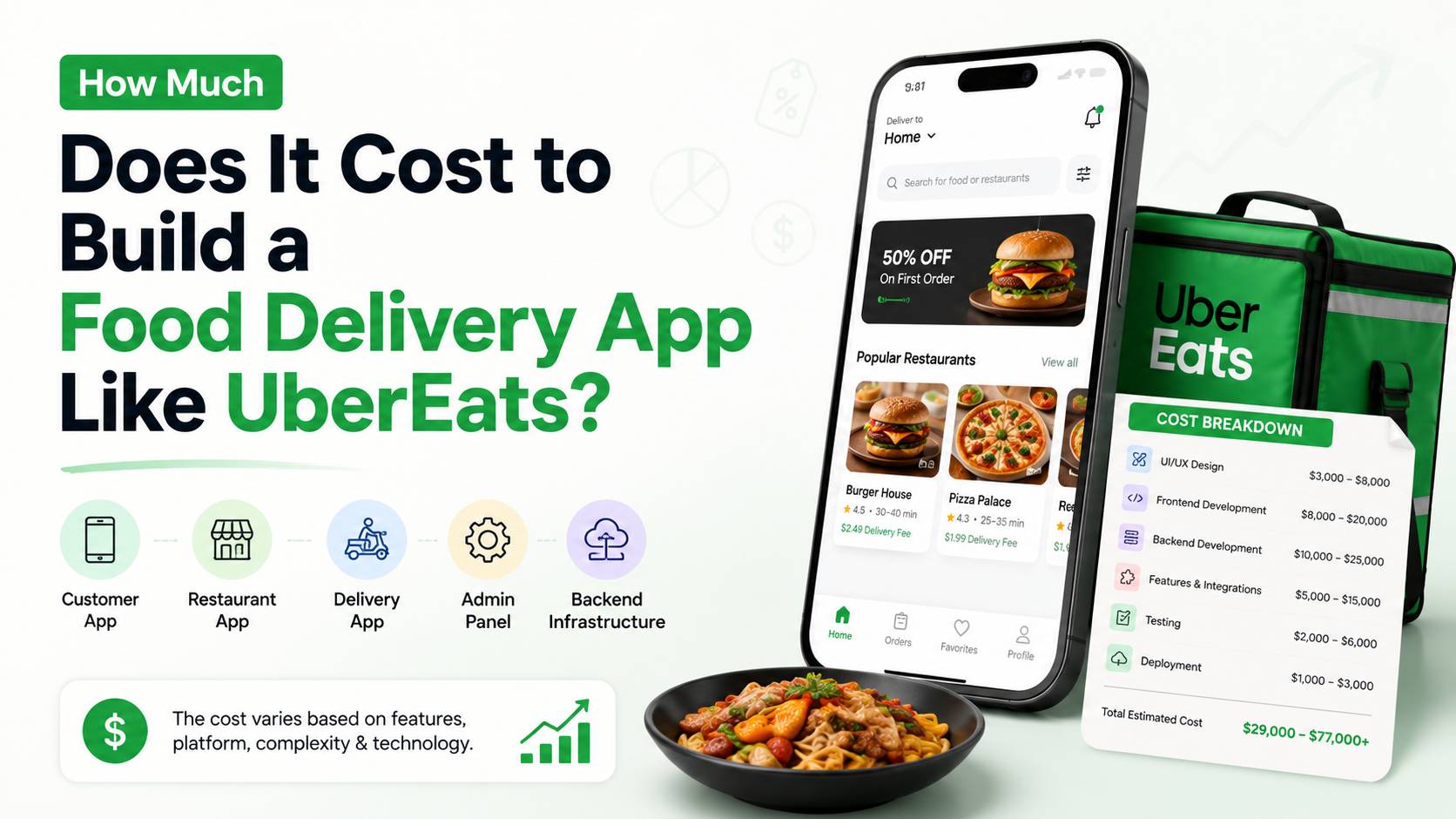
Here is a realistic component-by-component breakdown for a growth-stage platform built with an experienced offshore team. Treat these as planning ranges, not quotes - your actual numbers depend on feature depth and team rates.
| Component | Estimated Cost (USD) |
|---|---|
| Discovery & planning | $2,000 – $8,000 |
| UI/UX design | $3,000 – $10,000 |
| Customer app | $10,000 – $30,000 |
| Store / dark store app | $15,000 – $30,000 |
| Delivery partner app | $6,000 – $12,000 |
| Admin dashboard | $12,000 – $25,000 |
| Backend & APIs | $15,000 – $45,000 |
| QA & testing | $8,000 – $18,000 |
| Deployment & DevOps | $3,000 – $8,000 |
Add these up and you land roughly in the $80,000–$200,000 band, which lines up with the growth-stage tier from earlier. An MVP trims this dramatically by narrowing each app to its essentials and serving a single zone.
A note on geography, because it matters a lot. Developer rates in India and APAC typically run $20–$70 an hour, while teams in North America charge $100–$200. The same platform can cost two to three times more depending only on where it is built. This is the main reason so many founders worldwide build their quick-commerce platforms with Indian development partners.
Technology Stack Used in Apps Like Zepto and Blinkit
You do not need to dictate the stack to your team, but you should understand the choices so you can have an informed conversation. Here is what platforms in this category typically use, and why.
Frontend
React Native and Flutter are the two cross-platform front-runners. Both let you build for Android and iOS from a single codebase, which keeps costs down and releases in sync. React Native has a huge ecosystem and talent pool; Flutter gives you very smooth, consistent UI. Either is a defensible choice.
Backend
Node.js is popular for real-time, event-driven workloads - exactly what live order tracking and inventory updates demand. NestJS, built on top of Node, adds structure and scalability that pays off as your team and codebase grow.
Database
You will likely use more than one:
- PostgreSQL for structured, transactional data like orders and payments, where consistency matters.
- MongoDB for flexible data like product catalogues that change shape often.
- Redis for caching and real-time features - keeping cart data, session info, and inventory counts available in milliseconds.
Cloud
AWS, Google Cloud, and Azure are all capable. The reason you build on cloud rather than your own servers is elasticity: you can scale up automatically during a festival surge and scale down when demand drops, paying only for what you use.
Integrations
- Razorpay and Stripe for payments
- Google Maps for navigation and route optimisation
- Firebase for push notifications, analytics, and crash reporting
The thread connecting all of these is real-time performance and the ability to scale. Quick commerce lives or dies on speed, and the stack has to support that under load.
Development Timeline
How long does this take? Here is a realistic timeline for a full multi-app platform.
| Phase | Duration |
|---|---|
| Discovery & planning | 2 – 4 weeks |
| UI/UX design | 3 – 5 weeks |
| Development | 4 – 7 months |
| Testing (runs in parallel) | 4 – 6 weeks |
| Launch & deployment | 1 – 2 weeks |
For a full growth-stage platform, plan on six to ten months end to end. A focused MVP can realistically launch in three to four months if you keep the scope disciplined.
The single biggest cause of timeline blowouts is scope creep - the steady trickle of "can we just add one more thing" that turns a four-month MVP into a ten-month epic. Guarding the scope is one of the most valuable things a founder can do.
MVP vs Full-Scale Grocery Delivery Platform
This is the most important strategic decision you will make, so let's compare the two directly.
| Aspect | MVP | Full-Scale Platform |
|---|---|---|
| Coverage | Single zone / one dark store | Multi-city, many stores |
| Apps | Lean customer, store, delivery, admin | Full ecosystem + super admin |
| Features | Core ordering, payments, tracking | AI recommendations, BI, forecasting, franchise tools |
| Timeline | 3 – 4 months | 6 – 10 months |
| Cost | $25K – $50K | $200K+ |
| Goal | Validate demand and unit economics | Scale a proven model |
What belongs in an MVP: browsing and search, cart and checkout, payments, real-time order tracking, a working fulfilment flow in the store app, basic rider assignment, and an admin panel your team can operate. That is enough to take real orders in one neighbourhood and learn whether people actually reorder.
What can wait: AI-driven recommendations, predictive inventory, multi-city operations, franchise management, advanced analytics, loyalty programmes, and most "nice to have" features. None of these matter if your core loop does not work.
My honest advice to founders: build the MVP, run it in one area, and watch the numbers obsessively. Quick commerce is a high-volume, low-margin business, and the operators who succeed are the ones who validate the economics before they scale, not the ones who build every feature on day one. The most expensive platform is the one built on an assumption that turns out to be wrong.
Hidden Costs Many Founders Miss
The development quote is the part everyone plans for. These are the costs that surprise people after launch - and they are recurring.
- Cloud hosting. Expect roughly $800–$3,000 a month for a growing platform, scaling with order volume. During peak campaigns it spikes.
- CDN costs. Serving images and content quickly across regions adds up as traffic grows.
- SMS and OTP charges. Every login, order confirmation, and delivery update can trigger a paid message. At scale, this becomes a real line item.
- Push notification and API fees. Several third-party services charge per call or per message.
- Customer support operations. Refunds, complaints, and missing-item issues need staff and tooling. In grocery, with its frequent orders, support volume is steady.
- App maintenance. Budget 15–25% of your build cost per year for updates, bug fixes, OS-version compatibility, and security patches. This is not optional; an unmaintained app degrades fast.
- Marketing and customer acquisition. This is the big one. Acquiring a customer in a category this competitive is expensive, and you are often discounting early orders to build the habit. Many founders spend more on acquisition in year one than on building the app itself.
I have seen teams nail the build budget and then get caught flat-footed by these operating costs. Plan for them from the start, because in a thin-margin business they are the difference between a sustainable operation and a cash bonfire.
How to Reduce Grocery App Development Costs
There are smart ways to control your spend without crippling the product. Here are the ones that consistently work.
Build an MVP first. I keep returning to this because it is the highest-leverage decision available to you. Validate before you scale.
Prioritise essential features. Ruthlessly. Every feature you defer is money and time saved, and most "must-have" features turn out to be optional once you see real usage.
Use cross-platform development. One codebase for Android and iOS can cut your front-end cost substantially versus building two native apps.
Choose a scalable architecture from the start. This sounds like it adds cost, but it saves far more. Rebuilding a backend that cannot scale is one of the most expensive mistakes in this space. Build modular, build for growth, and you avoid a painful and costly re-platform later.
Work with an experienced offshore team. A vetted partner in India or APAC can reduce your total build cost by 40–60% compared to Western rates, without sacrificing quality - provided you choose a team that has actually shipped on-demand platforms before. Experience matters more than rate; a cheap team that has never built real-time logistics will cost you more in rework.
Why Businesses Choose Tvisha Technologies for Grocery App Development
When founders evaluate development partners for a project this complex, what they are really looking for is a team that has done it before - one that understands the difference between a simple e-commerce app and a real-time, multi-app quick-commerce platform.
That experience is where Tvisha Technologies fits. The team has spent years building on-demand and hyperlocal solutions, which means the hard parts - real-time inventory syncing, fleet management, scalable backends, multi-app ecosystems - are familiar territory rather than first-time experiments. The work spans scalable architectures designed to grow with order volume, enterprise-grade development practices, strong UI/UX expertise, and dedicated development teams that work as an extension of your own.
The reason that combination matters is simple: in quick commerce, the cost of getting the architecture wrong is enormous. A partner who has built these systems before helps you avoid the expensive mistakes - over-engineering the wrong things, under-engineering the backend, building features users never wanted - that sink first-time projects. The goal is not just to ship an app, but to ship one that holds up when your business actually starts scaling.
Future Trends in Quick Commerce
If you are building now, it helps to build with the next few years in mind. Here is where the category is heading.
AI-powered recommendations. Personalised suggestions based on purchase history are becoming standard. In a habitual category like grocery, getting recommendations right lifts both order value and frequency.
Predictive inventory management. The leading players already use demand forecasting to position the right stock in the right dark store before orders come in. This reduces stockouts and waste, both of which hit margins directly.
Dark store automation. Expect more automation inside fulfilment centres - smarter picking systems and layout optimisation to shave seconds off every order.
Drone and alternative delivery experiments. Still early and mostly experimental, but worth watching as the industry hunts for ways to cut last-mile costs.
Hyper-personalisation. Beyond product recommendations, platforms are tailoring the entire experience - timing, offers, and assortment - to individual users.
You do not need to build all of this on day one. But a scalable architecture gives you the room to add these capabilities as you grow, rather than rebuilding to accommodate them.
Final Thoughts
Let's bring it together.
The cost to build a Zepto-, Blinkit-, or Instamart-like platform ranges from around $25,000 for a focused MVP to $200,000 and beyond for a full enterprise ecosystem. Where you land depends on how many applications you build, how complex your backend is, and how disciplined you are about scope.
A few things are worth remembering. First, you are not building one app - you are building an ecosystem, and the store-management app you might be tempted to overlook is the one that determines your delivery speed. Second, the development quote is only part of the picture; cloud, support, maintenance, and marketing are real, recurring costs in a thin-margin business. Third, and most importantly, start with an MVP. Validate your unit economics in one neighbourhood before you spend a crore scaling something unproven.
And finally, the partner you choose shapes the outcome as much as the budget you set. Quick commerce is unforgiving of architectural mistakes, so the experience of your development team is not a luxury - it is risk management.
If you are serious about entering this space and want a clearer picture of what your specific platform would cost and require, the most useful next step is a conversation with a team that has built these systems before. That is exactly the kind of discussion Tvisha Technologies has with founders every week - turning a rough idea into a costed, sequenced plan you can actually act on.
Frequently Asked Questions
1. How much does it cost to build an app like Zepto? Building a Zepto-like platform costs roughly $25,000–$50,000 for an MVP and $200,000 or more for a full enterprise ecosystem. The wide range reflects how many applications you build (customer, store, delivery, admin, super admin), the complexity of your backend, and your team's location.
2. How long does grocery app development take? A disciplined MVP can launch in three to four months. A full multi-app, multi-city platform typically takes six to ten months end to end, including discovery, design, development, testing, and launch.
3. What technology is used by quick-commerce apps? Common choices include React Native or Flutter for the apps, Node.js or NestJS for the backend, PostgreSQL, MongoDB, and Redis for data, AWS or Google Cloud for hosting, and integrations like Razorpay, Google Maps, and Firebase. The priority across all of them is real-time performance and scalability.
4. Can I launch with an MVP? Yes, and you should. An MVP lets you validate demand and unit economics in a single zone before committing to a full build. It is the lowest-risk, highest-learning way to enter quick commerce.
5. What is the maintenance cost of a grocery delivery app? Plan for 15–25% of your initial build cost per year for ongoing maintenance - updates, bug fixes, OS compatibility, and security patches. Cloud hosting (roughly $800–$3,000 a month) and third-party service fees are separate recurring costs.
6. How many developers are required to build a quick-commerce app? A typical team includes a product manager, one or two UI/UX designers, mobile developers, backend developers, a QA engineer, and a DevOps engineer. Enterprise builds add a solution architect and data/AI specialists. Team size scales with scope.
7. How does a dark store management app work? It is the app store staff use to fulfil orders. When an order comes in, it directs pickers to the right shelves, supports barcode scanning and packing, updates inventory in real time, and flags low stock. Its speed directly determines your delivery time, which is why it is one of the most important apps in the ecosystem.
8. Which platform should I build first, Android or iOS? In India, Android-first usually makes sense given its market dominance. Most startups, however, choose cross-platform development (Flutter or React Native) so they can serve both Android and iOS from a single codebase at close to the cost of one.
9. How do grocery delivery apps make money? Revenue comes from delivery fees, platform or handling charges, commissions or margins on products (especially in inventory-owned models), subscription plans, and increasingly advertising - brands pay for visibility and sponsored placements, which has become a high-margin revenue stream for the leading players.
10. Is quick commerce profitable in 2026? It is a high-volume, low-margin business, and profitability is hard but no longer theoretical - leading players have reached operating profitability at the cluster or company level by increasing average order value and dark-store density. For new entrants, the realistic path runs through focused validation, tight operations, and disciplined scaling rather than chasing the giants head-on.






 Whatsapp
 Email
Email