Job
enquiry:+91-9121642626
Job
enquiry:+91-9121642626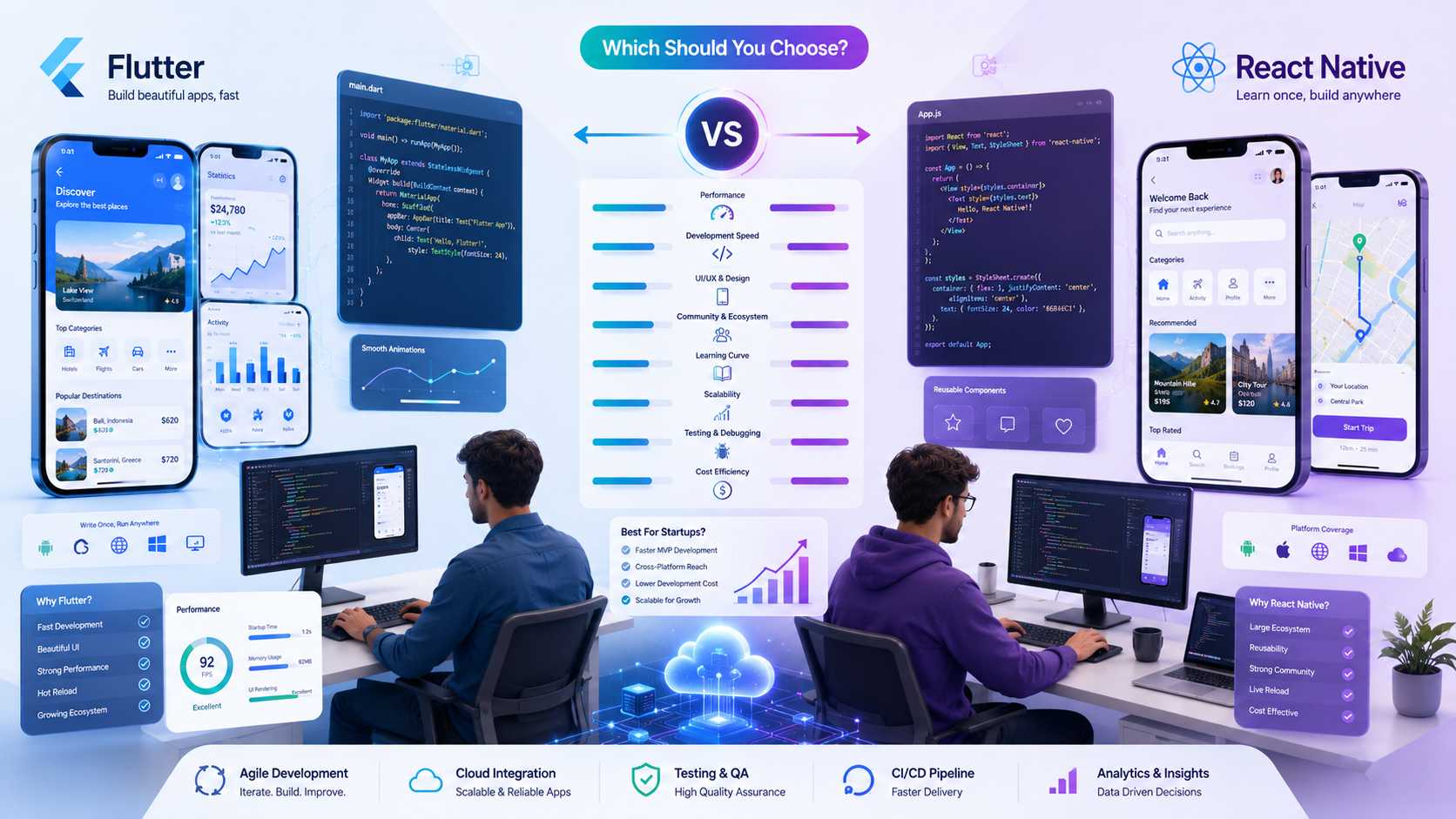
Flutter vs React Native: Which Should You Choose?
If you're building a cross-platform app, the choice usually comes down to two frameworks: Flutter and React Native. Together they dominate cross-platform development, and both are excellent — which is exactly what makes choosing between them tricky.
Here's the thing most older comparisons get wrong: the frameworks you're comparing in 2026 aren't the ones people argued about a few years ago. Both have changed dramatically. React Native rebuilt its core, and Flutter swapped out its rendering engine. The old "Flutter is faster, React Native is easier" shorthand no longer tells the whole story. This guide gives you the current picture — what each is, how they really compare now, who uses them, and how to decide.
What is Flutter?
Flutter is an open-source UI toolkit from Google, first released in 2017. It lets you build apps for Android, iOS, web, and desktop from a single codebase, using Google's Dart language. Its defining trait is that it doesn't use the platform's native UI components — instead, it draws every pixel on screen itself through its own rendering engine. That gives you complete, pixel-perfect control over how your app looks, and a UI that's identical across every platform.
Flutter compiles Dart ahead-of-time to native machine code, which is part of why it performs so well, and it comes with a huge library of customisable widgets following both Material (Android) and Cupertino (iOS) design styles.
What is React Native?
React Native is an open-source framework from Meta (Facebook), released in 2015. It lets you build cross-platform mobile apps using JavaScript and React — the same skills millions of web developers already have. Its defining trait is the opposite of Flutter's: instead of drawing its own UI, it renders using the platform's real native components. A button in a React Native app is an actual native button, so apps tend to feel naturally at home on each platform.
If your team already works in React for the web, much of that knowledge and some code carries straight over, which is a big reason React Native has stayed so popular with businesses.
What changed in 2026 (and why old comparisons mislead)
This is the part to understand before any verdict, because both frameworks just went through their biggest upgrades in years.
React Native eliminated its bridge. For most of its life, React Native communicated with native code through an asynchronous "JavaScript bridge" — and that bridge was its single biggest performance bottleneck. As of late 2024, React Native's New Architecture — built on JSI (a direct JavaScript Interface), the Fabric renderer, TurboModules, and a "bridgeless" mode, with the Hermes engine as default — replaced that bridge entirely. The result is direct, synchronous communication with native code and performance close to native for most apps. This is now the default in new projects, not an experimental opt-in.
Flutter replaced its rendering engine. Flutter swapped its old Skia engine for Impeller, now the default on both iOS and Android. Impeller pre-compiles shaders at build time, which eliminated the "shader jank" — those occasional stutters in animations — that used to be Flutter's main weak spot. It now delivers consistent 60–120fps rendering, even on demanding UIs.
The upshot: the performance gap that defined the old debate has narrowed to the point where, for the large majority of apps, it's no longer the deciding factor.
Performance compared
For around 90% of apps — business tools, e-commerce, fintech, healthcare, the typical CRUD-and-moderate-animation app — the performance difference between Flutter and React Native is now marginal. Users won't be able to tell which one built the app.
The gap only really shows at the extremes:
- Flutter still edges ahead for graphics- and animation-heavy apps — games, data-visualisation dashboards, anything with custom, pixel-level UI or constant complex animation. Because it renders directly to the GPU through Impeller, it handles that load more smoothly, and 120fps on high-refresh screens is comfortable.
- React Native has its own edges — it tends to start up slightly faster, can be lighter on battery and app size (it uses the system's UI components rather than bundling a whole rendering engine), and its New Architecture gives it tight, direct access to native modules. That makes it strong when your app leans heavily on third-party native SDKs.
On app size, Flutter apps are usually a little larger, since they bundle their rendering engine; React Native uses the system's components and tends to be leaner. On modern phones the difference rarely matters, but it can on low-end devices.
At a glance
| Flutter | React Native | |
|---|---|---|
| Created by | Meta (Facebook) | |
| Language | Dart | JavaScript / TypeScript |
| Released | 2017 | 2015 |
| UI approach | Draws its own pixels (Impeller engine) | Uses real native UI components |
| Performance | Excellent; edges ahead for graphics/animation | Excellent (New Architecture closed the gap) |
| Consistency | Pixel-perfect, identical across platforms | Platform-authentic (feels native to each OS) |
| Talent pool | Smaller (Dart), but growing fast | Very large (JavaScript) — easier to hire |
| Learning curve | Moderate (learn Dart) | Easy for JavaScript/React developers |
| App size | Slightly larger | Slightly smaller |
| Web & desktop | Mature multi-platform support | Supported, less mature |
| Market share | ~46% of cross-platform devs | ~35–38% |
Developer experience and hiring
This is where the two genuinely diverge, and for many teams it matters more than performance.
React Native runs on JavaScript and TypeScript, the most widely used languages in the world. That means a much larger talent pool — by most counts, three to five times more JavaScript developers than Dart developers — so React Native teams are generally easier and cheaper to hire for, and faster to spin up if you already have web developers. The vast npm ecosystem also means there's a library for almost everything.
Flutter uses Dart, which is less common, so there's a learning curve and a smaller hiring pool. But Dart is clean, modern, and quick to pick up for anyone with object-oriented experience, Flutter's tooling and documentation are widely praised, and its developer base is growing faster than React Native's. For a team starting fresh, Dart isn't a real barrier; for a team already deep in JavaScript, React Native is the lower-friction path.
UI philosophy: painted vs native
It's worth understanding the core design difference, because it shapes everything.
Flutter paints its own interface, so your app looks exactly the same on every device and you get total design control — ideal for strong, custom branding and a consistent look across platforms.
React Native uses each platform's real UI components, so apps automatically feel native to iOS and Android and adapt as those platforms evolve — ideal when you want your app to feel like a natural citizen of each OS rather than a distinct brand world.
Neither is "better." It's a genuine choice between brand consistency and platform-authentic feel.
Who uses each
Both power apps with hundreds of millions of users, which should put any "is it production-ready?" worry to rest.
- Flutter is used by Google Pay, BMW, eBay Motors, and Alibaba, among many others — often where custom UI and consistency matter.
- React Native powers parts of Instagram, Facebook, Shopify, Discord, and Coinbase, among others — often where teams value the JavaScript ecosystem and native feel.
When to choose Flutter
- Your app is visually rich or animation-heavy — custom UI, games, dashboards, anything where motion and pixel-level design are central.
- You want a pixel-perfect, identical look across platforms and strong custom branding.
- You're targeting mobile plus web and desktop from one codebase and want mature multi-platform support.
- You're building a fresh team and don't have an existing JavaScript investment to leverage.
When to choose React Native
- Your team already knows JavaScript or React, or you want to reuse skills and some code from a web app.
- Hiring and team scale matter — the larger talent pool makes staffing easier and often cheaper.
- You want apps that feel natively at home on each platform with minimal effort.
- Your app relies heavily on third-party native SDKs, or you want a slightly leaner app and faster startup.
- You're building a straightforward business app or MVP quickly — the ecosystem speeds things up.
The honest verdict
In 2026, there's no universal winner — and any guide claiming one is selling something. Both Flutter and React Native are mature, production-grade, and fast enough for the vast majority of apps. The performance debate that used to dominate this comparison is largely settled: for most projects, you genuinely can't go wrong on that front.
So decide on what actually differs: your team's existing skills, your hiring situation, your UI needs (pixel-perfect brand consistency vs platform-native feel), and your platform targets. Pick the one that fits those, and put your energy into building a great product — because at this point, the framework is rarely what makes or breaks an app.
If you're not sure, an experienced development partner can help you weigh the trade-offs against your specific project rather than the abstract benchmarks.
Frequently asked questions
Is Flutter better than React Native? Neither is universally better. Flutter edges ahead for graphics- and animation-heavy apps and pixel-perfect UI consistency; React Native wins on talent availability, native feel, and reusing JavaScript skills. For most apps, both are excellent — the right choice depends on your team and project.
Which is faster, Flutter or React Native? Flutter still has a slight edge for graphics-intensive and animation-heavy apps. But React Native's New Architecture (which replaced its old JavaScript bridge) closed most of the gap, so for the large majority of apps the difference is no longer noticeable to users.
Which is easier to learn? React Native is easier if you already know JavaScript or React, which many developers do. Flutter uses Dart, which has a modest learning curve but is quick to pick up for anyone with object-oriented experience.
Which has a bigger developer community and talent pool? React Native benefits from the huge JavaScript talent pool — by most counts three to five times larger than Dart's — making developers easier to hire. Flutter's community is smaller but growing faster, and it now leads slightly in overall cross-platform market share.
Which should I choose in 2026? Choose based on your team's skills, hiring needs, and UI requirements rather than performance, since both are now fast enough for most apps. Flutter for visually rich, brand-consistent apps; React Native for JavaScript teams, easier hiring, and a platform-native feel.
Do big companies use Flutter and React Native? Yes. Flutter is used by Google Pay, BMW, eBay Motors, and Alibaba; React Native powers parts of Instagram, Shopify, Discord, and Coinbase. Both are proven at large scale.
Building your cross-platform app
Flutter and React Native are both outstanding choices in 2026 — the right one comes down to your team, your design goals, and your project. The good news is that whichever you pick, you can build a fast, high-quality app on it.
We build cross-platform apps in both Flutter and React Native, and we'll recommend the right fit for your project rather than a one-size-fits-all answer. Learn more about our mobile app development services, or get in touch to talk it through. (See also our guide on choosing a cross-platform framework and web vs native vs hybrid apps.)











 Whatsapp
 Email
Email