Job
enquiry:+91-9121642626
Job
enquiry:+91-9121642626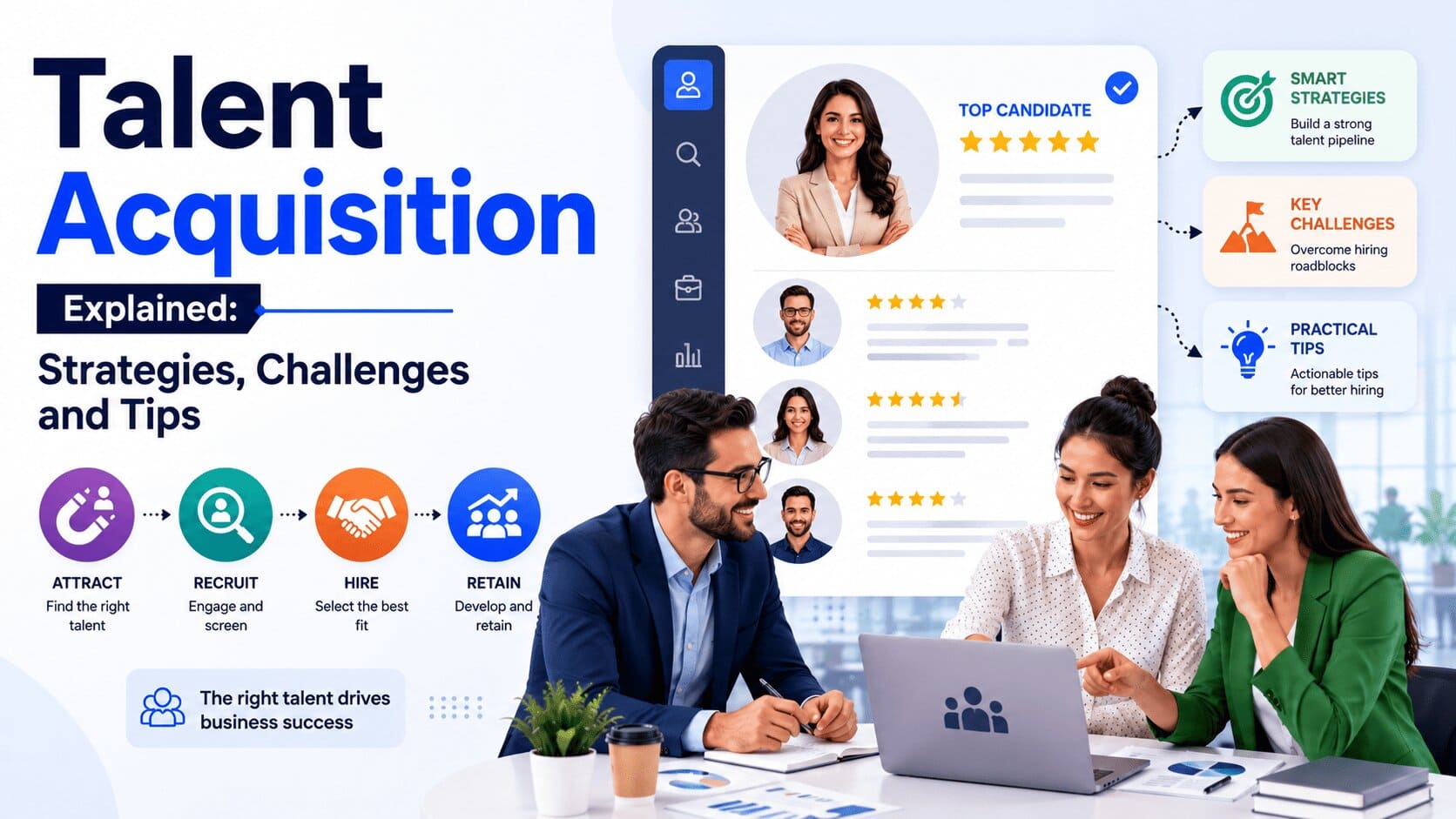
Talent Acquisition: Strategies, Technologies, and Best Practices for Modern Hiring
Ask any HR lead how their worst hiring year started and watch what happens to their posture. Shoulders drop a little. There's usually a pause. Then something like: we lost two engineers in the same month and just, I don't know, never caught up. Four months the role sat there. The team absorbed the extra work until it couldn't, then two more people quietly started looking. By the time they filled the original position they'd actually lost three. And nobody could quite explain how it happened because it happened the same way it always happens, gradually and then all at once.
So. Talent acquisition. The term gets thrown around constantly, usually in the same breath as 'employer brand' and 'candidate experience' and other phrases that sound meaningful in a deck and can mean almost nothing in practice. What I want to do here is get into what it actually involves, where it breaks down, what the tools are doing (and aren't doing), and where things are genuinely heading in 2026. Parts of this you've probably heard before, maybe enough times that you've stopped really listening. Other parts, I hope, land differently.
What Is Talent Acquisition?
If you google it you'll get something like: the strategic, ongoing process of identifying and hiring talent to meet current and future organizational needs. Which is correct, I suppose, in the way that 'exercise is physical activity that improves health' is correct. Technically true. Doesn't really tell you anything about why it's so hard to do consistently or why so many organizations confuse it with something much simpler. The word doing the heaviest lifting in that definition is 'ongoing.' Most companies treat hiring as episodic. That gap, between ongoing and episodic, is where most of the pain actually lives.
What it's supposed to look like is a team that's building candidate pipelines while current headcount is still stable, studying which skills the market's tightening around before those skills become critical gaps, having early conversations with people who might be right for roles that don't exist yet. It's proactive. Tied to workforce planning. Connected to where the business is actually going, not just where it was last fiscal year. When it works like that, it doesn't feel like hiring at all. It feels more like relationship management with a very long time horizon, which maybe explains why most organizations can't quite commit to it.
Talent Acquisition vs Recruitment: Understanding the Key Differences
Recruitment is a transaction. Job opens, ad goes up, candidates apply, someone gets hired, clock resets. There's nothing wrong with that for the right kind of role in the right kind of market. But calling it talent acquisition is a bit like calling a grocery run meal planning. You ended up with food, technically.
Talent acquisition is the bigger, slower, harder thing. It's got workforce forecasting in it. Pipeline work done during calm periods. Employer brand built between hiring cycles rather than when there's a hard-to-fill role sitting open and someone's panicking. It asks a question most hiring functions aren't actually equipped to answer: what does this team need to look like in three years, and what needs to happen starting now for that to be possible? Most organizations say they're operating at that level. Their time-to-fill data usually tells a different story, if anyone's pulling it.
Why Talent Acquisition Is Critical for Business Success
Bad hires cost more than the salary. Everyone knows this and almost nobody tracks it rigorously enough to feel the full weight of it. The stuff that shows up: recruiter fees, job board spend, the onboarding weeks where someone's pulling salary and producing very little. The stuff that doesn't , a team quietly rerouting its energy around a person who isn't carrying their share, a manager whose one-on-ones have turned into ninety percent damage control, two people who eventually stop saying anything and just leave. Strong talent acquisition chips away at those odds. Not in a dramatic, measurable-in-one-quarter way. More like a slow correction that you notice, if you're watching, about eighteen months in.
Beyond that, there's the employer brand effect, which most companies understand in theory and underinvest in practice. Candidates talk. The person you rejected gracefully becomes a referral source. The person you ghosted after three rounds of interviews posts about it and you spend six months wondering why your applicant quality dropped. The companies that treat every candidate like a potential future relationship, not just a current transaction, build something that quietly recruits for them. It doesn't happen fast. But it accumulates in ways that eventually become hard to ignore.
The Talent Acquisition Process Explained
Workforce planning comes first, or it's supposed to. Working out which roles the business needs now versus in twelve to eighteen months, where skill gaps are forming, what growth projections actually mean for headcount. Most organizations do a version of this annually and then watch it become irrelevant by Q2. The ones doing it continuously, adjusting as strategy shifts, are in a different position when roles open up.
Sourcing follows. Not posting and waiting, actually going to find people. Job boards, yes, but also referral networks, talent communities, direct outreach to people who aren't actively looking. That last group, passive candidates, is where a lot of the best hires come from, and they require a different approach entirely because they're not reading your job description with any urgency.
Screening narrows the field. Interviews and assessment do the actual evaluation, ideally with some structure so the decision reflects evidence rather than whoever interviewed well under pressure that particular afternoon. Offer, then onboarding, which is where an uncomfortable number of companies undo months of good hiring work by making someone's first ninety days feel like an afterthought. And retention, which is technically outside the hiring process but is absolutely inside the talent acquisition function if you're thinking about it correctly, which most teams aren't, yet.
Key Talent Acquisition Strategies for Modern Hiring
Employer branding first, because it's the one with the longest lead time. Not a careers page refresh. Not a 'great place to work' badge. The actual, lived experience of working somewhere, communicated in ways that let candidates evaluate it rather than just absorb it. Employee stories that are specific enough to be credible. Glassdoor responses that don't read like they were written by legal. The details that feel too small to bother with and turn out to matter enormously to the people you most want to hire.
Pipelining is the one that gets cut first when things get busy and then desperately wished for six months later. In practice it just means keeping in touch with people you'd want to hire before you're in a position to hire them, which sounds simple and turns out to be surprisingly easy to let slide when there's no immediate pressure to do it. The awkwardness is real: you're maintaining a relationship with no concrete offer attached, which requires a certain kind of patience most recruiting functions haven't been structured to reward. Teams that stick with it anyway tend to have a very different experience when a role opens suddenly. Teams that don't are usually the ones sending cold InMail to people who've never heard of them and wondering why the response rate is bad. Skills-based hiring is a mindset shift more than a process change. It means asking what someone can actually do right now rather than inferring it from where they went to school or which companies they've appeared at on a CV. Done seriously, it surfaces people a traditional screen would filter and who often end up being among the stronger performers once they're in. Data-driven sourcing, meaning actual quality-of-hire metrics by source channel rather than just volume, is something almost every team could do with their existing tools and almost no team does consistently enough to learn anything from.
Essential Talent Acquisition Tools and Technologies
Applicant Tracking Systems are the backbone of most hiring operations and also the source of more recruiter frustration than almost anything else I've heard about. They work when they're configured for the actual workflow and maintained by someone who understands both the tool and the hiring process. They become bureaucratic nightmares when they're set up by a vendor during implementation and then left to calcify. AI-powered sourcing and matching tools are genuinely useful for surface-level candidate identification at scale, though the 'AI' label covers a very wide range of actual capability and the marketing materials aren't always a reliable guide to which end of that range you're buying.
Recruitment chatbots handle repetitive candidate queries and scheduling at hours when no human is available, which matters more than it sounds during high-volume periods. Video interviewing platforms have become genuinely normalized post-2020 and do speed up early screening considerably. People analytics dashboards give visibility into pipeline health and sourcing effectiveness, and the teams using them to actually make decisions rather than generate reports tend to hire faster and better. HRMS integration, connecting talent acquisition data to the rest of the employee lifecycle, prevents the handoff problem at onboarding where everything that was carefully tracked during hiring becomes invisible the moment someone gets an offer letter.
Common Talent Acquisition Challenges and How to Overcome Them
Technical skill shortages aren't a sourcing problem, they're a supply problem, and more job board spend doesn't fix a supply problem. What actually moves the needle is usually a combination of things nobody wants to do all at once: rewriting job criteria around demonstrated skill rather than credential proxies, building internal capability for roles where external supply is genuinely tight, and sourcing in geographies or communities that most competitors haven't thought to look yet. Slow hiring is mostly self-inflicted, which makes it both more frustrating and more fixable than it gets treated. Good candidates have options. A three-week silence between final interview and offer letter isn't neutral, it's actively damaging. Most hiring teams know their process is slow. Identifying exactly which stage is creating the drag, actually going and looking at the timestamps rather than assuming, is the step that rarely happens.
Bias in hiring is less a discrete problem and more a property of systems that weren't designed with it in mind. Structured interviews reduce it. Skills-first criteria reduce it. Blind screening reduces it. None of them eliminate it, and the organizations treating any single intervention as a solution rather than a contribution are probably not examining their data closely enough. Measuring ROI remains genuinely hard. Quality of hire and retention rate are the metrics that get closest to what matters, but they take time to surface and most quarterly reviews don't have the patience for them.
Emerging Talent Acquisition Trends in 2026
Agentic AI is the real shift happening right now. Not AI that screens resumes faster, but AI that manages entire workflow sequences: initial shortlisting, scheduling, status communication, follow-up, with humans stepping in at the points that require actual judgment. The recruiters I know who've worked inside these systems describe a strange experience of suddenly having time to do the relational parts of the job they got into recruiting to do in the first place. Whether that scales cleanly across more complex roles is still an open question.
Skills-first planning is becoming more than a hiring philosophy and more of an operational necessity as job requirements shift faster than credential pipelines can track. Internal mobility is getting genuine executive attention in more organizations, partly because the math on external hire cost versus internal development is finally being run clearly enough to be uncomfortable. And the AI governance piece is messier than most vendor conversations let on. Fairness in hiring, real fairness not just auditable fairness, can't be automated. The teams treating AI as decision support rather than decision maker are in a better position, I think, though I keep watching the line between those two things blur in practice.
Best Practices for Successful Talent Acquisition
The hiring plan question is worth sitting with: is it tied to where the business is genuinely going, or is it last year's headcount with minor adjustments? Those produce very different outcomes and most organizations are running the second while describing it as the first. Employer branding is the one that requires continuity to work, meaning it needs attention during the periods when you're not actively hiring, which is exactly when it tends to get deprioritized. Interview structure matters more than most hiring managers want to hear, because without it the decision often defaults to whoever most reminded the panel of someone they already liked, which is a polite way of describing a bias problem. Pipelines, again: built during calm, useful during urgent, almost always neglected during calm. Metrics need to actually change decisions to be worth tracking, and that's a different bar than just pulling a report.
Feedback collected from candidates and hiring managers and acted on rather than filed. Technology used in ways that amplify human judgment rather than substitute for it. And an honest accounting of where the process is losing people it wanted to keep, because that data exists in most ATS systems and most teams haven't pulled it. The organizations treating these as ongoing operating habits, not annual initiatives with a launch date and a six-month fade, tend to compound their advantage in ways that become hard to compete with. I keep coming back to that word, compound. It's the one that explains both why this is hard to start and why it's worth it.
Conclusion
Talent acquisition has grown into something that shapes business performance in ways that are hard to attribute cleanly but very easy to feel over time. The companies taking it seriously, building pipelines before they need them, investing in employer brand between hiring cycles, using technology to amplify rather than replace human judgment, are consistently building stronger teams than the ones treating hiring as a reactive, fill-the-vacancy function.
Where it goes from here is genuinely unclear to me in a few respects. The AI trajectory is moving fast enough that the tools available now look quite different from what was available eighteen months ago, and I'd expect that to continue. The skills-first shift seems durable but hasn't been tested through a serious economic contraction yet. Internal mobility as a genuine strategic priority rather than an HR talking point is a shift I'm watching but not quite ready to call confirmed across industries. What I'm fairly confident about: the gap between organizations doing this thoughtfully and those still running on reactive instinct is widening. And that gap tends not to close on its own.
Frequently Asked Questions (FAQs)
Q1. What is talent acquisition meaning in simple terms?
Talent acquisition is the strategic, ongoing process of identifying, attracting, and hiring people who align with a company's long-term goals. Unlike basic recruitment, which fills immediate vacancies, talent acquisition builds pipelines, strengthens employer branding, and plans for future workforce needs. It is a proactive discipline that treats hiring as a core business function rather than a reactive administrative task.
Q2. What is the difference between talent acquisition and recruitment?
Recruitment is a short-term, reactive process focused on filling a specific open role. Talent acquisition is a long-term, strategic function that encompasses workforce planning, employer branding, pipeline development, and retention strategy. Recruitment ends when a hire is made. Talent acquisition is continuous building relationships with candidates well before any vacancy exists.
Q3. What are the main stages of the talent acquisition process?
The talent acquisition lifecycle typically includes workforce planning, employer branding, candidate sourcing, screening and assessment, interviewing, offer management, and onboarding. Each stage feeds the next. Organizations that execute all stages consistently produce higher-quality hires, achieve better retention outcomes, and build stronger, more resilient teams over time.
Q4. What is talent acquisition in HRM?
In human resource management, talent acquisition refers to the strategic HR function responsible for identifying and securing the human capital an organization needs to achieve its business goals. It sits alongside compensation, learning and development, and employee relations as a core pillar of modern HRM and is increasingly supported by technology, data analytics, and AI-powered tools.
Q5. What are the most effective talent acquisition strategies?
The most effective talent acquisition strategies include proactive pipeline building, strong employer branding, data-driven sourcing decisions, structured interview processes, employee referral programs, and skills-based hiring assessments. Organizations that combine these approaches with a positive candidate experience consistently attract higher-caliber candidates and reduce both time-to-hire and early attrition rates.
Q6. How is AI changing talent acquisition?
AI is automating resume screening, powering candidate matching algorithms, generating interview questions, summarizing candidate profiles, and enabling predictive workforce planning. These capabilities allow talent acquisition teams to process higher volumes faster while improving decision quality. AI does not replace human judgment in hiring it removes friction and surfaces better information so recruiters can make smarter decisions.






 Whatsapp
 Email
Email