Job
enquiry:+91-9121642626
Job
enquiry:+91-9121642626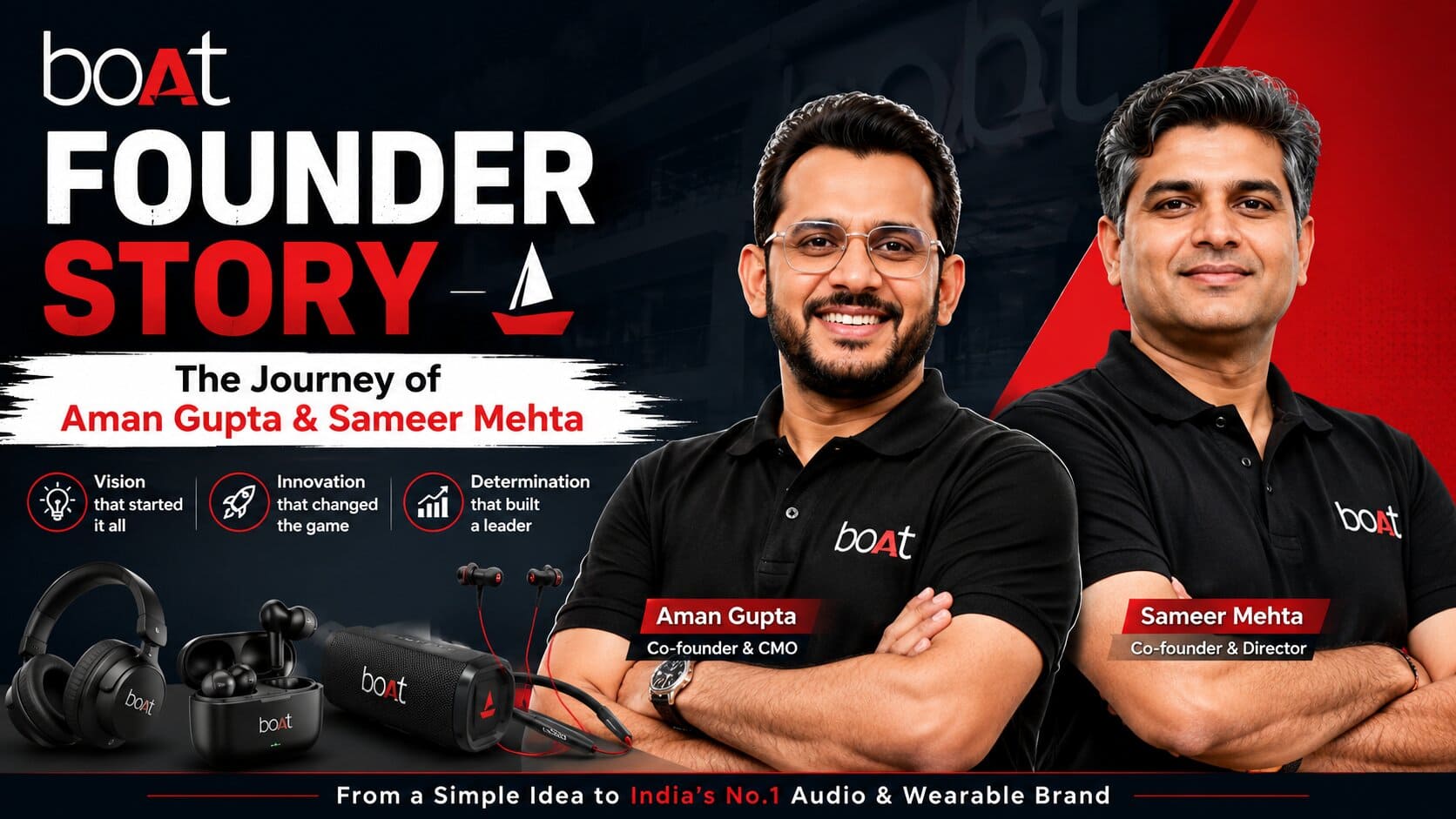
boAt Founder Story: How Aman Gupta and Sameer Mehta Built India's Audio Brand
Most people first heard of boAt through a pair of earphones that lasted longer than they expected. Or through Aman Gupta on Shark Tank India, saying something sharp and unscripted that made them look up the brand. That's how a lot of Indian consumer companies get discovered not through advertising, but through the slow build of trust.
What most people don't know is that boAt started in 2014 with something as boring as a charging cable. Two people with a very specific frustration about the Indian electronics market decided to actually do something about it. One of them became a household name. The other built the machine that made everything run.
This is the boAt founder story, not the polished version, but the full one.
What is boAt?
boAt is an Indian consumer electronics brand that sells audio products, smartwatches, and lifestyle accessories. The company is officially operated under its parent entity, Imagine Marketing Services Pvt. Ltd., and is headquartered in New Delhi.
In practical terms: boAt is what happens when someone decides the gap between ?300 junk earphones and ?5,000 global imports is a business opportunity. The brand targets young urban Indians, people who care about how a product looks and how it holds up, and who aren't willing to overpay just because a foreign company put its logo on the box.
By 2022, boAt was clocking approximately ?3,000 crore in annual revenue. At peak market share, 4 out of every 10 pairs of earphones sold in India were boAt. Globally, the brand ranked in the top five for truly wireless stereo (TWS) earbuds, a fact that tends to surprise people, because it doesn't fit the usual picture of a local budget brand.
Who Are the Founders of boAt?
boAt was co-founded by Aman Gupta and Sameer Mehta. The two have divided the company between them in a way that actually makes sense: Aman owns brand and marketing, Sameer owns product and operations. That division didn't create friction, it created speed.
Most of the spotlight has fallen on Aman, partly because of Shark Tank and partly because brand-facing founders always get more coverage. Sameer Mehta is the less visible of the two, but understanding boAt properly means understanding both of them.
Aman Gupta: Early Life and Education
Aman Gupta was born on 4 March 1982 in Delhi. He grew up in a business family, which probably explains why he spent most of his corporate career feeling faintly restless like someone who understood instinctively that working for other people's companies had a ceiling.
He completed his Chartered Accountancy (CA) from the Institute of Chartered Accountants of India. After that, he pursued an MBA from the Indian School of Business (ISB), Hyderabad, one of the more respected business programs in the country. That combination of financial discipline and strategic thinking would later show up clearly in how boAt managed its margins.
Before co-founding boAt, Aman worked at Citibank, KPMG, and then Harman International the audio company behind JBL and Harman Kardon. That Harman chapter is the one that matters most. It showed him exactly how the global audio business worked: pricing strategy, distribution networks, what margins look like at different price points, and why the Indian mid-market was mostly being ignored.
He didn't immediately quit to start something. He sat with the observation for a while. Learn more about Aman Gupta.
Sameer Mehta: Early Life and Career
Sameer Mehta is boAt's Executive Director and the person responsible for the operational side of the company. He comes from a trading and supply chain background, which meant he understood procurement, manufacturing relationships, and logistics in a way that most marketing-oriented founders don't.
Before boAt, Sameer and Aman were already working together through Imagine Marketing, their parent company, primarily as Apple accessories distributors in India. That business was functional but limiting they were building volume on someone else's brand with someone else's product decisions. Sameer understood that limitation operationally. He could see exactly where the margins were and where they disappeared.
When the idea of boAt came up, Sameer's role was clear: build the back end. Source the right manufacturers, manage quality, build the supply chain that would let a small startup sell at accessible prices without producing disposable garbage.
How the Idea of boAt Was Born
Aman and Sameer were running Imagine Marketing when the idea for boAt started taking shape. They were already in the consumer electronics space they knew how products moved, what consumers actually bought, and what they complained about.
The frustration was simple. Indian consumers were getting squeezed at both ends. On one side, cheap imports from China that fell apart. On the other, global brands priced at a premium most people couldn't justify. Nobody serious was building something in between an Indian brand, reasonably priced, that looked like it was designed for someone who actually cared.
Aman noticed this gap from his time at Harman. Sameer noticed it through distribution. The idea didn't come from a single moment it accumulated from watching the same market failure repeat itself.
The question they asked wasn't "can we build a product?" It was "can we build a brand?" That distinction drove everything that came after.
The Founding of boAt in 2016
boAt was founded in 2016 under Imagine Marketing Services Pvt. Ltd. The first product the company launched was a charging cable unexciting, practical, and precisely the right starting point.
Cables break constantly. The existing options were either terrible quality or strangely overpriced for what they were. A cable was a low-risk test: could the boAt name actually mean something to a consumer, before the company committed to the complexity of audio hardware?
The cable sold. Not in spectacular numbers, but well enough to confirm the basic premise: Indian buyers would choose a better product over the cheapest option if the price difference felt fair.
From there, boAt moved into earphones, headphones, wireless speakers, and eventually truly wireless earbuds and smartwatches. Each category built on the brand equity of the one before. The pricing stayed in a range that felt honest — mostly ?500 to ?4,000 — while the design quality looked like something significantly more expensive.
Initial Challenges Faced by boAt
boAt didn't launch into a friendly market. Chinese imports dominated every accessible price point. Global brands owned the premium segment. And most investors, when Aman and Sameer went looking for early funding, passed.
The pitch didn't look obviously safe from the outside. Consumer electronics is a high-volume, thin-margin business, and a new Indian brand with no manufacturing facility was asking investors to bet on a name and a gap. Most of them weren't interested.
So they bootstrapped. That decision born of necessity, not strategy ended up shaping the entire culture of boAt. Every rupee of marketing spend had to justify itself. There was no cushion for experiments that didn't work. It made the founders extremely deliberate, which is not something you can buy with venture capital.
Aman Gupta's Role in boAt's Growth
Aman's job was to make the brand feel real to someone who'd never heard of it. That's harder than it sounds when you're selling earphones in a market full of earphones.
He positioned boAt as a lifestyle brand not a hardware company. A hardware company sells specifications. A lifestyle brand sells belongings. Aman understood early that young Indians weren't just buying earphones; they were buying a statement about how they lived.
The IPL partnership with Delhi Capitals put the brand in front of massive audiences at a moment when awareness was everything. Bollywood ambassadors followed. Influencer campaigns with mid-tier creators with 100,000 to 500,000 followers drove actual conversions in a way that premium celebrity ads often don't.
Shark Tank India accelerated this further. His appearance on the show gave consumers a face and a backstory to attach to the brand. Sales reportedly climbed in the weeks after the show aired, and boAt's social media footprint expanded into demographics that product advertising alone hadn't reached.
Sameer Mehta's Contribution to boAt's Success
Sameer's contribution is harder to photograph. Operations don't make for good Instagram content.
He managed the manufacturing relationships that allowed boAt to produce well-designed products at prices that made commercial sense. He built the procurement discipline that kept quality from slipping even as the product range expanded rapidly. And he made the strategic sequencing calls, when to move from cables to earphones, when to enter smartwatches, how to manage a growing SKU catalog without fragmenting the brand.
That sequencing is underrated. Most companies in fast-growing categories expand too fast and too wide, and the brand loses coherence. boAt's expansion happened in phases that built on each other, and Sameer's operational hand is visible in that discipline.
boAt's Unique Business Strategy
Affordable Premium Products
The core boAt bet was always about price-to-quality ratio, not just low price. Products priced between ?500 and ?4,000 that looked and felt like they cost ?8,000. That ratio gave consumers a reason to choose boAt over cheaper alternatives and a reason to feel good about the purchase.
Understanding Indian Consumers
boAt products were designed with the Indian consumer actually in mind, sweat resistance for gym use, durability for daily metro commutes, bass-heavy tuning for the music preferences of the target demographic. This sounds obvious. Most global brands launching in India don't actually do it.
Digital-First Marketing Approach
boAt went digital before digital was the default strategy for Indian consumer brands. Heavy investment in e-commerce listings, review management, SEO, and social media gave them distribution reach without the overhead of traditional retail.
Influencer and Celebrity Collaborations
Beyond big-ticket celebrity deals, boAt built a network of smaller influencer partnerships that reached real consumers in real contexts. The strategy was less about reach and more about relevance the right person recommending the product to an audience that trusted them.
Key Milestones in boAt's Journey
- 2014 — Imagine Marketing Services Pvt. Ltd. incorporated by Aman Gupta and Sameer Mehta
- 2016 — boAt brand launched; first product is a charging cable
- 2018 — boAt enters top consumer electronics brands by sales volume on Amazon India
- 2020 — boAt becomes India's #1 audio brand by market share
- 2021 — Revenue crosses ?1,000 crore; Aman Gupta appears on Shark Tank India Season 1
- 2022 — Revenue reaches approximately ?3,000 crore; global top-five ranking in TWS earbuds
- 2023 — boAt launches Made-in-India manufacturing push; expansion into premium audio segments
boAt's Product Portfolio
Audio Products
boAt's core range covers wired earphones, over-ear headphones, neckband earphones, and truly wireless stereo (TWS) earbuds. Products like the Rockerz and Airdopes series have become reference points in their respective price categories.
Smartwatches
The boAt smartwatch range — launched under the Storm and Lunar series — extended the brand into the wearables market and gave boAt a second significant category with strong repeat purchase potential.
Accessories and Lifestyle Products
Charging cables, power banks, and branded lifestyle accessories complete the range. The accessories segment is where it all started, and it still serves a function — keeping the brand present in everyday consumer touchpoints.
Shark Tank India and Aman Gupta's Popularity
Shark Tank India, which premiered on Sony LIV in late 2021, turned Aman Gupta into a public figure in a way that no brand campaign could have manufactured.
His appeal on the show was that he didn't perform with confidence. He expressed genuine opinions about what was wrong with a pitch, explained why a valuation didn't hold up, and occasionally got visibly frustrated with answers that didn't make sense. Indian audiences don't see that kind of unfiltered business conversation very often. It worked.
The show introduced boAt to consumer segments outside its primary 18-35 target: older buyers, first-time online shoppers, consumers in smaller cities who saw a familiar face attached to a brand they'd seen but never engaged with.
boAt's Revenue Growth and Market Leadership
- 2018 — Established market presence, top seller across major e-commerce platforms
- 2019 — Consistent year-on-year growth of 100%+
- 2020 — Captured India's #1 position in audio market share during pandemic-driven work-from-home boom
- 2021 — ?1,000 crore+ revenue; ~27% share of India's wearable audio market
- 2022 — ?3,000 crore revenue; global top-five TWS ranking confirmed
The pandemic years were oddly good for boAt. As remote work exploded and people needed earphones for video calls, boAt's accessible pricing and strong e-commerce presence meant they captured demand that traditional retail-dependent brands missed.
Awards and Achievements
- Ranked India's #1 audio brand by IDC and CMR market research reports (multiple years)
- Global top 5 in TWS earbuds market share (IDC 2021-2022)
- Aman Gupta listed among Forbes India's top entrepreneurs
- boAt recognized among India's fastest-growing consumer brands
- Featured in Economic Times, CNBC TV18, and Inc42 startup coverage consistently from 2019 onward
Lessons Entrepreneurs Can Learn from boAt Founders
The boAt story is studied in business circles now. A few things stand out that feel genuinely transferable rather than just survivorship bias dressed as wisdom.
- Find a gap that's obvious in hindsight. The space between ?300 junk and ?5,000 JBL was visible to anyone paying attention. Most people saw it and moved on. Aman and Sameer saw it and built something in it.
- Divide responsibilities and mean it. Aman took brand. Sameer took operations. Neither stepped into the other's territory. That clarity removed a category of conflict that kills many co-founder relationships.
- Bootstrap if you have to — it builds discipline that capital can't. The early years without outside money forced boAt to be economical and deliberate. That discipline stuck even after the funding came in.
- Treat brand identity as infrastructure. boAt invested in how the brand looked and felt before the revenue justified it. That early investment compounded.
Challenges and Future Opportunities
boAt is not without its friction points.
Chinese competitors — Xiaomi, Realme, OnePlus — kept pressing into the same price ranges. Quality complaints on certain product lines showed up in e-commerce reviews and became a persistent conversation. The after-sales service experience, by many accounts, has lagged behind the growth of the product range.
Category expansion brought its own complexity. boAt is now in smartwatches, premium audio, and a wide accessories range. The question every expanding brand eventually faces — what do we actually stand for? — is one boAt will have to keep answering clearly.
The opportunity side is real too. India's consumer electronics market is growing. The domestic manufacturing push, if executed seriously, could improve margins and reduce supply chain vulnerability. International markets remain largely untapped for the brand.
The Future Vision of boAt
Aman Gupta has spoken publicly about building boAt into a global Indian brand something that carries Indian identity without being limited to the Indian market. That's a different kind of ambition than being the most affordable earphones on Flipkart, and it requires different execution.
The Made-in-India push is part of this. Moving manufacturing onshore would reduce dependence on Chinese supply chains and position boAt differently in conversations about Indian self-reliance, a cultural and commercial argument that resonates with a growing segment of Indian consumers.
Whether boAt reaches that global scale or cements itself as India's defining audio brand honestly, either outcome would be worth studying. The founders have built something that didn't exist before they decided it should.
Conclusion
The boAt founder story is not a clean one. It doesn't start with a eureka moment or a venture capitalist writing a cheque on the spot. It starts with two people who'd been watching the same market gap for years and finally decided to stop watching.
Aman Gupta brought the brand instinct and the public face. Sameer Mehta built the operational reality behind it. Together they built something that now accounts for a significant share of the earphones in a billion-plus country's ears.
Most startup stories are told as if the outcome was inevitable. This one wasn't. The rejections were real. The bootstrapped years were hard. And the brand they built from a charging cable in 2016 to a ?3,000 crore company in under a decade that didn't happen because the idea was good. It happened because the execution was relentless.
Frequently Asked Questions (FAQs)
1. Who is the founder of boAt?
boAt was co-founded by Aman Gupta and Sameer Mehta in 2014. Together, they built the company into one of India's leading audio and wearable brands.
2. When was boAt founded?
boAt was founded in 2014 under Imagine Marketing Services Pvt. Ltd. The company started by offering affordable and stylish audio accessories for Indian consumers.
3. What inspired Aman Gupta and Sameer Mehta to start boAt?
The founders noticed that premium audio accessories were expensive, while affordable options often lacked quality. They saw an opportunity to create stylish, high-quality products at competitive prices.
4. What products does boAt sell?
boAt offers a wide range of products, including wireless earbuds, headphones, speakers, smartwatches, charging cables, and other mobile accessories.
5. Why is boAt so popular in India?
boAt became popular due to its affordable pricing, trendy designs, strong branding, celebrity endorsements, and products tailored to the preferences of Indian consumers.








 Whatsapp
 Email
Email